
Loading, please wait...


LOT 0553
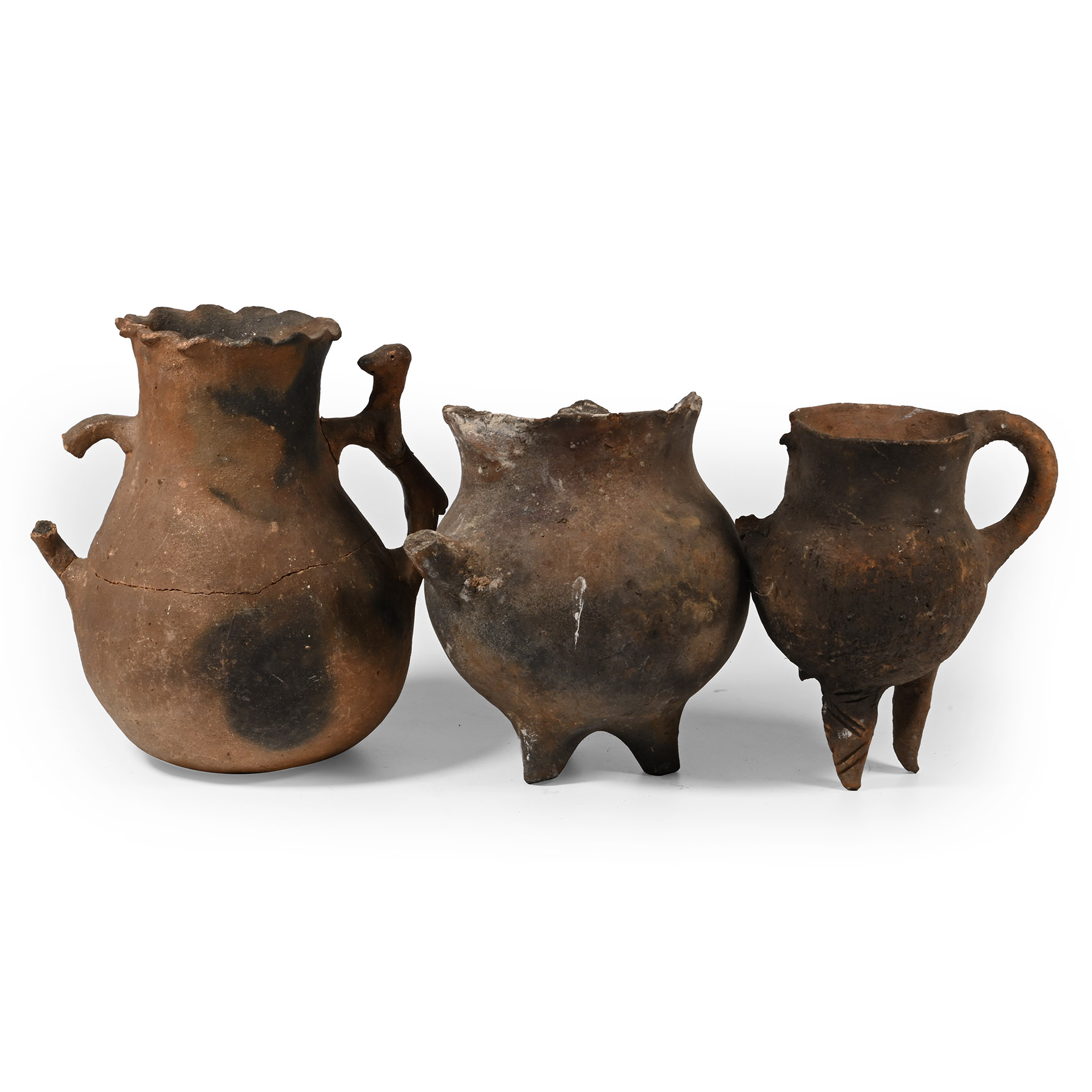
Cypriot Terracotta Vessel Group
2ND-1ST MILLENNIUM B.C.
6 1/4 - 7 3/4 in. (2 kg total, 16-19.5 cm).
With loop and strap handles, flared stub legs, crimped rim and other details. [3, No Reserve]
ProvenanceFrom a collection acquired on the UK art market from various auction houses and collections mostly before 2000.
From an important Cambridgeshire estate; thence by descent.
TimeLine Auctions follows a vetting process to ensure the authenticity and legality of all items, reinforcing our commitment to integrity and responsible trading. Each antiquity, antique, and coin lot undergoes thorough examination by a vetting committee of at least ten external specialists, professional trade association members, scientists, and archaeologists: Our Vetting Process
AUCTIONS:
TimeLine is a leading auction house specialising in antiquities, ancient art, collectables, natural history, coins, medals, and books. Our auctions offer museums, collectors, historians, and enthusiasts the opportunity to acquire unique and historically significant pieces.
-
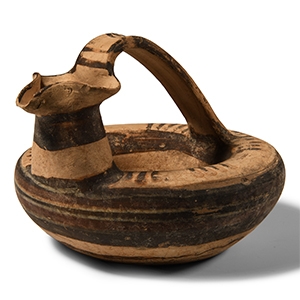
Etrusco-Corinthian Ring Askos
Circa 575 B.C.Sold for (Inc. bp): £260
With strap handle positioned over the central hole; black-figure decoration with fired umber (reddish-brown) consisting of a broad band heightened with crimson and white round the upper part of the wall, and a wavy band on the reversed area below; broad band of black (fired umber) inside the ring and around the neck below the spout; groups of transverse lines with faded petals around the top, horizontal lines across the handle; intact. 349 grams, 16.5 cm
Acquired from Charles Ede Gallery, London, in 1982. Prominent Palm Springs, California, USA, collection. with Artemis Gallery, Colorado, USA, 14 July 2012, lot 30 (US$2,500-3,000). Property of a South Australian private collector, with collection reference 14.08. Accompanied by detailed collector's catalogue pages including description and photograph.
Etrusco-Corinthian pottery is a local imitation of Corinthian pottery, made from the late seventh to the mid-sixth century B.C., with production concentrated on the southern Etruscan cities of Caere, Veii and Vulci. The forms predominately employed include various forms of jug (olpai, oinochoe) and unguent containers (aryballoi and alabastra) as well as amphorae and craters. The askos is the name given in modern parlance to a type of Greek pottery vessel used to pour small quantities of liquids such as oil. It is recognisable from its flat shape and a spout at one or both ends that could also be used as a handle; they were usually painted decoratively like vases and were mainly used for storing oil and refilling oil lamps. They were extensively traded in and around the Mediterranean, and local types emerge in Italy from the early Iron Age in Italy (cf. CVA Taranto – Museo Nazionale I, pl. 1.1 (Inv. 2400) – refer photo at 14.08 – 3); also CVA British Museum 7, pl. 4.4). The original meaning of ἀσκός is “wineskin” which can be seen in the shapes of early askoi. This askos has unique painted decoration for which a parallel has not been found to date. For an earlier variant of this type, see CVA Tarquinia – Museo Archeologico Nazionale III, pl. 27.7-8 (Inv. RC. 1892). Described as 'Italo- Geometric' and dated to third quarter of the seventh century. Neck is longer than on Inv.14.08, and with different decorations, but otherwise it is an early parallel. Another variant of this type can be seen in CVA Museo Civico d’Archeologia Ligure di Genova, I, pl. 1.2-3 (Inv. 1101). The groups of horizontal line decoration can be seen on earlier types, cf. late eighth to early seventh century footed cup in the Museo Archeologico della Maremma (CVA Grosetto Museo Archeologico I, pl. 26.3 (Inv. 24294)). -
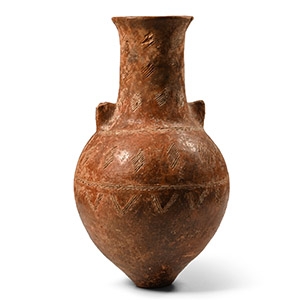
Large Cypriot Red Burnished Ware Amphora-Shaped Vessel
Early Bronze Age, 2300-2150 B.C.Sold for (Inc. bp): £780
The ovoid body and trumpet-shaped neck decorated with bands of hatched lozenges, shoulder with encircling broken bands above and below with inverted chevrons beneath; lateral flange handles. 1.7 kg, 30.5 cm
From a collection acquired on the UK art market from various auction houses and collections mostly before 2000. From an important Cambridgeshire estate; thence by descent. -
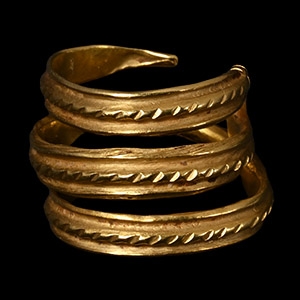
Etruscan Gold Spiral Ring
8th-3rd century B.C.Sold for (Inc. bp): £780
Comprising a D-section band with median band of raised ropework; S-curved format. 5.45 grams, 19.01 mm overall, 15.21 mm internal diameter (approximate size British F, USA 2 3/4, Europe 3.67, Japan 3)
with Arts d'Orient Archaeology, Paris, 7 June 2006, no. 556. Ex Galerie Dominique Thirion, Brussels, Belgium. From the private collection of Mr K.A.
