
Loading, please wait...
_900x900.jpg "Cypriot Terracotta Goddess Figurine")
_200x200.jpg "Cypriot Terracotta Goddess Figurine")
.jpg "Cypriot Terracotta Goddess Figurine")
LOT 0094
Cypriot Terracotta Goddess Figurine
LATE 2ND MILLENNIUM B.C.
8 in. (299 grams, 20.2 cm).
With columnar body and flared base, arms raised, applied domed breasts, pinched facial features with applied mouth and ears; applied band to the brow for the hair or headdress; remains of coral-pink painted detailing.
ProvenanceFrom the collection of French scholar and diplomat Auguste Dozon (1822-1890).
Subsequently Hotel Des Ventes Monte Carlo, 6th May 2018, lot 7.
With French cultural property passport.
Cf. similar in the collection of the Metropolitan Museum of Art under accession no.74.51.1615 (Cesnola Collection).
CONDITIONTimeLine Auctions follows a vetting process to ensure the authenticity and legality of all items, reinforcing our commitment to integrity and responsible trading. Each antiquity, antique, and coin lot undergoes thorough examination by a vetting committee of at least ten external specialists, professional trade association members, scientists, and archaeologists: Our Vetting Process
AUCTIONS:
TimeLine is a leading auction house specialising in antiquities, ancient art, collectables, natural history, coins, medals, and books. Our auctions offer museums, collectors, historians, and enthusiasts the opportunity to acquire unique and historically significant pieces.
-
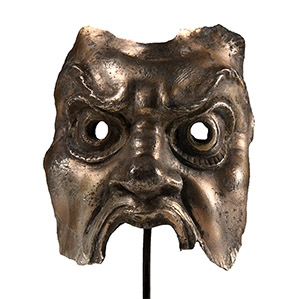
Greek Silver-Gilt Mask of Silenus
3rd-2nd century B.C.Sold for (Inc. bp): £2,470
Naturalistically modelled in repoussé as the mature and frowning face of the god Silenus; accompanied by a custom-made display stand. 9.4 grams, 37 mm (160 grams total, 98 mm high including stand)
Ex old English collection. London art market, 1980s. This lot has been checked against the Interpol Database of stolen works of art and is accompanied by search certificate number no.11849-207741.
In Greek mythology, Silenus was a god of the forest, associated with musical creativity, ecstatic dance and drunkenness. He was also a prophet and a bearer of dire wisdom. When the god Dionysus was born from the thigh of Zeus, Hermes took the infant to live with Silenus, where he was raised together with local nymphs in a cave on mount Nysa. Silenus was frequently present in the train of Dionysus, fought with the latter against the giants, and accompanied him on his adventures. -
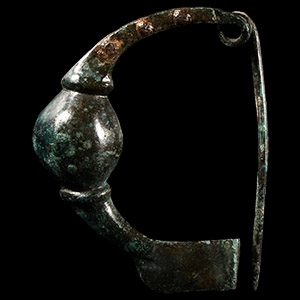
Greek Bronze Bow Brooch
8th-7th century B.C.Sold for (Inc. bp): £156
The keeled bow with a large central boss, integral pin and rectangular footplate. 55.9 grams, 72 mm
From the family collection of a Surrey gentleman since before 1960.
The distinctive form of this fibula seems to be an Italic variant of characteristic Geometric period examples from Thessaly that have been discovered in large numbers, for example in the sanctuary of Zeus Thaulios near Pharos. It belongs to the category of Greek catch plate brooches, although the rectangular footplate is substantially reduced compared to the Greek prototypes. -
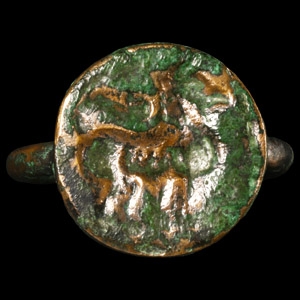
Greek Bronze Ring with Animal
3rd-2nd century B.C.Sold for (Inc. bp): £130
With round-section hoop, the round bezel with a standing quadruped with its tail curved above its back. 7.80 grams, 26.32 mm overall, 20.45 mm internal diameter (approximate size British U 1/2, USA 10 1/4, Europe 23.15, Japan 22)
Ex old English collection. London art market, 1980s.
