
Loading, please wait...
LOT 0572
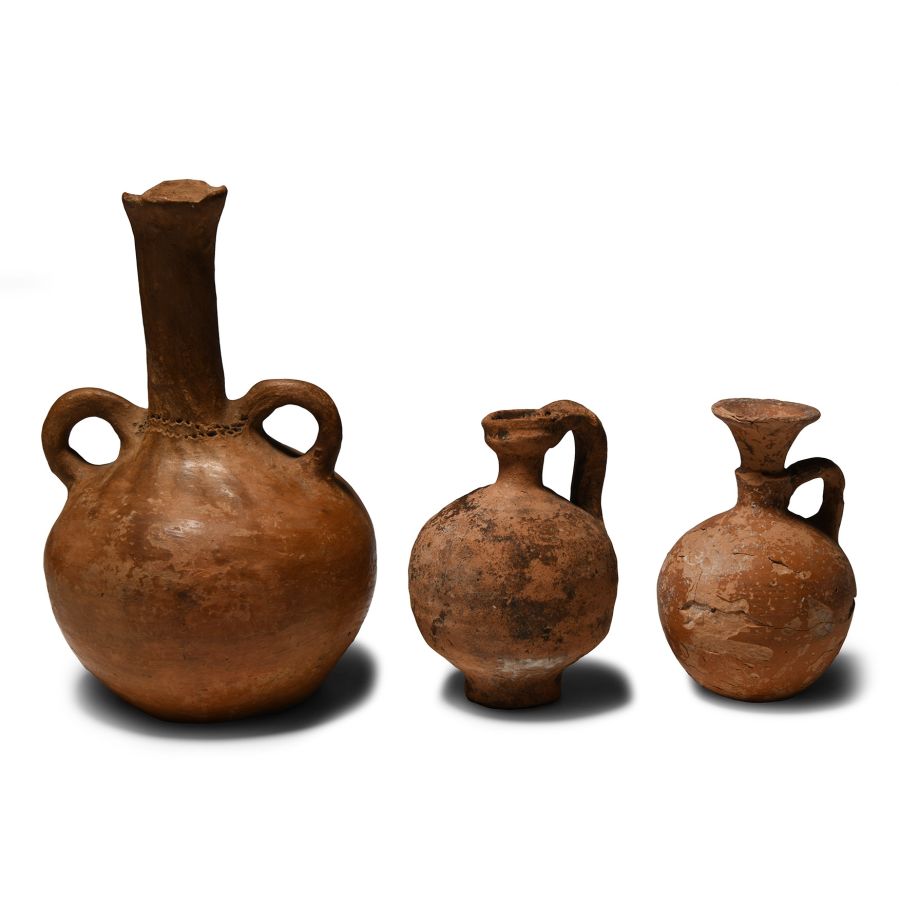
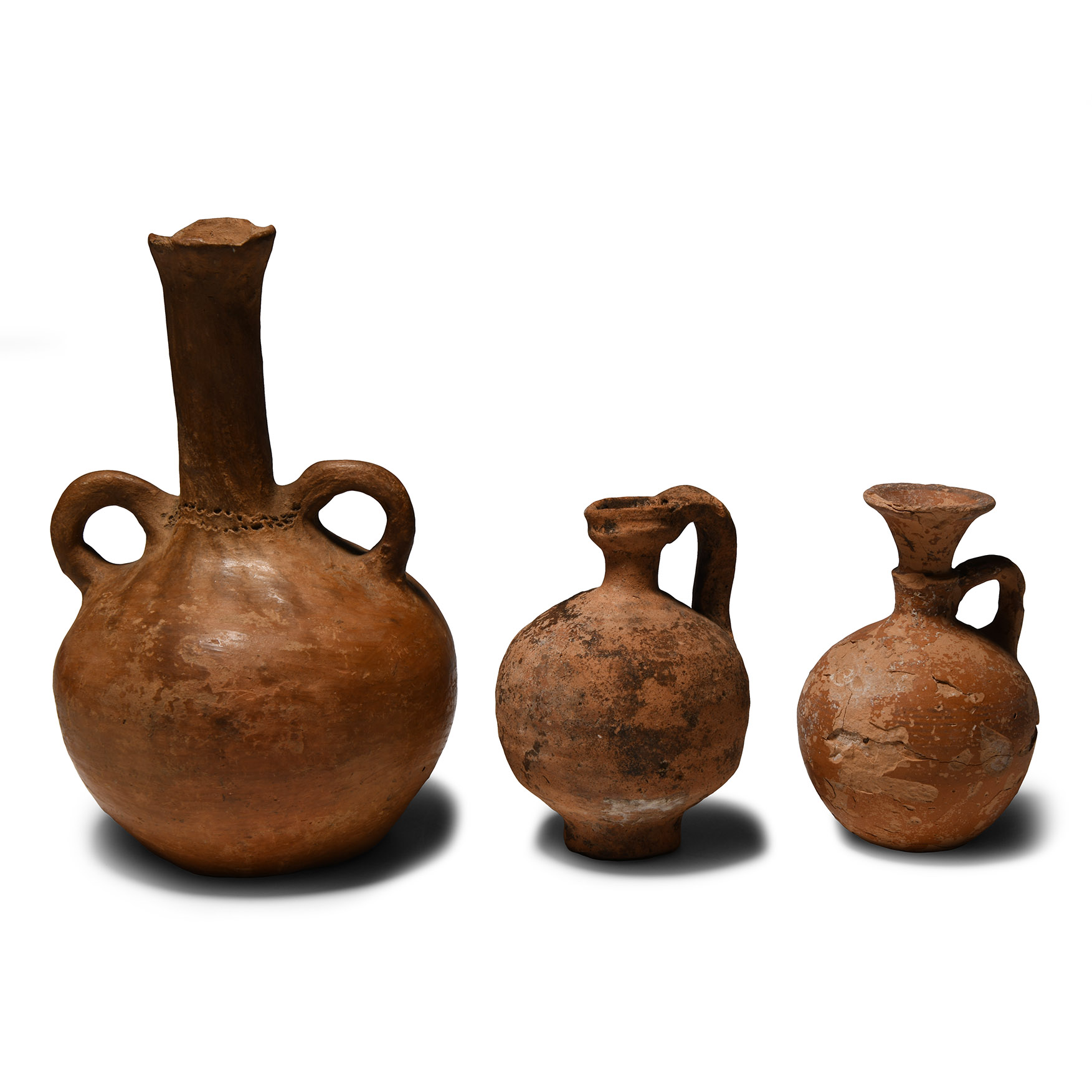
Cypriot Terracotta Flask Group
MIDDLE-LATE BRONZE AGE, 2000-1200 B.C.
3 5/8 - 6 1/2 in. (490 grams total, 9.2-16.5 cm).
Comprising: one globular with loop handles to the shoulder, pointillé decoration and funicular mouth; two globular with loop handle and trumpet-shaped mouth. [3, No Reserve]
ProvenanceFrom a collection acquired on the UK art market from various auction houses and collections mostly before 2000.
From an important Cambridgeshire estate; thence by descent.
This lot is accompanied by an illustrated lot declaration signed by the Head of the Antiquities Department, Dr Raffaele D’Amato.
TimeLine Auctions follows a vetting process to ensure the authenticity and legality of all items, reinforcing our commitment to integrity and responsible trading. Each antiquity, antique, and coin lot undergoes thorough examination by a vetting committee of at least ten external specialists, professional trade association members, scientists, and archaeologists: Our Vetting Process
AUCTIONS:
TimeLine is a leading auction house specialising in antiquities, ancient art, collectables, natural history, coins, medals, and books. Our auctions offer museums, collectors, historians, and enthusiasts the opportunity to acquire unique and historically significant pieces.
-
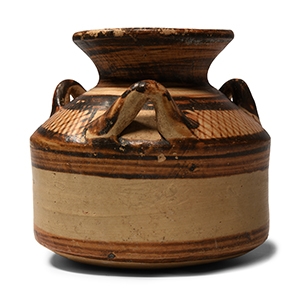
Mycenaean Straight-Sided Painted Alabastron
Late Helladic IIIB Period, 1300-1200 B.C.Estimate: £1,200 - 1,700 (‡+bp*)
Opening Bid: £600
Drum-shaped with a sloping shoulder, short neck, trumpet-style neck and mouth and a gently rounded base; three loop handles at regular intervals around the shoulder; reddish-brown painted geometric bands and cross-hatching against a cream slip. 190 grams, 93 mm wide
Ex private collection, Holland. Acquired from Royal Athena Gallery, 2003, stock no.LAE07/2500. Accompanied by an original Royal Athena label. This lot has been checked against the Interpol Database of stolen works of art and is accompanied by search certificate number no.11852-206835. This lot is accompanied by an illustrated lot declaration signed by the Head of the Antiquities Department, Dr Raffaele D’Amato. -

Graeco-Persian Agate Scaraboid with Recumbent Zebu
Late 4th-3rd century B.C.Sold for (Inc. bp): £260
Engraved to the underside with a reclining zebu facing right with short protruding horns and a pointed ear; smooth, curved top and a narrow longitudinal perforation. 1.83 grams, 15 mm
with Herbert A. Cahn, Basel, 1990s. Accompanied by a copy of an Art Loss Register certificate no.S00075367. This lot is accompanied by an illustrated lot declaration signed by the Head of the Antiquities Department, Dr Raffaele D’Amato.
The body, head and joints are rendered in the “globolo” drilling technique, in which circular recesses of different sizes are carved into the stone, whilst fine cuts are used to depict the horns, ear and tail. In the Achaemenid period, ‘globolo’ style visible on some gemstones, mainly with animal motifs, developed in Syria-Phoenicia, but the gems did not carry specific Persian motifs, except perhaps this series with a zebu bull. -
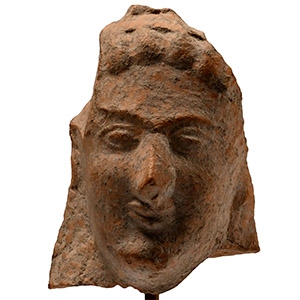
Greek Terracotta Female Protome
6th-5th century B.C.Estimate: £400 - 600 (‡+bp*)
Opening Bid: £180
Head of a girl with long hair and curls framing the forehead; elongated, oval face with almond-shaped eyes, slender nose and round chin; the lips forming an Archaic smile; mounted on a custom-made display stand. 33 grams total, 79 mm including stand
with Herbert A. Cahn, Basle, 1990s. Accompanied by a copy of an Art Loss Register certificate no.S00075470. This lot is accompanied by an illustrated lot declaration signed by the Head of the Antiquities Department, Dr Raffaele D’Amato.
Small mould-made heads were used for female divinities, sphinxes and sirens, or attached to pottery as plastic ornaments. The figure was wearing a polos, a small, drum-shaped headdress designating in this period a divinity.
