
Loading, please wait...
LOT 0056
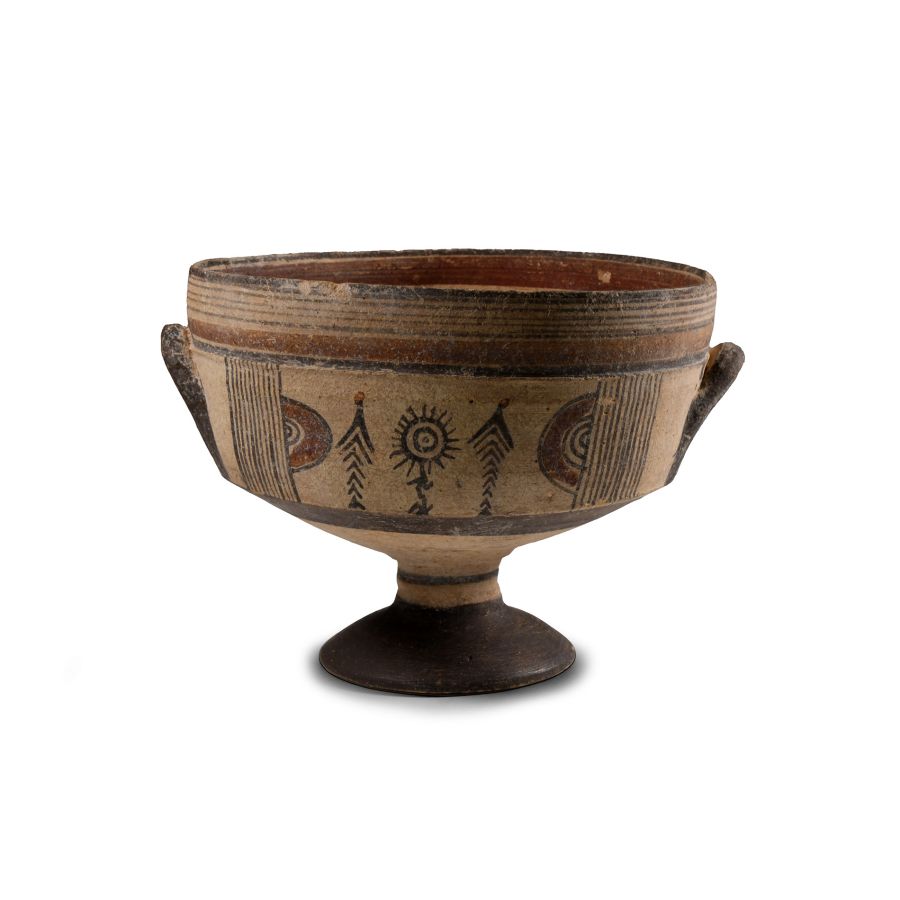
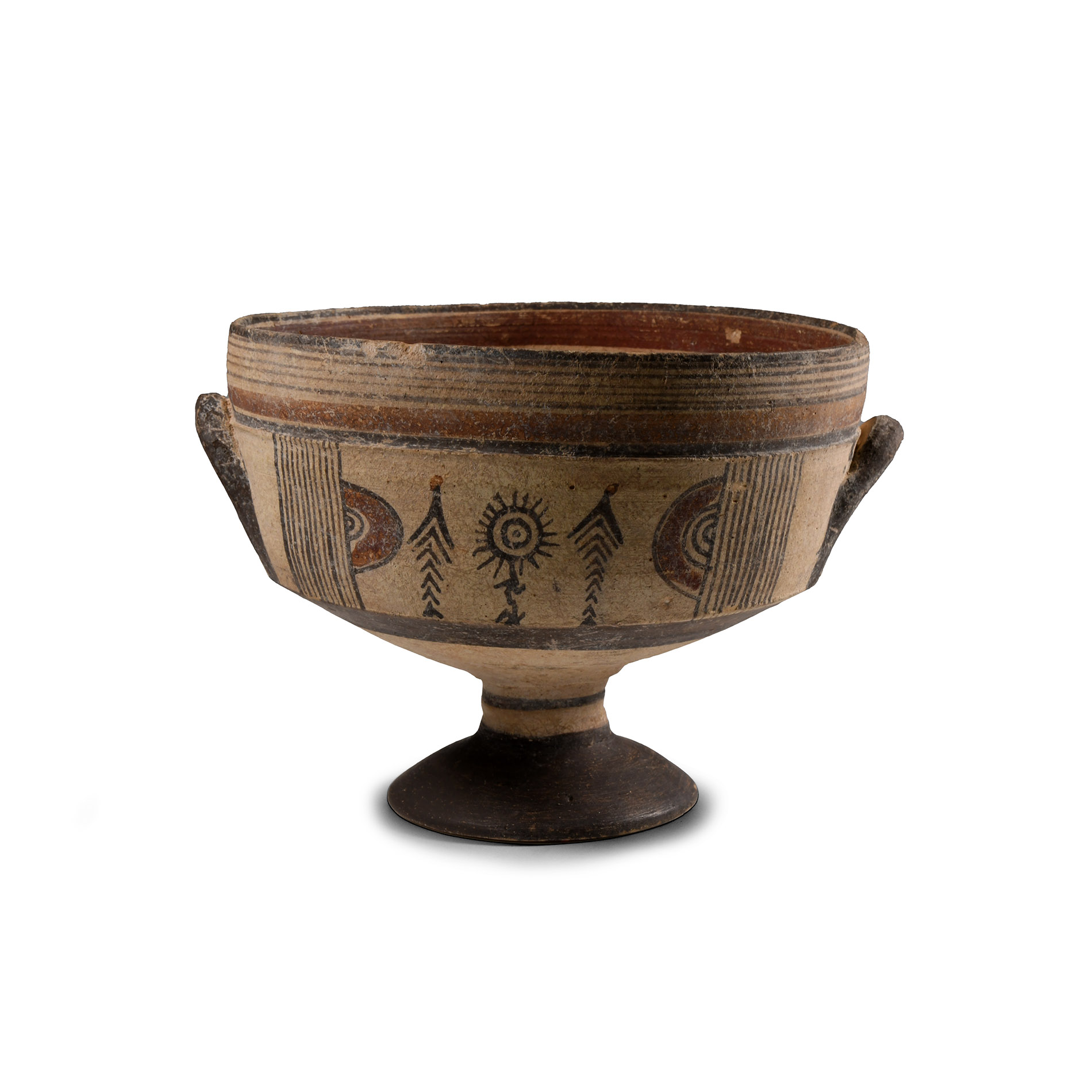
Cypriot Decorated Kylix
850-750 B.C.
8 1/4 in. (685 grams, 21 cm wide).
With domed foot and short stem supporting a broad bowl with carination below the rim and two lateral ledge handles; bands of painted concentric rings to the inner face in black and red, similar to the shoulder above panels of vertical stripes, arrows and other motifs; median Maltese cross to one face and bull's eye motif to the other.
ProvenanceWith Sotheby's London, antiquities sale, 17 May 1983, lot 132.
Acquired from the above by Mr Leinonen, by descent to his son, Stan Leinonen.
On loan to the Detroit Institute of Arts 6 December 1983-24 April, 2019.
On view in Hallway East of Rivera Court circa 1989 and again in European Medieval and Renaissance in the 2000s.
Cf. similar in the collection of the British Museum under accession no.1869,0604.21.
CONDITIONTimeLine Auctions follows a vetting process to ensure the authenticity and legality of all items, reinforcing our commitment to integrity and responsible trading. Each antiquity, antique, and coin lot undergoes thorough examination by a vetting committee of at least ten external specialists, professional trade association members, scientists, and archaeologists: Our Vetting Process
AUCTIONS:
TimeLine is a leading auction house specialising in antiquities, ancient art, collectables, natural history, coins, medals, and books. Our auctions offer museums, collectors, historians, and enthusiasts the opportunity to acquire unique and historically significant pieces.
-
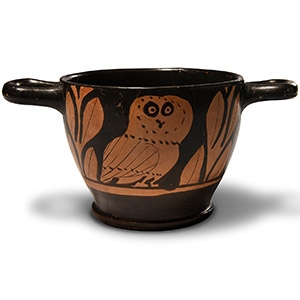
Apulian Red-Figure Skyphos with Owls
5th century B.C.Sold for (Inc. bp): £1,820
The cup with two handles to the neck and a broad, integral foot; both principal faces displaying an owl standing right between laurel branches; repaired. 127 grams, 15 cm wide
Acquired in Europe before 1994. with Christie's, New York, 2 June 1995, lot 95. -
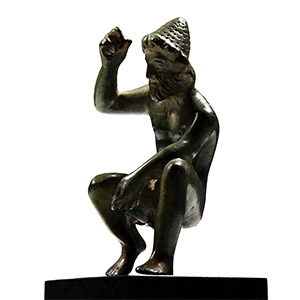
Greek Bronze Hephaistos Statuette
Circa 5th century B.C.Estimate: £20,000 - 30,000 (+bp*)
Opening Bid: £10,000
The elegant figure depicting the Greek god of fire and metalworking seated and nude except for the pilos on his head, lean body with naturalistic detailing, shown bearded and with curly hair emerging beneath the cap; he would have once held a pair of tongs in his left hand and a hammer in his right hand; accompanied by a custom-made display stand. 294 grams total, 13.5 cm high including stand
Fine condition, wonderful state of preservation, very rare.
with Elie Borowski, Basel. Subsequently in the collection of Denys Sutton (1917-1991), London, acquired from the above on 11 October 1963. Thence by descent. with Sotheby's, New York, 6 December 2012, lot 11. Accompanied by an academic report by Dr Raffaele D’Amato. This lot has been checked against the Interpol Database of stolen works of art and is accompanied by search certificate number no. 11827-207739.
According to legend, Hephaistos was thrown into the ocean by his mother Hera and raised by the sea nymph Thetis. Upon his return to Olympus, he took his revenge by imprisoning his mother and obtaining the hand of the most beautiful of the goddesses, Aphrodite. He became the blacksmith of the gods. Sculptural depictions of the god, known as Vulcan to the Romans, are very rare. Hephaistos was the armourer of the heroes, and certainly his greatest artwork was making Achilles' armour. -
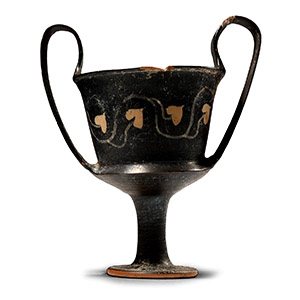
South Italian Blackware Kantharos with Ivy Branch
5th-4th century B.C.Estimate: £1,500 - 2,000 (‡+bp*)
Opening Bid: £750
The high-handled drinking cup with carinated lower body, discoid feet and vines painted to the equator. 472 grams, 23.3 cm high
Acquired in Europe before 1994.
