
Loading, please wait...
LOT 0055
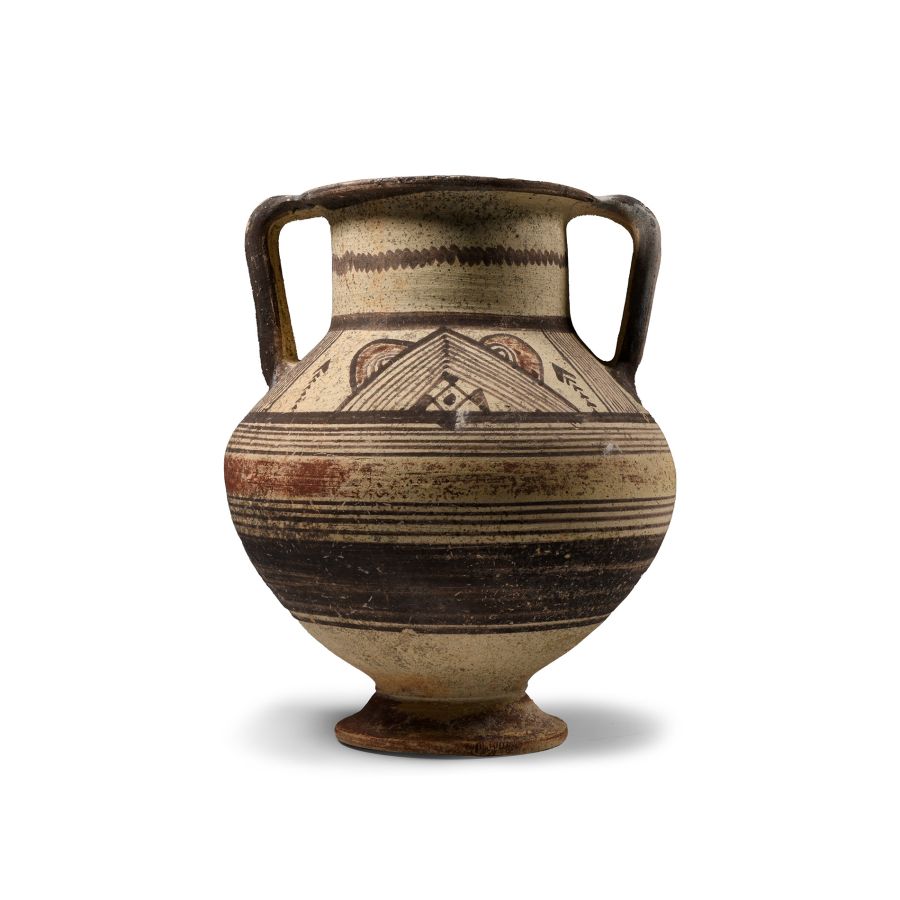
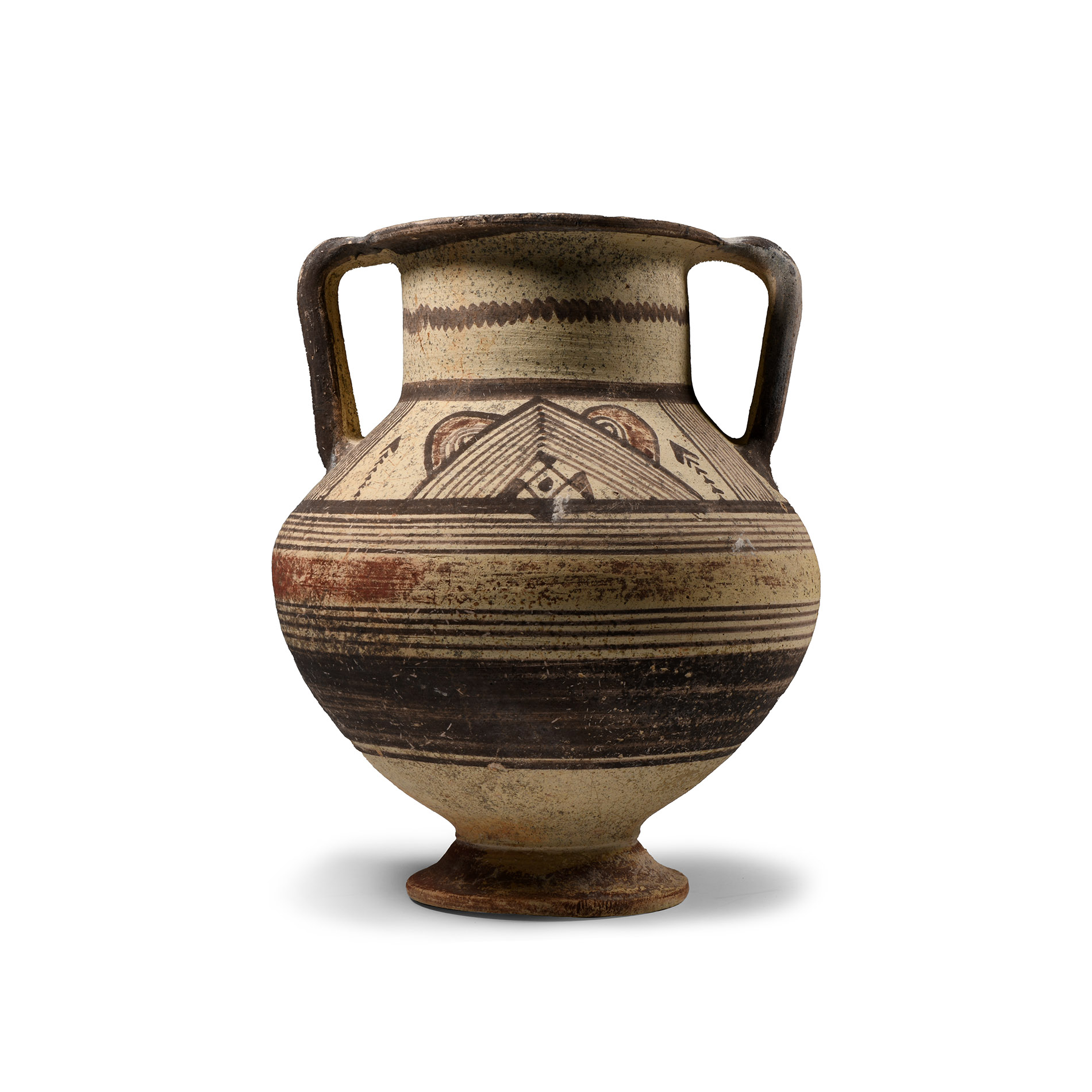
Cypriot Decorated Amphora
700-600 B.C.
9 1/4 in. (1.12 kg, 23.5 cm high).
Creamware body with broad neck and pear-shaped body, trumpet-shaped base; ribbed strap handles extending to the everted rim; painted with dense zones of concentric black chevrons, rings, and other geometric ornament, red detailing.
Provenancewith Christie's, London, 11 July 1990, lot 122.
Subsequently in the collection of Dr Takey Crist, Jacksonville, North Carolina.
Exhibited: The Cyprus Museum, Jacksonville, North Carolina, 1988-2018.
LiteratureCf. similar though less ornate example in the collection of the British Museum under accession no.1866,0415.98.
CONDITIONTimeLine Auctions follows a vetting process to ensure the authenticity and legality of all items, reinforcing our commitment to integrity and responsible trading. Each antiquity, antique, and coin lot undergoes thorough examination by a vetting committee of at least ten external specialists, professional trade association members, scientists, and archaeologists: Our Vetting Process
AUCTIONS:
TimeLine is a leading auction house specialising in antiquities, ancient art, collectables, natural history, coins, medals, and books. Our auctions offer museums, collectors, historians, and enthusiasts the opportunity to acquire unique and historically significant pieces.
-
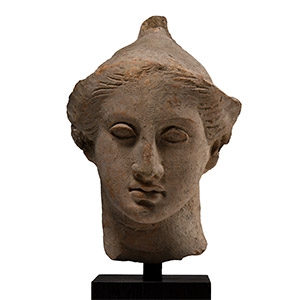
Greek Tarentine Terracotta Head of a Youth
Mid 4th century B.C.Sold for (Inc. bp): £5,720
Possibly depicting Ganymede or Paris, wearing a soft Phrygian cap with everted brim, the hair swept back from the face; almond-shaped eyes with pronounced eyelids, straight nose and fleshy lips; mounted on a custom-made display stand. 1.2 kg total, 25.3 cm high including stand
Acquired early 20th century. From the collection of Count Henri d'Epinay (1940-2017), Longuenesse, France. Accompanied by a copy of a French cultural passport no.196149. Accompanied by an academic report by Dr Raffaele D'Amato. This lot has been checked against the Interpol Database of stolen works of art and is accompanied by search certificate no.11824-207736.
The terracotta sculpture appears to have similarities with other Tarentine heads from the early Hellenistic Period. A marble head from Taranto, datable to the end of the 4th century B.C., presents similar elements. The visible character is clearly attributable to Graeco-Roman mythology. The only clue regarding the identity of the head is provided by the Phrygian cap, which narrows down the identification to few characters from Greek mythology: the Trojan prince Ganymede, abducted by Zeus for his beauty and named by him the cupbearer of the gods, or the Trojan prince Paris. There are many representations of Ganymede in a Phrygian cap (Hakanen, 2022, plates 6,12a). However, the third possibility is that the sculpture represents Attis, lover of the goddess Cybele. -
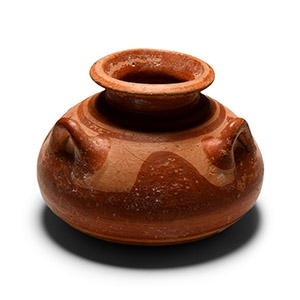
Mycenaean Painted Pottery Alabastron
14th-13th century B.C.Estimate: £2,000 - 3,000 (‡+bp*)
Opening Bid: £1,000
Formed with a squat globular body, everted rim and three lug handles to the shoulder; painted reddish-brown over a cream slip with concentric bands and rings to the mouth, neck, shoulder and base, larger solid undulating forms covering the lower body. 70 grams, 69 mm
Acquired from Royal Athena Gallery, 2003. This lot has been checked against the Interpol Database of stolen works of art and is accompanied by search certificate number no.11851-206833.
Late Helladic IIIA period of Mycenaean culture. -
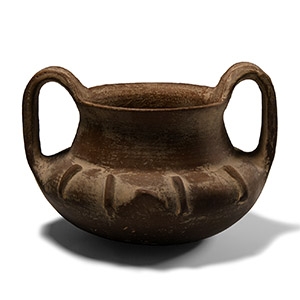
Etruscan Brownware Impasto Vase
8th-7th century B.C.Estimate: £1,000 - 1,400 (‡+bp*)
Opening Bid: £500
Biconical with a broad neck, everted rim and two high handles, shoulder decorated with high vertical ridges with conical knop at centre to two faces. 328 grams, 14.4 cm
Ex private Mister X. (1931-2017) collection. Sold in the benefit of the 'Croix-Rouge of Monaco'.
