
Loading, please wait...

LOT 2131
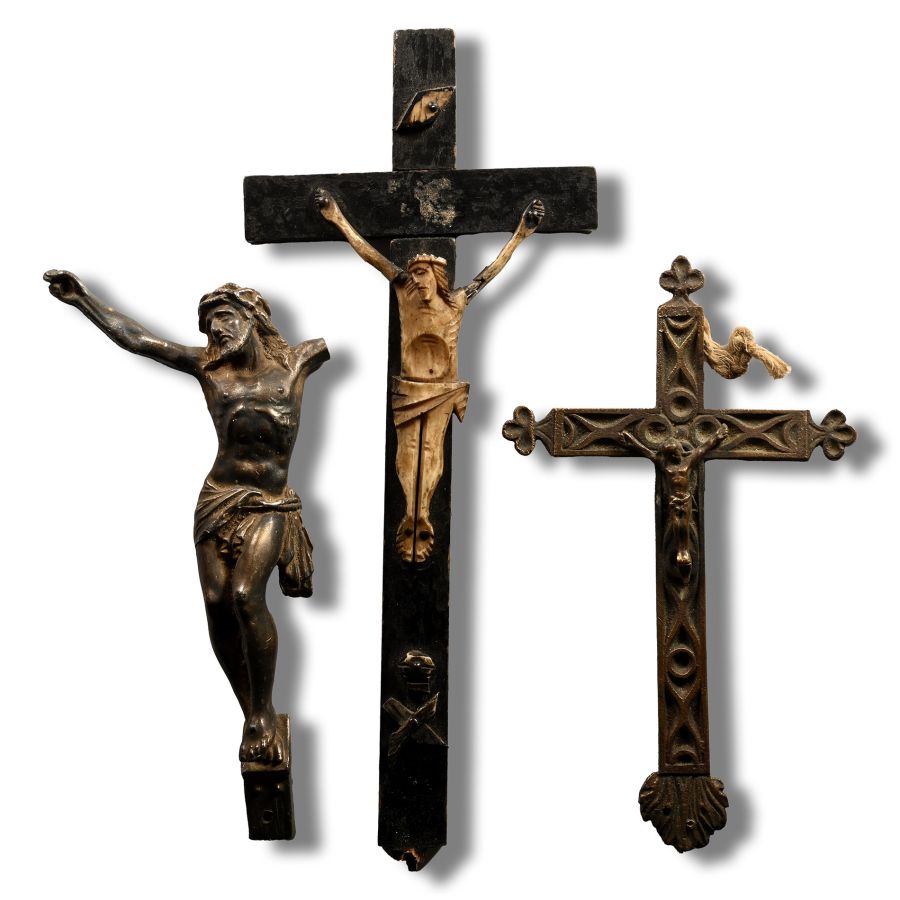
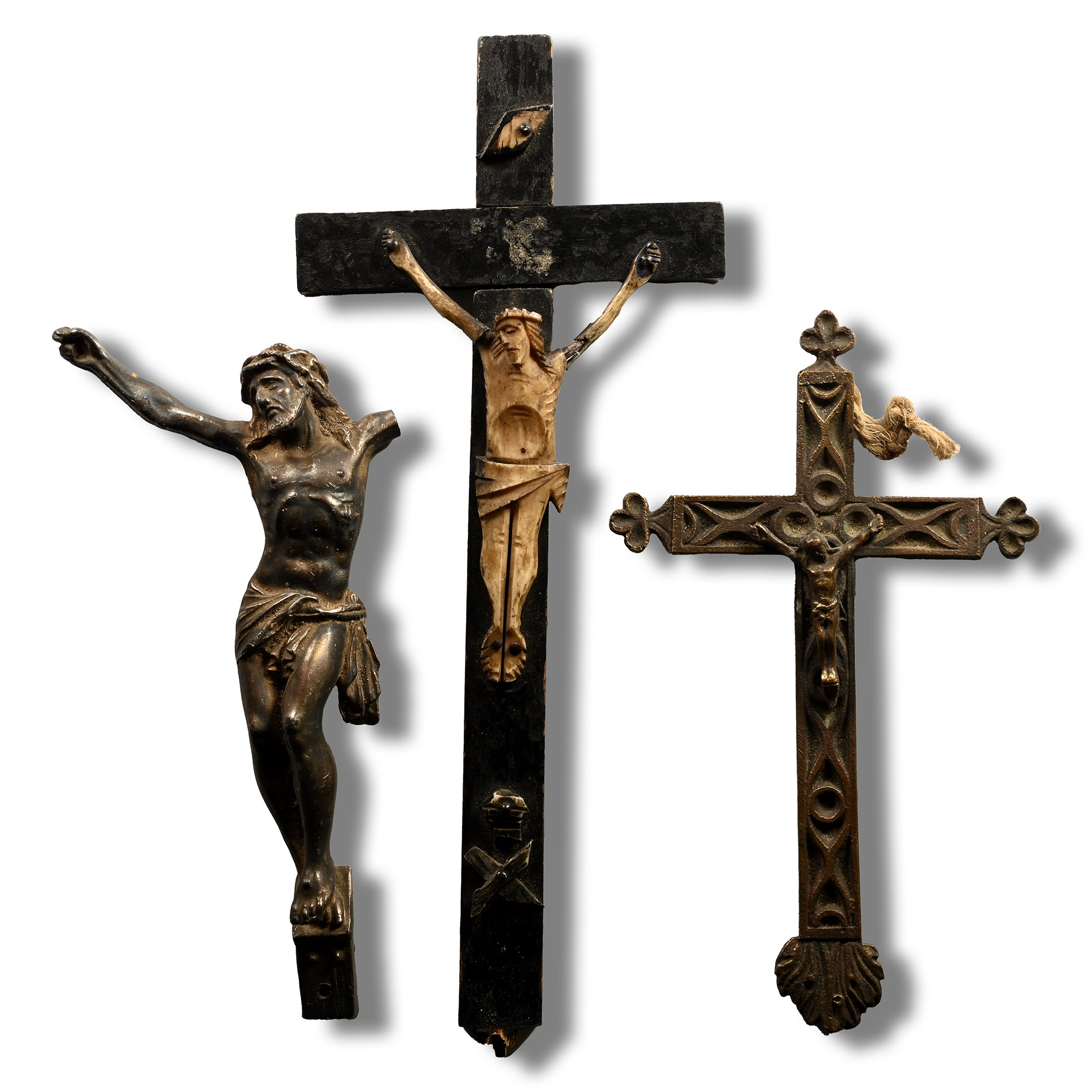
Cross and Corpus Group
18TH-19TH CENTURY A.D.
5 - 7 5/8 in. (171 grams total, 12.6-19.5 cm).
Comprising three Corpus Christi figures in bronze and bone, modelled in the round with arms outstretched, loin cloth to the thighs, feet placed (on two of them) on the supporting block; one without cross. [3, No Reserve]
ProvenanceFrom the private collection of Victor Brox (1941-2023), formed in the 1980s-1990s.
This lot is accompanied by an illustrated lot declaration signed by the Head of the Antiquities Department, Dr Raffaele D’Amato.
See Münter, F., Siunbilder und Kunstvorstellungen der alten Christen, Altona, 1825; Capello, V., La crocifissione fra fede, arte e scienza, Bologna, 2017.
FootnotesThe artists, probably Italian, with extraordinary dedication and sensitivity, created images of a still living Christ, afflicted by suffering. They had paid great attention to detail, with particular care taken over the softly curled hair, tense musculature, and protruding ribs.
CONDITIONTimeLine Auctions follows a vetting process to ensure the authenticity and legality of all items, reinforcing our commitment to integrity and responsible trading. Each antiquity, antique, and coin lot undergoes thorough examination by a vetting committee of at least ten external specialists, professional trade association members, scientists, and archaeologists: Our Vetting Process
AUCTIONS:
TimeLine is a leading auction house specialising in antiquities, ancient art, collectables, natural history, coins, medals, and books. Our auctions offer museums, collectors, historians, and enthusiasts the opportunity to acquire unique and historically significant pieces.
-
Western Asiatic Style Terracotta Figure Group
20th century A.D.Sold for (Inc. bp): £20
Mixed group including male with applied columnar headdress and belt. 200 grams total, 10.7-14.4 cm
Acquired 1980-2015. Ex Abelita family collection. This lot is accompanied by an illustrated lot declaration signed by the Head of the Antiquities Department, Dr Raffaele D’Amato. -
Mount Athos Wooden Cross with Silver-Gilt Mounts
Circa 1700 A.D.Sold for (Inc. bp): £4,160
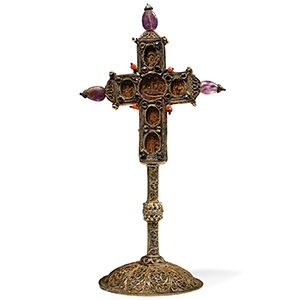
Comprising: a wooden cross with carved scenes from the life of Christ (Nativity and others to one face, Crucifixion and others to the other face) housed in a filigree frame with beaded wire borders to the circular openings; three large amethyst beads to the arms, smaller coral and glass beads to each face; cannetille balustered stem and domed base. 140 grams, 21.8 cm
Ex Iconastas, London, SW1, UK, in 2004. Ex Mayfair Gallery Limited, London W1, UK, in 2005. Property of a London, UK, gentleman collector. Accompanied by a copy of the Mayfair Gallery invoice dated 10 January 2005. Accompanied by a copy of the Iconastas invoice dated 18 February 2004. Accompanied by an academic report by Dr Raffaele D'Amato. This lot has been checked against the Interpol Database of stolen works of art and is accompanied by search certificate no.12488-229957. This lot has been cleared against the Art Loss Register database, and is accompanied by an illustrated lot declaration signed by the Head of the Antiquities Department, Dr Raffaele D’Amato. -
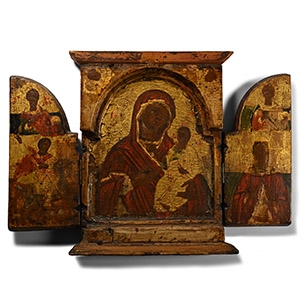
Greek Triptych Icon with Mother of God and Christ, Saint George and Other Saints
18th century A.D.Sold for (Inc. bp): £234
Executed in oil and tempera and gold leaf; the central panel with the veiled head of Mary with her head inclined towards the infant Jesus supported by her left hand, wearing a red maphorion mantle with elaborate golden borders, over an off-white robe, with gold cuffs; the infant facing to left, dressed in blue tunic and wrapped in a yellow shawl, right hand extended in blessing gesture, Greek inscriptions ΜΡ ΘΥ (Μήτηρ (τοῦ) Θεοῦ = Mother of God) flanking Mary's head, and 'ΙϹ ΧϹ' (ΙΗϹΟΥϹ ΧΡΙϹΤΟϹ = Jesus Christ) beside the infant; the side panels with icons of Saints Kosmas and Damianos (upper sections) and Saint George killing the dragon and Saint Barbara (lower sections). 425 grams, 20.5 cm
Property of a London, UK, gentleman collector. This lot is accompanied by an illustrated lot declaration signed by the Head of the Antiquities Department, Dr Raffaele D’Amato.
Even after the fall of Constantinople, icons painted on wood remained the principal object of devotion for Orthodox Christians wherever the commonwealth of the Eastern Roman Empire left its traces. The painted icons are still used by the Orthodox for personal devotion, for display in churches on feast days, and to decorate the iconostasis (partition) of the church. This icon is a portable one, for domestic or travel prayers.
