
Loading, please wait...


LOT 0435
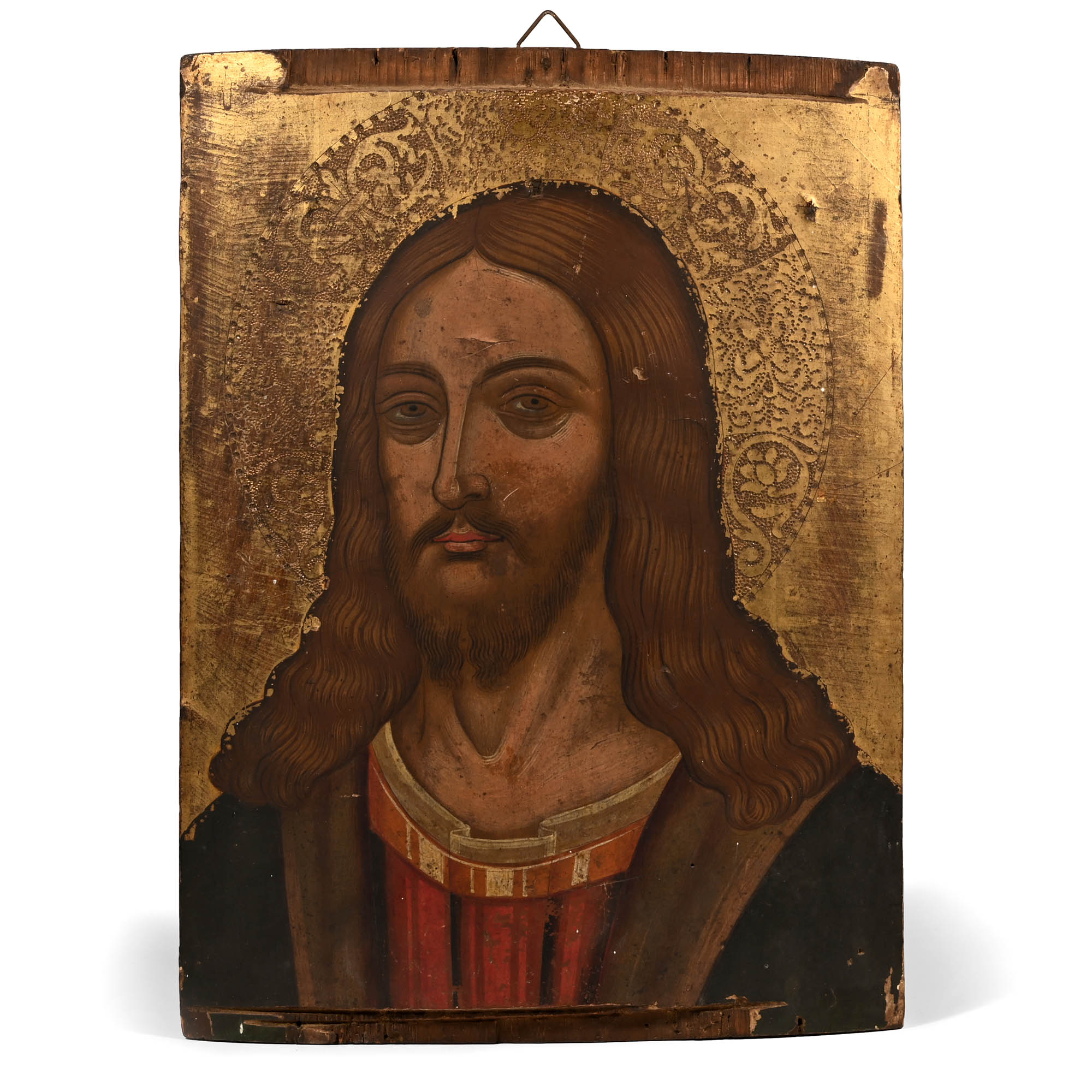
Cretan Wooden Icon of Christ Ecce Homo
VENETIAN, EARLY 17TH CENTURY A.D.
11 5/8 x 16 in. (1 kg, 29.7 x 40.8 cm).
Curved in section with mounting slots to reverse; gessoed board with gilt surface, reserved portrait bust in three-quarter view on a textured field with tendrils, scrolls and other ornament; nimbate Christ shown with shoulder-length auburn hair and short beard wearing layered robes.
ProvenanceEx Lucas Auctions, Milano, Italy.
From an important collection of icons.
Accompanied by an academic report by Dr Raffaele D’Amato.
This lot has been checked against the Interpol Database of stolen works of art and is accompanied by search certificate number no.12344-224611.
Cf. Weizmann, K. et al., The Icon, New York, 1982; Psilakis, N., Byzantine Churches and Monasteries of Crete, Heraklion, 1998; Popescu, G.A., Cristiani d'Oriente, spiritualità, arte e potere nell'Europa Post-Bizantina, Milano, 1999; also see the famous Ecce Homo of El Greco, in the Pathmos Monastery, in Chatzidakis, M., Icons of Patmos. Questions of Byzantine and Post-Byzantine Painting, Athens, 1985, as a prototype.
CONDITIONTimeLine Auctions follows a vetting process to ensure the authenticity and legality of all items, reinforcing our commitment to integrity and responsible trading. Each antiquity, antique, and coin lot undergoes thorough examination by a vetting committee of at least ten external specialists, professional trade association members, scientists, and archaeologists: Our Vetting Process
AUCTIONS:
TimeLine is a leading auction house specialising in antiquities, ancient art, collectables, natural history, coins, medals, and books. Our auctions offer museums, collectors, historians, and enthusiasts the opportunity to acquire unique and historically significant pieces.
LOT 0435
Cretan Wooden Icon of Christ Ecce Homo
Estimate £2,000 - 3,000€2,320 - 3,480 (for guidance only)$2,700 - 4,050 (for guidance only)
-
.jpg)
Rembrandt Etchings from Jan Luyken Book of Trades 'Het Menselyk Bedryf'
17th century A.D. and laterSold for (Inc. bp): £39
Pair of prints each in a glazed wooden frame with reveal; showing the Boekdrukker (Bookprinter) and the Horlogiemaaker (Clockmaker). 781 grams total, 25.5 x 19 cm each
Private collection, Amsterdam, Netherlands. Acquired in 2015. Private collection, London, -
Watercolour on Paper by Bellingham Smith
Circa 1885-1922 A.D.Sold for (Inc. bp): £52
Winter scene with bare trees against a pale sky; signed bottom right. 171 grams, 35.5 x 25.5 cm
Private collection, London. -
Large Georgian Bronze Trade Weight
Late 18th century A.D.Sold for (Inc. bp): £33
Discoid in plan with recess to upper face, stamped markings including dagger, crowned G and others. 453 grams, 70 mm
From a private Barnsley, UK, family collection.
