Loading, please wait...

Cretan Red Carnelian Hieroglyphic Seal Cretan Red Carnelian Hieroglyphic Seal Cretan Red Carnelian Hieroglyphic Seal
Use mousewheel to zoom in and out, click to enlarge
Details

LOT 0090

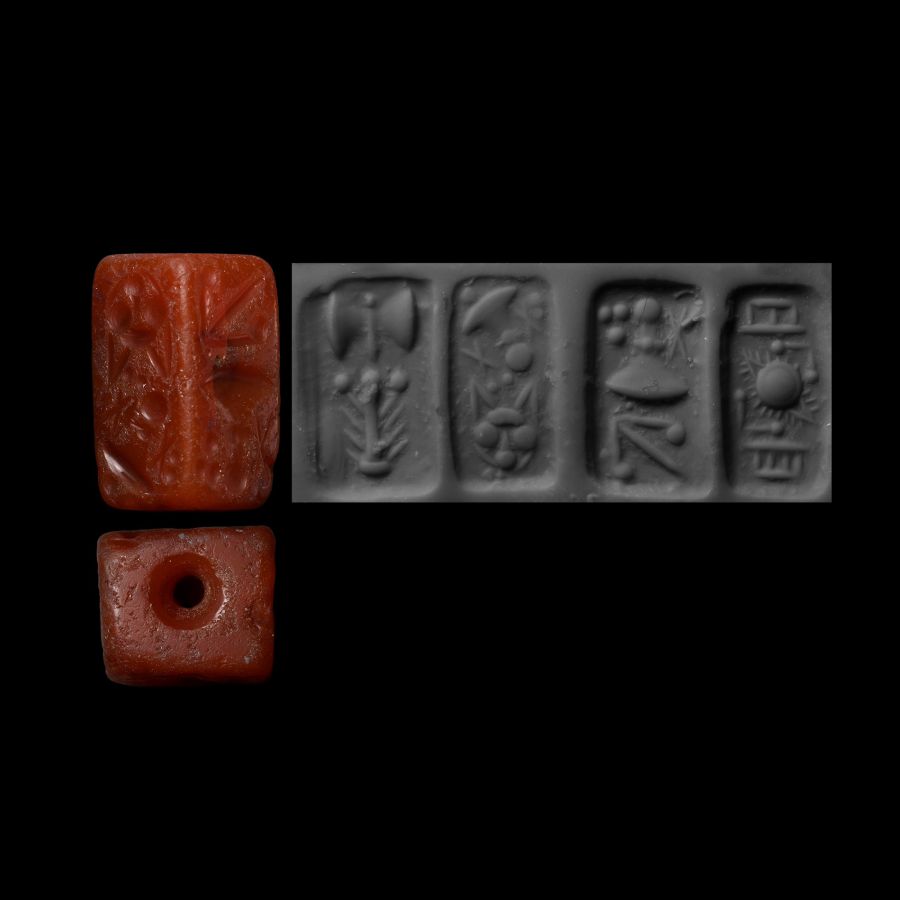
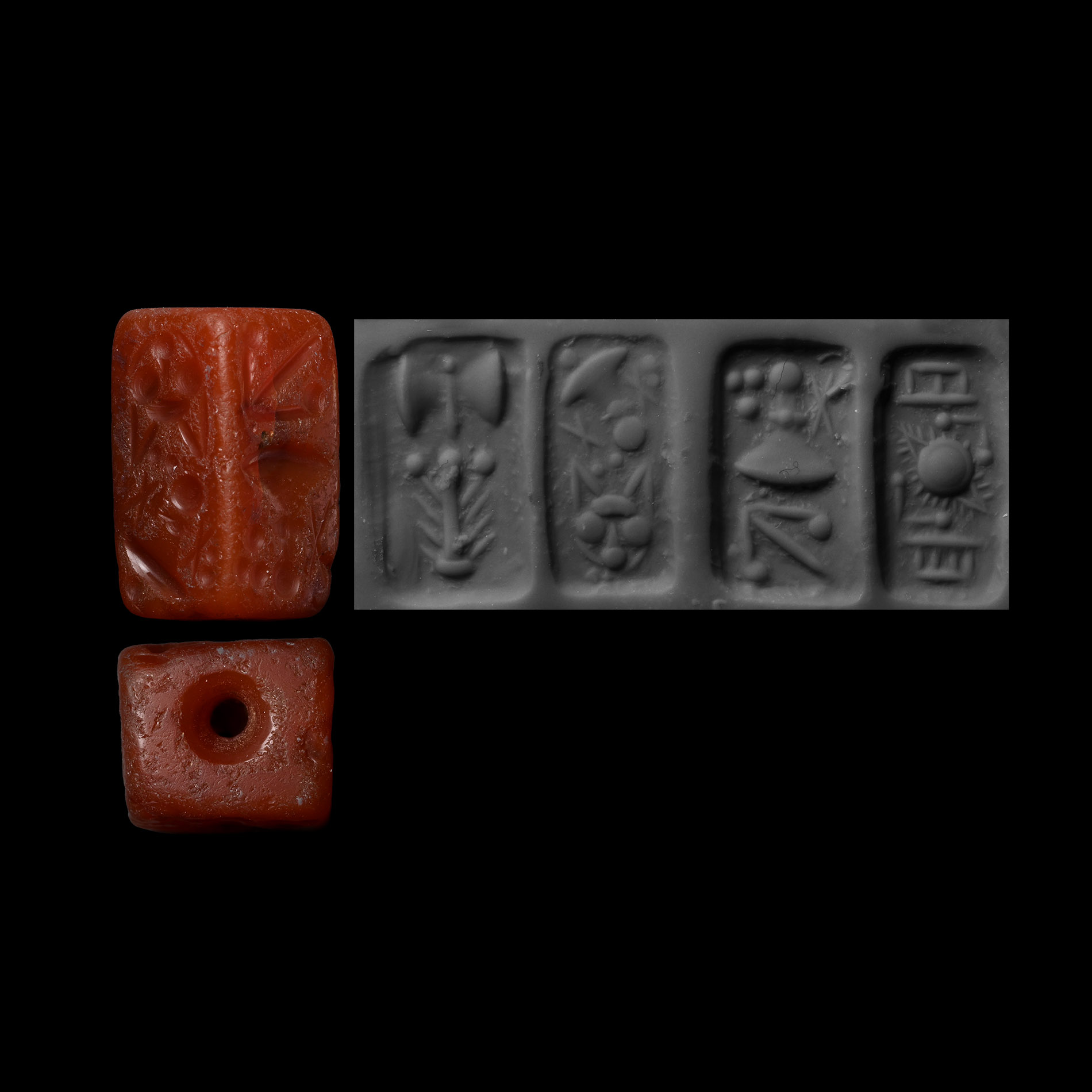
Cretan Red Carnelian Hieroglyphic Seal

EARLY 2ND MILLENNIUM B.C.

5/8 in. (3.99 grams, 18 mm).

Square in section and pierced longitudinally, incuse scene to each face: labrys above a tree; starburst between hatched panels; arrow, axe and other objects; figure above an axe.

Provenance

From the Priday collection, Brookmans Hall, Hertfordshire, UK, formed 1930-1940s onwards by descent.

This lot has been checked against the Interpol Database of stolen works of art and is accompanied by a search certificate number no.12385-225393.

Literature

Cf. similar in the British Museum under accession no. 1921,0711.2 for similar multi-face seal.; see Boardman, J. Greek Gems and Finger Rings: Early Bronze Age to Late Classical, London, 1970, p. 35, fig. 56 for type.

CONDITION
VETTING:

TimeLine Auctions follows a vetting process to ensure the authenticity and legality of all items, reinforcing our commitment to integrity and responsible trading. Each antiquity, antique, and coin lot undergoes thorough examination by a vetting committee of at least ten external specialists, professional trade association members, scientists, and archaeologists: Our Vetting Process


AUCTIONS:

TimeLine is a leading auction house specialising in antiquities, ancient art, collectables, natural history, coins, medals, and books. Our auctions offer museums, collectors, historians, and enthusiasts the opportunity to acquire unique and historically significant pieces.

LOT 0090

Cretan Red Carnelian Hieroglyphic Seal

Sold for (Inc. bp): £4,680

Print page

RELATED LOTS
  • Greek Core-Formed Glass Amphora
    Greek Core-Formed Glass Amphora
    4th-3rd century B.C.

    Sold for (Inc. bp): £1,300

    Polychrome glass amphora with applied trail decoration to the body and spirals around the neck, two applied handles to shoulder. 32.6 grams, 83 mm


    Formerly in North American collection, 1990s. Ex Lyon and Turnbull, Edinburgh, Scotland.

    Lot Details

  • Greek Terracotta Attic Black Figure Vessel Fragment Group
    Greek Terracotta Attic Black Figure Vessel Fragment Group
    6th century B.C.

    Sold for (Inc. bp): £572

    Comprising: carinated rim fragment from a bowl with reserved siren, panther, rosette and other ornament; bowl base with reserved advancing nude male or satyr on a red field, sgraffito detailing; skyphos rim fragment with part of the handle, reserved egg-and-dart band. 106 grams total, 7.4-13 cm


    From an early 20th century collection. By descent the property of a UK lady. Ian Wilkinson collection, Nottinghamshire, UK, formed since 1985. Accompanied by a previous handwritten note including provenance.

    The body of the panther resembles the style of the school of Sophilos, an Attic painter active circa 580-560 B.C. The naked image (a dancing satyr?) recalls the Attic black figure depictions of ithyphallic satyrs, with torso, arms, legs and incision for internal details in white paint, made around 500 B.C.

    Lot Details

  • Parthian Reclining Banqueteer Holding a Skyphos and Rhyton
    Parthian Reclining Banqueteer Holding a Skyphos and Rhyton
    3rd-1st century B.C.

    Estimate: £8,000 - 10,000 (+bp*)

    Opening Bid: £4,000

    Furniture fitting comprising a square panel with raised border and four stub feet, poppy head finials (one absent); hollow-formed banqueteer reclining with weight on his left elbow and proper right leg bent beneath his pleated robe; right hand raised supporting a ram's head rhyton, left hand supporting a skyphos; wreath of laurel leaves around his bearded head. 1.58 kg, 25 cm


    Private New York collection, formed in the 1960s. Acquired on the North American art market, 1990s. with Cahn Auktionen AG, Basel, Switzerland, 13 November 2015, no.84 (CHF 18,000). Accompanied by an academic report by Dr Raffaele D'Amato. This lot has been checked against the Interpol Database of stolen works of art and is accompanied by a search certificate number no.12379-226873.

    The Greek 'συμπόσιον' 'symposion' was the later part of a formal banquet which took place after the food had been consumed, when the serving of strong drink was accompanied by music, dancing, poetic composition or recital or earnest conversation. The custom has similarities with the Roman convivium and with the customs of many Mediterranean and Western Asiatic people. The Parthian Empire was culturally diverse and included many Hellenic groups; the Arsacid court adopted a range of aspects of contemporary Greek culture, among them Greek military structures and the Greek language as a lingua franca alongside the Parthian (Iranian) language and Aramaic.

    Lot Details

Stay up-to-date with the latest from TimeLine Auctions by joining our mailing list