
Loading, please wait...
LOT 0342
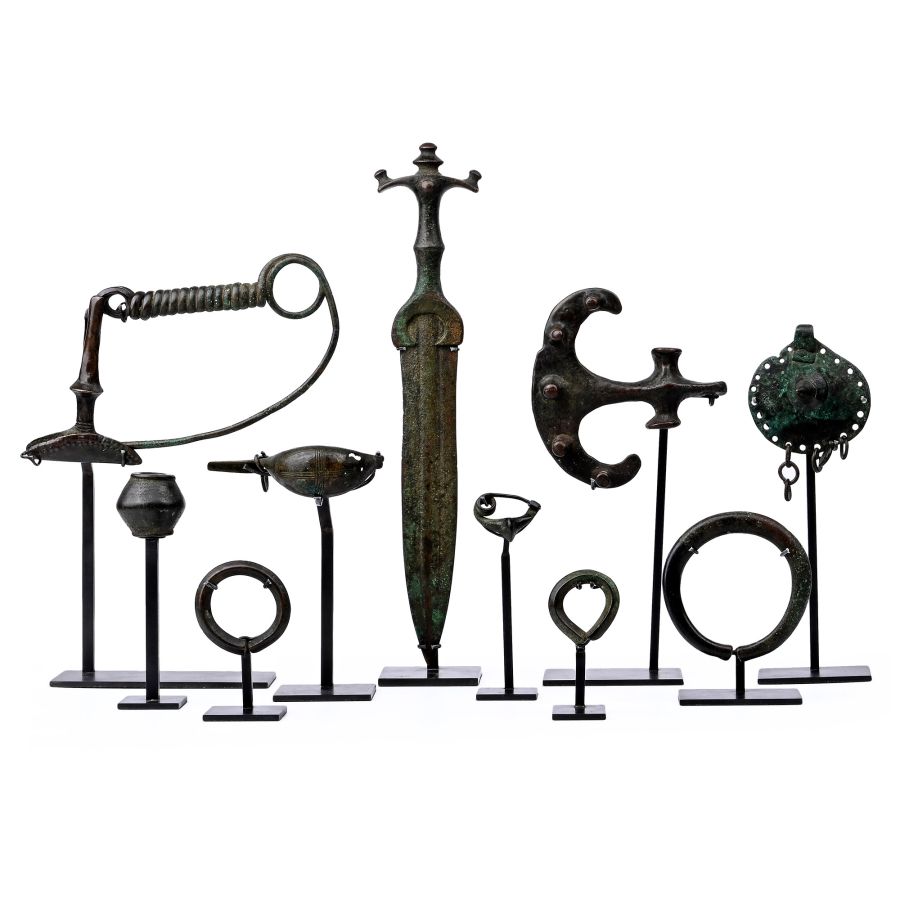
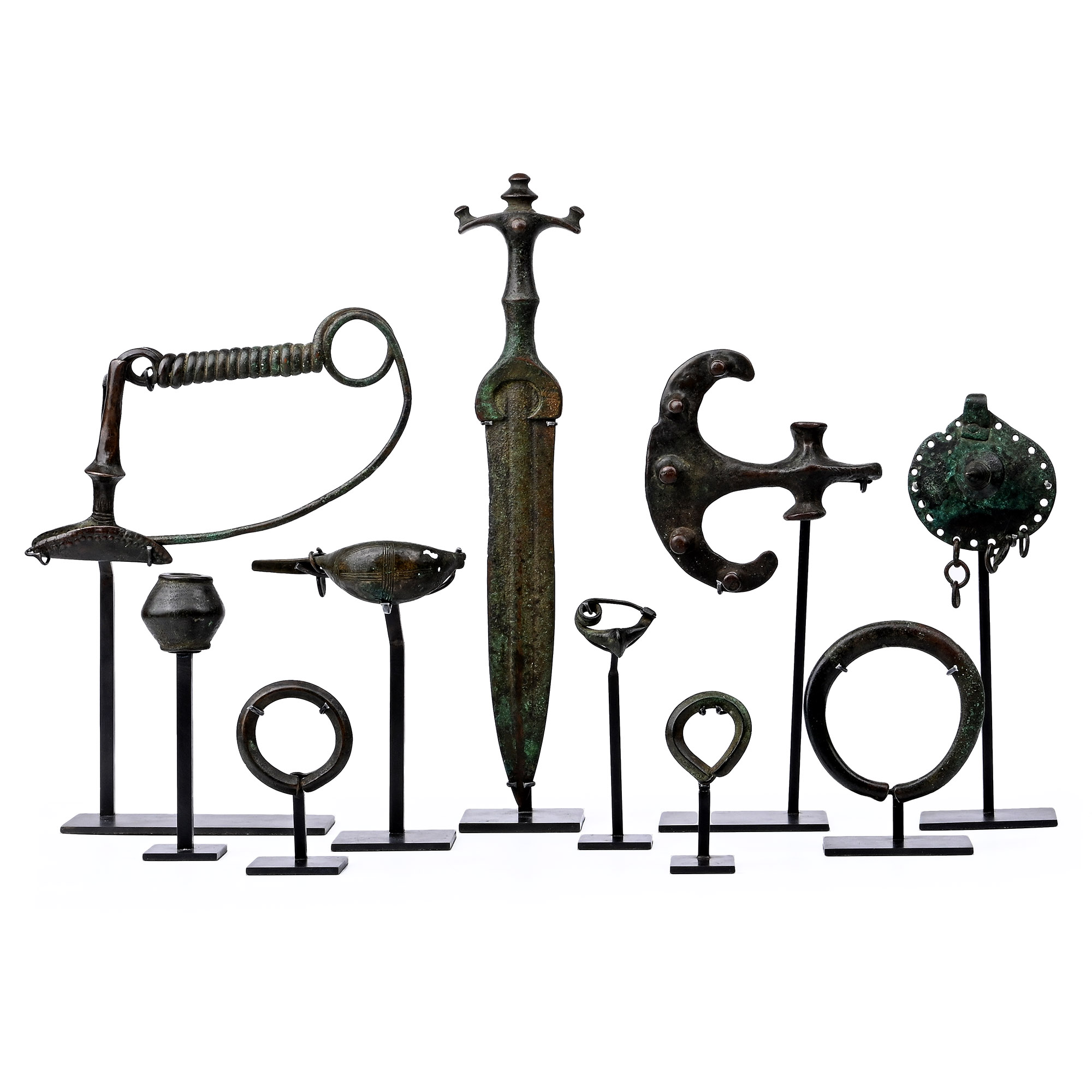
Corsican Bronze Age Hoard from the Ajaccio Area, Discovered c. 1880–1890
LATE BRONZE AGE, CIRCA 900 B.C.
2 7/8 - 11 3/8 in. (2 kg total, 7.4-29 cm including stands).
Including: a) a dagger or short sword in bronze, with grooves on the blade and semicircular guard, oval pommel with a large, two-tiered button in the centre, two smaller buttons at the ends, and two other buttons on the sides; b) the pommel of a second dagger; c) a small axe in crescent shape ornamented by bosses; d) a harness element shaped like a bronze disc fitted with a spike; e) a large violin bow fibula; f) a small boat fibula, decorated on the surface with lines forming a cross; g) a small arched fibula; h) a large bronze ring, with shape and dimensions of a bracelet; i-j) two smaller rings of rhomboid shape. [10]
ProvenanceDiscovered c.1880-90 near Ajaccio, Corsica.
Private collection of Mr Ducasse.
Thence by descent to Jean Dimitri Ducasse (b.1883), Sarrebourg.
Thence by descent.
Belle Vente Meuble et Objets d’Art, Cortot et Associés, 26 November 2022, no.133.
Acquired from the above sale.
Accompanied by a copy of French cultural export passport no.237816.
Accompanied by a copy of an Art Loss Register certificate, no.S00228228.
This lot has been checked against the Interpol Database of stolen works of art and is accompanied by a search certificate number no.13241-251803.
Forrer, R., ‘Un trésor de bronzes préhistoriques decouvert en Corse’, in Bulletin de la Société préhistorique de France, 10, 1924, pp.
224-232.
Cf. for similar fibulae, Leichenault, M., ‘Les fibules de l’age du fer corse: aspects methodologiques et etat des recherches’ in Peche-Quilichini, K. (ed.), L’âge du Fer en Corse – Acquis et perspectives. Actes de la Table-Ronde de Serra-di-Scopamena, Serra-di-Scopamena, 2012, pp. 96-106, fig.6 nos.3,4.
FootnotesAccording to the examination of R. Forrer, the hoard belonged to the culture of the Shardana, who colonised Sardinia and part of Corsica at the end of the first millennium B.C. Forrer dated the hoard to 900 B.C., a period in which the culture of the Nuraghes of Sardinia was at its zenith. The hoard possibly represents a votive treasure, because the axe is without a hole for insertion in a shaft, although the dagger and the other elements could be perfectly usable in the everyday life of the ancient Sardinian people.
CONDITIONTimeLine Auctions follows a vetting process to ensure the authenticity and legality of all items, reinforcing our commitment to integrity and responsible trading. Each antiquity, antique, and coin lot undergoes thorough examination by a vetting committee of at least ten external specialists, professional trade association members, scientists, and archaeologists: Our Vetting Process
AUCTIONS:
TimeLine is a leading auction house specialising in antiquities, ancient art, collectables, natural history, coins, medals, and books. Our auctions offer museums, collectors, historians, and enthusiasts the opportunity to acquire unique and historically significant pieces.
LOT 0342
Corsican Bronze Age Hoard from the Ajaccio Area, Discovered c. 1880–1890
Sold for (Inc. bp): £97,500
-
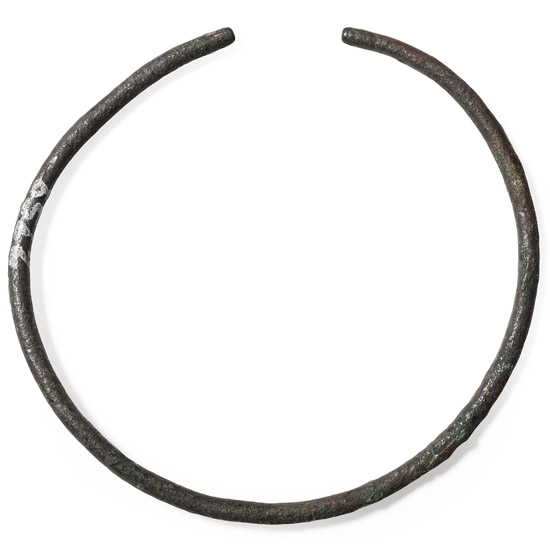
Large Bronze Age Bracelet
1st millennium B.C.Sold for (Inc. bp): £20
A round-section penannular bar with an inked collector's number '2759' to one side. 17 grams, 82 mm
From the private collection of a European gentleman (1942-2024), formed since the 1970s. -
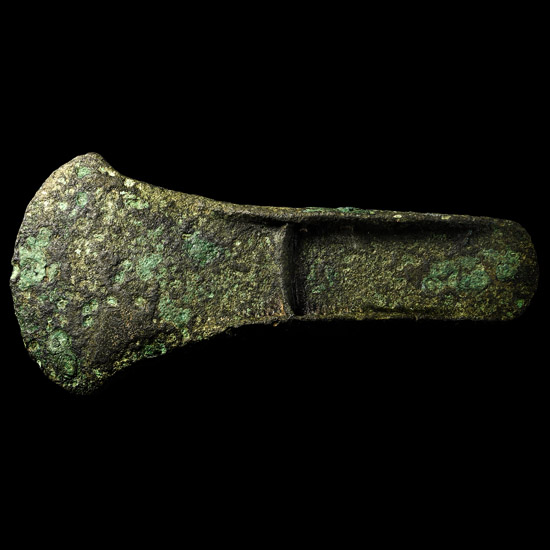
British Bronze Age 'Bannockburn Type' Palstave Axehead
Circa 1800-1200 B.C.Sold for (Inc. bp): £520
With a short square-ended butt, lateral flanges to both sides, a firm stop-ledge, broad curved edge with spur ends. 329 grams, 12.13 cm
From the private collection of the late Mr W. Magee, Hartlepool, County Durham, UK, 1960s-1990s, thence by descent. -
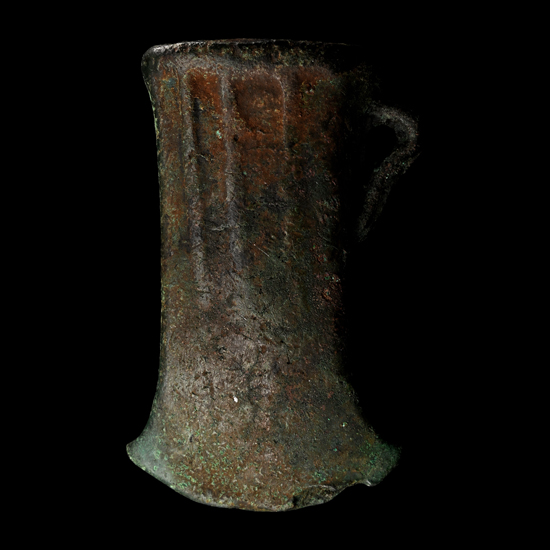
Late Bronze Age South East Variant Looped and Socketted Axehead
Southern England, 1000-800 B.C.Sold for (Inc. bp): £78
Hollow-formed and rectangular in section with rounded rim to the mouth, tapering lateral faces each with three raised ribs, flared blade with lateral spurs, narrow integral loop. 155 grams, 71 mm
Found UK. From the collection of a late West London, UK, gentleman.
