
Loading, please wait...
_900x900.jpg "Coptic Marble Liturgical Vessel Fragment with Inscription")
_200x200.jpg "Coptic Marble Liturgical Vessel Fragment with Inscription")
_900x900.jpg "Coptic Marble Liturgical Vessel Fragment with Inscription")
_200x200.jpg "Coptic Marble Liturgical Vessel Fragment with Inscription")
.jpg "Coptic Marble Liturgical Vessel Fragment with Inscription")
.jpg "Coptic Marble Liturgical Vessel Fragment with Inscription")
LOT 0029
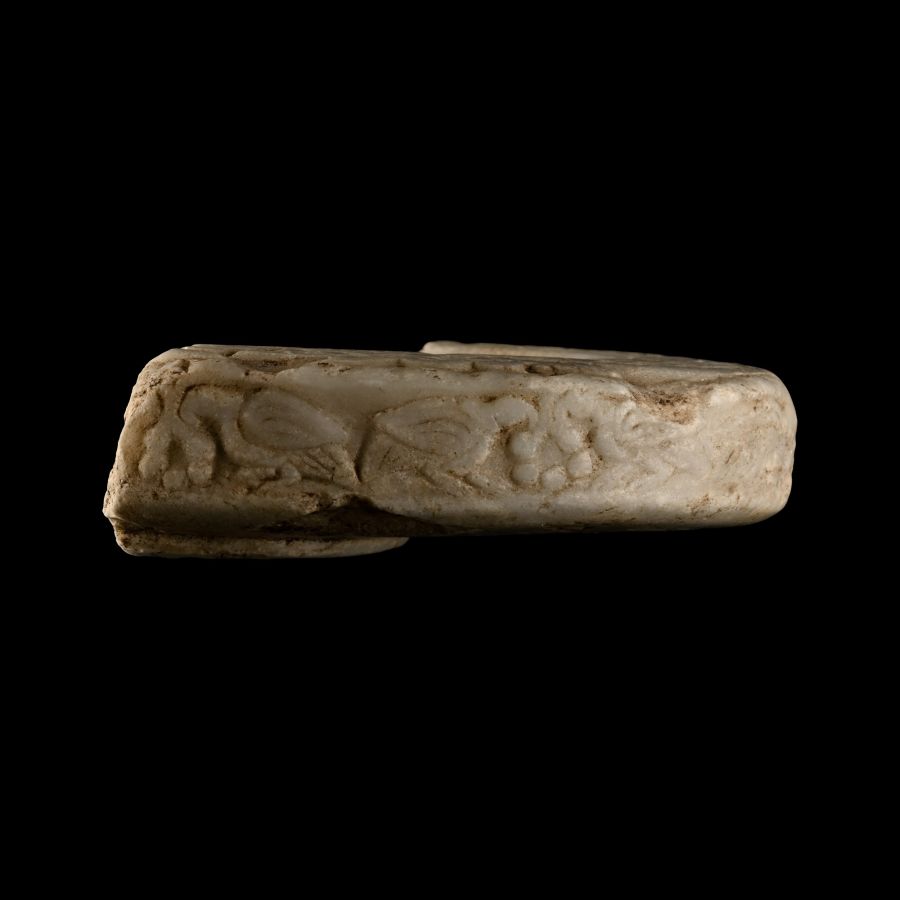
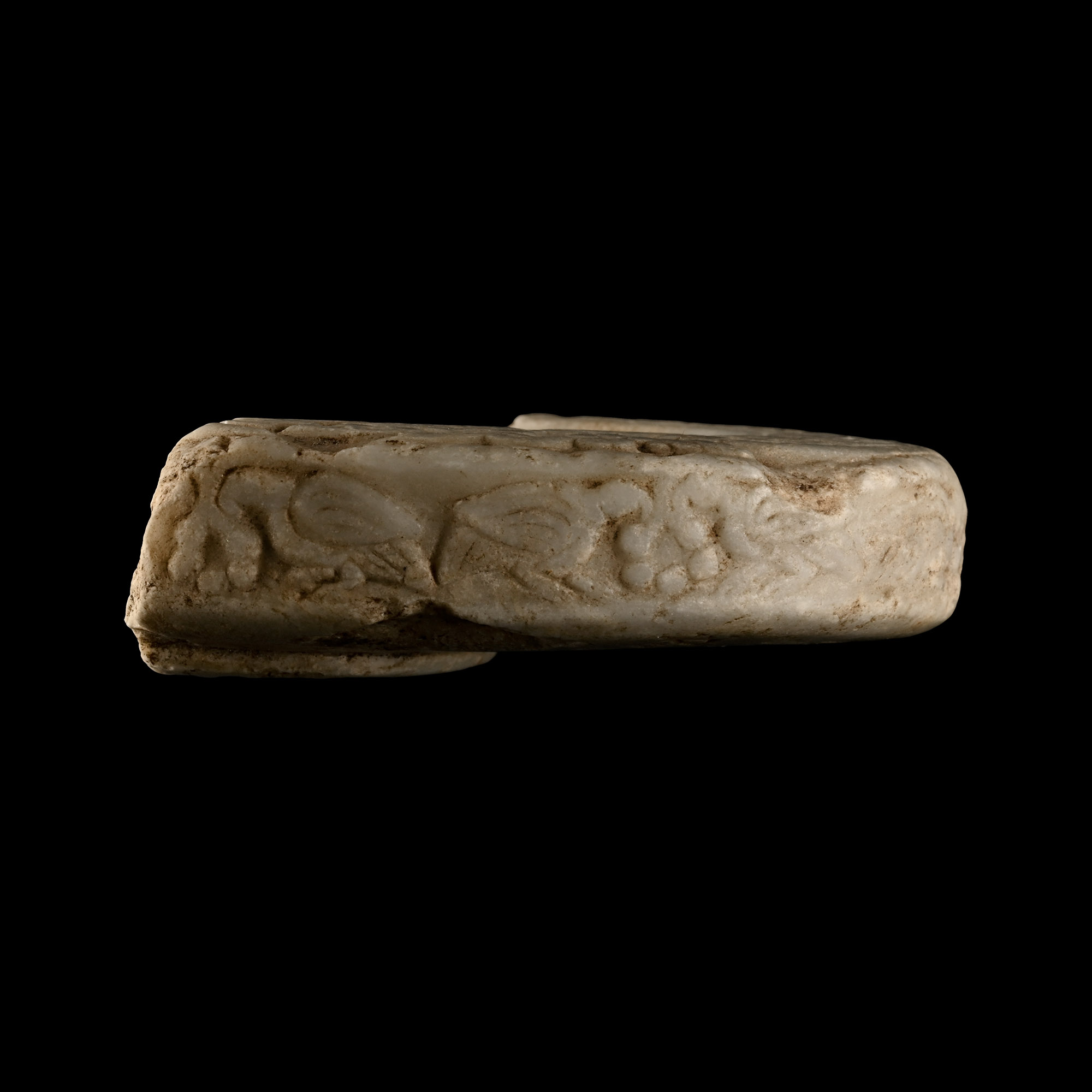
Coptic Marble Liturgical Vessel Fragment with Inscription
6TH CENTURY A.D.
2 1/8 in. (87 grams, 55 mm).
Tongue-shaped with low rounded pad on the underside, raised edge with low-relief decoration of grape vines and leaves, the edge with pairs of opposing doves eating grapes; dedicatory Demotic inscription on the underside.
ProvenanceAcquired in the mid 1980s-1990s.
Private collection, Switzerland, thence by descent.
Private collection, since the late 1990s.
Accompanied by an academic report by Dr Raffaele D'Amato.
This lot has been checked against the Interpol Database of stolen works of art and is accompanied by a search certificate number no.12575-232108.
See Atalla, N.S., Coptic Art, Sculptures, Architecture, L'Art Copte, II, Cairo, 1989, figs. pp.109ff., for similar carved interlaces; Rutschowscaya, M.H., Benazeth, D., L’Art Copte en Égypte, 2000 ans de Christianisme, Paris, 2000, figs.109-118; Poupaki, E., ‘Early Byzantine Marble Vases from Kos Island, Dodecanese, Greece’ in Diamanti, C., Vassiliou A. (eds.), Eν Σοφίᾳ μαθητεύσαντες, Essays in Byzantine Material Culture and Society in Honour of Sophia Kalopissi-Verti, Oxford, 2019, figs.2-3, for a possible parallel.
FootnotesThese vessels were used as liturgical objects for church offerings or ritual, and were extensively employed from late antiquity in ecclesiastical contexts.
CONDITIONTimeLine Auctions follows a vetting process to ensure the authenticity and legality of all items, reinforcing our commitment to integrity and responsible trading. Each antiquity, antique, and coin lot undergoes thorough examination by a vetting committee of at least ten external specialists, professional trade association members, scientists, and archaeologists: Our Vetting Process
AUCTIONS:
TimeLine is a leading auction house specialising in antiquities, ancient art, collectables, natural history, coins, medals, and books. Our auctions offer museums, collectors, historians, and enthusiasts the opportunity to acquire unique and historically significant pieces.
LOT 0029
Coptic Marble Liturgical Vessel Fragment with Inscription
Sold for (Inc. bp): £1,053
-
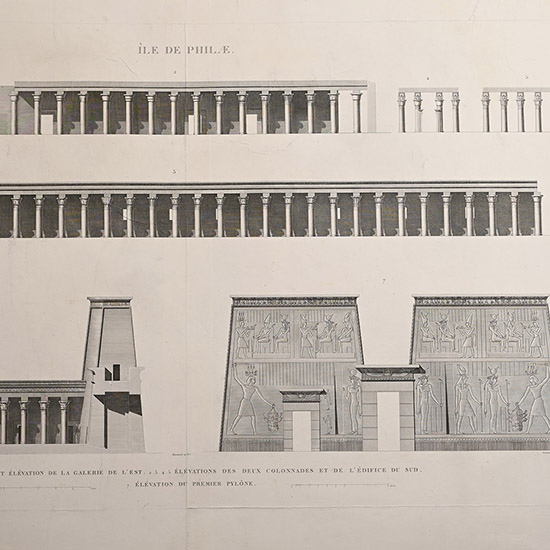
Very Large Egyptian Expedition Lithograph of the Temple of Philae
Early 19th century A.D.Sold for (Inc. bp): £94
Proof etching on laid paper of plate 6 from Description de l'egypte entitled Île de Philae. Coupe et élévation de la galerie de l'est. Élévations des deux colonnades et de l'édifice du sud. Élévation du premier pylône. 252 grams, 104 x 68.5 cm
From the collection of a North American priest. Acquired between 1981-1996. Property of a North American collector.
Produced between February 1802 and 1830 on the orders of Napoleon Bonaparte; published between 1809 and 1828. Just 1,000 copies were distributed to various institutions, printed on laid paper with an 'Égypte ancienne et moderne' watermark. The book is subtitled Recueil des observations et des recherches qui ont été faites en Égypte pendant l’expédition de l’Armée française, publié par les ordres de Sa Majesté l’Empereur Napoléon le Grand (Gathering of observations and discoveries which were made in Egypt during the expedition of the French army, published on the orders of His Majesty the Emperor Napoleon the Great). It was the world's first encyclopedia devoted exclusively to the remains of ancient Egypt. The plates of this book are the first to present the archaeological sites of Thebes (Luxor). The Philae temple complex was one of the major monuments dismantled from its original location and relocated to a new site during the Aswan High Dam project. Most of the complex dates to the Ptolemaic Period, although some earlier and later elements remain. -
.jpg)
Egyptian Predynastic Stone Frog
4th millennium B.C.Sold for (Inc. bp): £1,300
Pyramidal in form with shallow-carved hip and facial detailing. 537 grams, 81 mm
with Artemis Gallery, Munich, Germany, 2001. Private collection, Europe. This lot has been checked against the Interpol Database of stolen works of art and is accompanied by a search certificate number no.12580-232124.
The frog had a great role in ancient Egyptian mythology and was connected with the mythology of creation. A number of gods and goddesses were connected with the frog such as Heqet, Ptah, and Heh. The connection with the god Ptah as a god of creation was probably due to the idea that Ptah was the only god who created the world in ancient Egypt through his heart and his tongue. Every work of the god came about through what his heart devised and his tongue commanded. Frogs were often associated with Hekat, deity of birth and fecundity. Amulets of frogs were frequent votive gifts at such Predynastic and Archaic sites at Abydos, Naqada, and Saqqara. -
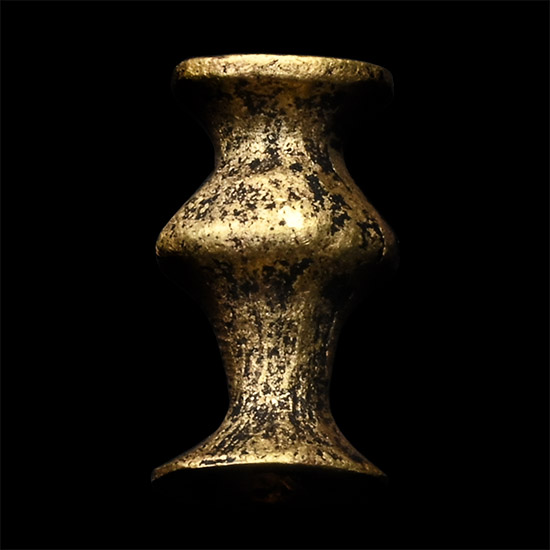
Egyptian Gold Bead Amulet
Late New Kingdom-Third Intermediate Period, circa 1069-900 B.C.Sold for (Inc. bp): £169
Formed as a poppy seed with flaring terminals. 0.91 grams, 9 mm
Ex French art market, 1920s.
