
Loading, please wait...
_900x900.jpg "Coptic Marble Liturgical Vessel Fragment with Inscription")
_200x200.jpg "Coptic Marble Liturgical Vessel Fragment with Inscription")
_900x900.jpg "Coptic Marble Liturgical Vessel Fragment with Inscription")
_200x200.jpg "Coptic Marble Liturgical Vessel Fragment with Inscription")
.jpg "Coptic Marble Liturgical Vessel Fragment with Inscription")
.jpg "Coptic Marble Liturgical Vessel Fragment with Inscription")
LOT 0459
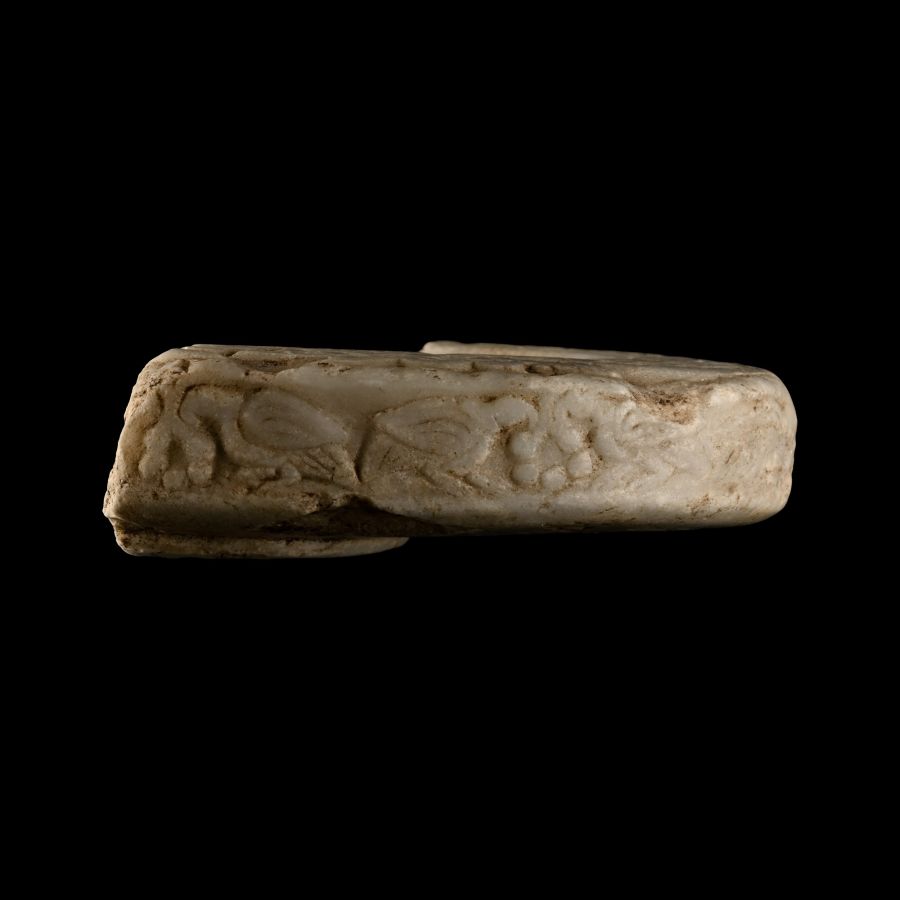
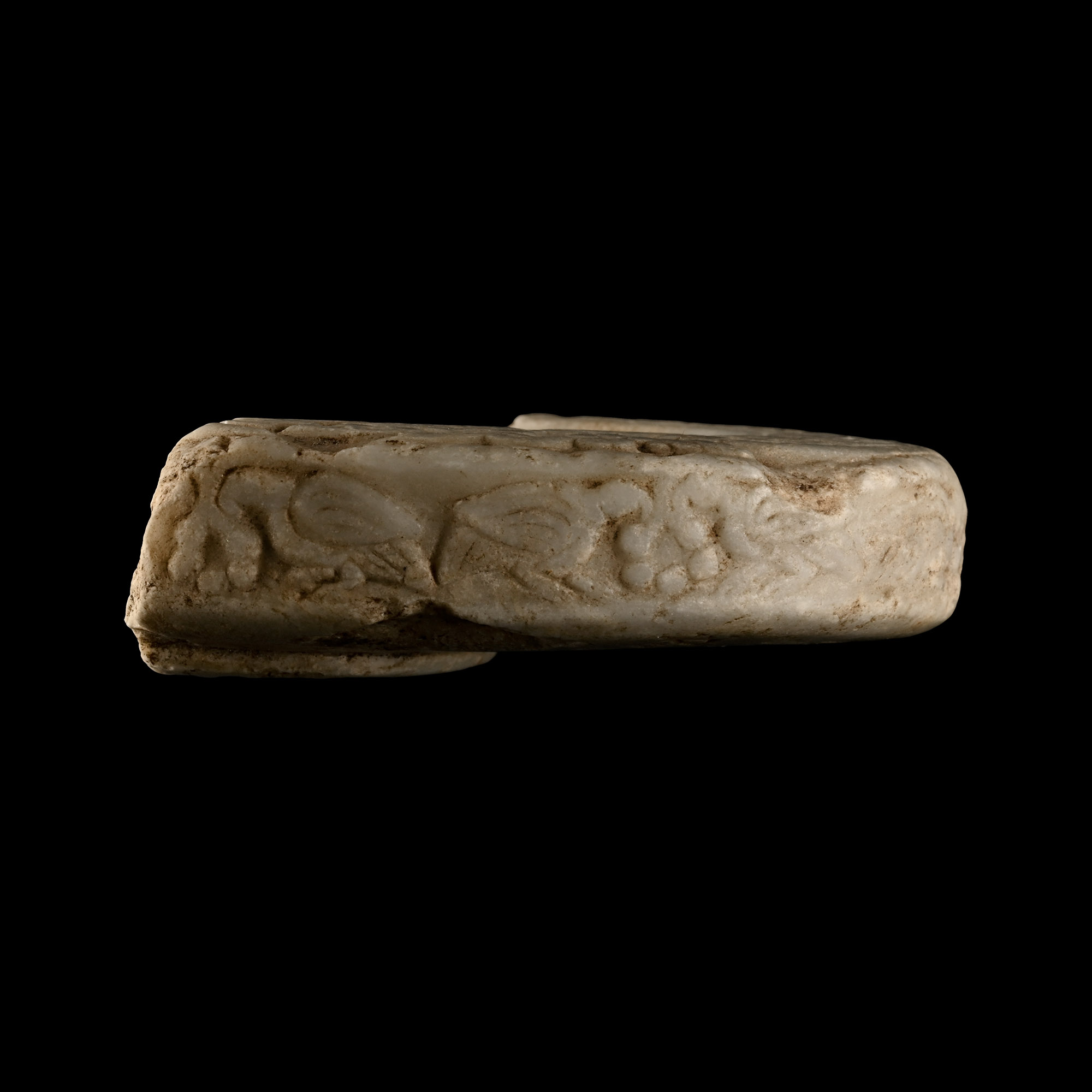
Coptic Marble Liturgical Vessel Fragment with Inscription
6TH CENTURY A.D.
2 1/8 in. (87 grams, 55 mm).
Tongue-shaped with low rounded pad on the underside, raised edge with low-relief decoration of grape vines and leaves, the edge with pairs of opposing doves eating grapes; dedicatory Demotic inscription on the underside.
ProvenanceAcquired in the mid 1980s-1990s.
Private collection, Switzerland, thence by descent.
Private collection, since the late 1990s.
Accompanied by an academic report by Dr Raffaele D'Amato.
This lot has been checked against the Interpol Database of stolen works of art and is accompanied by a search certificate number no.12575-232108.
See Atalla, N.S., Coptic Art, Sculptures, Architecture, L'Art Copte, II, Cairo, 1989, figs. pp.109ff., for similar carved interlaces; Rutschowscaya, M.H., Benazeth, D., L’Art Copte en Égypte, 2000 ans de Christianisme, Paris, 2000, figs.109-118; Poupaki, E., ‘Early Byzantine Marble Vases from Kos Island, Dodecanese, Greece’ in Diamanti, C., Vassiliou A. (eds.), Eν Σοφίᾳ μαθητεύσαντες, Essays in Byzantine Material Culture and Society in Honour of Sophia Kalopissi-Verti, Oxford, 2019, figs.2-3, for a possible parallel.
FootnotesThese vessels were used as liturgical objects for church offerings or ritual, and were extensively employed from late antiquity in ecclesiastical contexts.
CONDITIONTimeLine Auctions follows a vetting process to ensure the authenticity and legality of all items, reinforcing our commitment to integrity and responsible trading. Each antiquity, antique, and coin lot undergoes thorough examination by a vetting committee of at least ten external specialists, professional trade association members, scientists, and archaeologists: Our Vetting Process
AUCTIONS:
TimeLine is a leading auction house specialising in antiquities, ancient art, collectables, natural history, coins, medals, and books. Our auctions offer museums, collectors, historians, and enthusiasts the opportunity to acquire unique and historically significant pieces.
LOT 0459
Coptic Marble Liturgical Vessel Fragment with Inscription
Estimate £1,500 - 2,000€1,740 - 2,320 (for guidance only)$2,030 - 2,700 (for guidance only)
-
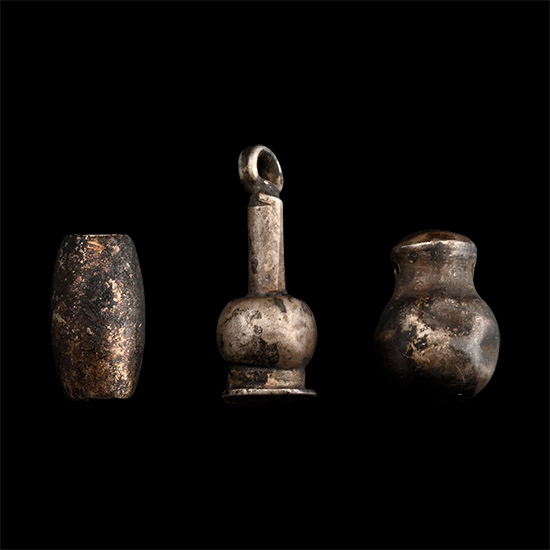
Egyptian Silver Poppy Amulet and Beads
Late Period, 664-332 B.C.Sold for (Inc. bp): £98
Comprising: a fusiform bead, a poppy-head amulet and a jar amulet. 2.80 grams total, 11-16 mm
From the collection of a London, UK, gentleman, 1990s. -
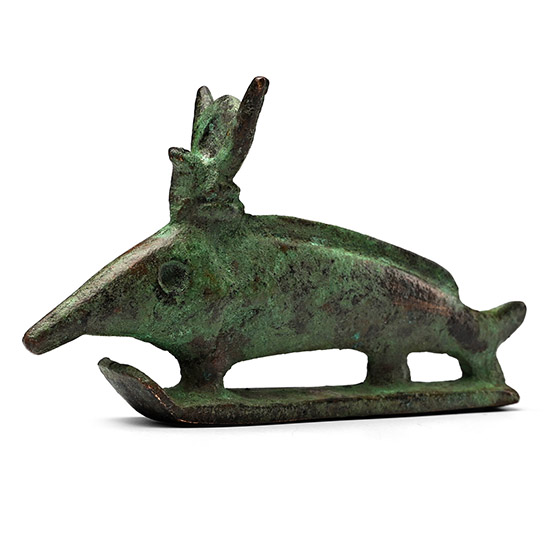
Egyptian Bronze Oxyrhynchus Fish
Late Period, 664-332 B.C. or laterSold for (Inc. bp): £1,235
Modelled in the round on a sledge attached by ventral and pectoral fins; with forked tail, a dorsal ridge, and a tapering nose, featuring recessed circular eyes to accept an insert, a horned sun disc headdress fronted by a uraeus, and a suspension loop behind. 203 grams, 11.5 cm
From the collection of a gentleman, acquired on the London art market in the 1990s. -
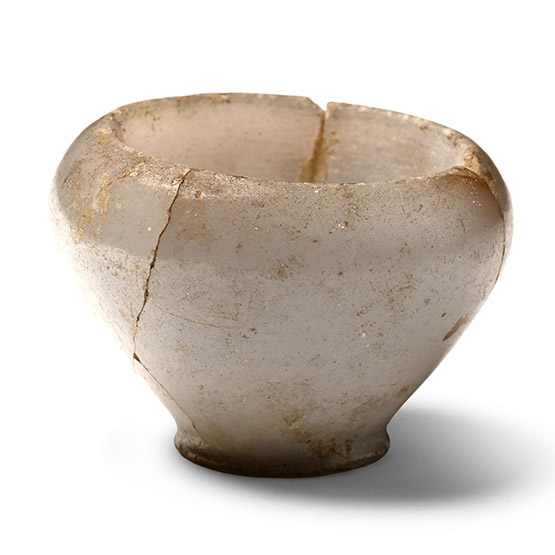
Egyptian Anhydrite Cosmetic Bowl
Middle Kingdom, circa 2040-1780 B.C.Sold for (Inc. bp): £156
Conical in profile with rounded rim, narrow disc base; repaired; a rare stone. 33.68 grams, 39 mm
Ex William Ohly, 1883-1955. Ex Abbey Museum, Barnet, by descent.
Anhydrite, incorrectly called "blue marble" by early excavators, was a stone favoured by the ancient Egyptians from the Middle Kingdom to the Second Intermediate Period. This particular example follows a Middle Kingdom-style cosmetic kohl jar that could be modelled with or without an integral rim.
