
Loading, please wait...
LOT 0463
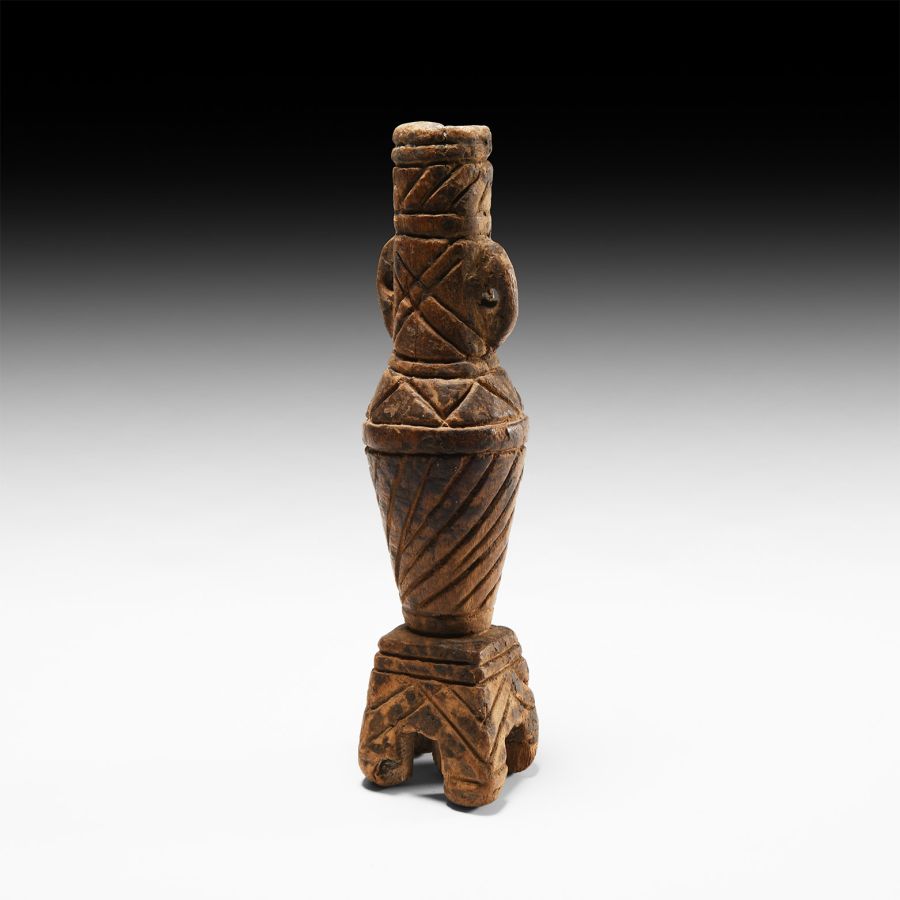
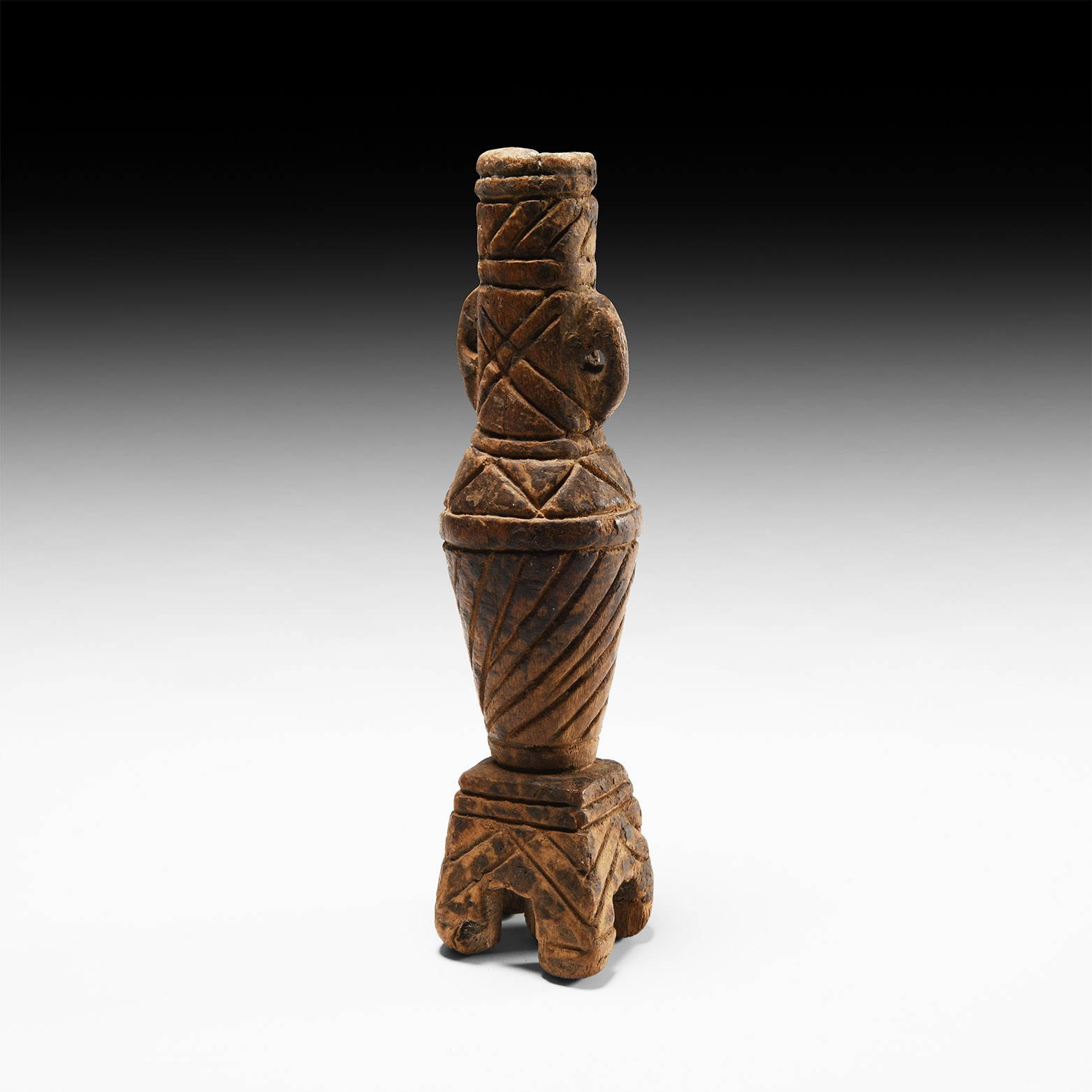
Coptic Kohl Container
6TH-7TH CENTURY A.D.
7 5/8 in. (129 grams, 19.5 cm).
A heavily carved wooden kohl vessel, tubular with pierced lateral flanges and rectangular base with a stub foot to each corner; with old collector's label reading 'Coptic kohol container VI-VIII C. OFRA10P / Q Louvre Cat. des Bois de l'Egypte Copte, Paris 1986 no.39-41'.
ProvenanceAcquired in the late 1980s-early 1990s.
Important North West London collection.
Cf. Gabra, G., Coptic Civilization: Two thousand years of Christianity in Egypt, Cairo, 2014, p.219 fig. 17.3, for a similar heavily carved wooden kohl tube with splayed foot.
CONDITIONTimeLine Auctions follows a vetting process to ensure the authenticity and legality of all items, reinforcing our commitment to integrity and responsible trading. Each antiquity, antique, and coin lot undergoes thorough examination by a vetting committee of at least ten external specialists, professional trade association members, scientists, and archaeologists: Our Vetting Process
AUCTIONS:
TimeLine is a leading auction house specialising in antiquities, ancient art, collectables, natural history, coins, medals, and books. Our auctions offer museums, collectors, historians, and enthusiasts the opportunity to acquire unique and historically significant pieces.
LOT 0463
Coptic Kohl Container
Estimate £1,200 - 1,700€1,390 - 1,970 (for guidance only)$1,620 - 2,300 (for guidance only)
-
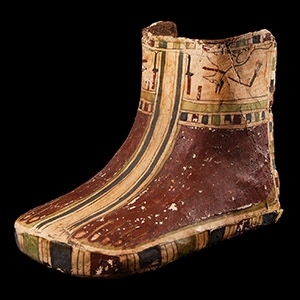
Egyptian Cartonnage Foot Covering with Anubis
Ptolemaic Period-Roman Period, 305 B.C.-323 A.D.Sold for (Inc. bp): £826
A polychrome painted cartonnage foot-case from a cartonnage mummy with two stylised bare feet to the upper face, each with a ankle panel with the god Anubis in jackal form with a flail over the shoulder, framed by geometric borders which continue around the perimeter of the foot cover; soles of polychrome chequered sandals to base. 295 grams, 25 cm wide
Fine condition.
Ex UK art market, 1970s. Property of a London gentleman. Accompanied by an academic report by Egyptologist Paul Whelan.
Foot-cases like this were part of group of cartonnage adornments for a mummy, which usually comprised a mask, broad collar, stomach cover, leg section, and foot-case. For a complete set found on a mummy from Abydos see Scott III, G.D., Ancient Egyptian Art at Yale, Yale, 1986, pp.160-161. -
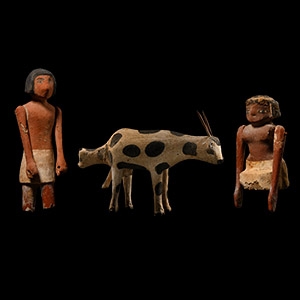
Egyptian Animal Birthing Diorama
Middle Kingdom, 11th-12th Dynasty, 2023-1862 B.C.Estimate: £5,000 - 7,000 (+bp*)
Opening Bid: £2,500
A wooden animal birthing scene composed of three figures: a standing cow or other quadruped giving birth to its young, its head, neck and forelegs emerging from the mother's rear, both with a black and white speckled coat; a standing male figure with articulated arms and pierced hands, wearing a kilt and cropped wig and with stylised facial detailing; a kneeling figure also with articulated arms, open-palm hands, wearing a kilt and cropped wig, stylised facial features; extensive remains of polychrome pigment. 111 grams total, 9.5-16 cm
From an early 20th century Home Counties collection. This lot has been checked against the Interpol Database of stolen works of art and is accompanied by search certificate no.11597-199209.
Such models would have been deposited in tombs; the purpose of such a scene was probably to evoke the season of spring, when calves were born, and the floodplain where farmers lived and raised their livestock. -
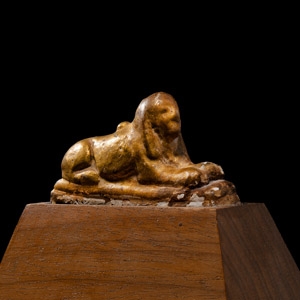
Egyptian Gilt Stucco Sphinx
Ptolemaic-Roman Period, 334 B.C.-332 A.D.Sold for (Inc. bp): £191
A gilt stucco sphinx from a funerary catafalque, lying couchant on a sub-rectangular base with stylised anatomical and facial detailing; accompanied by a custom-made wooden display base. 36 grams, 75 mm long (155 grams total, 10.8 cm including base)
Fine condition.
From a mid 20th century collection (based on the stand). With Richard Gill, Eternal Egypt, London SW19, 1990s. Acquired 31 August 1993. Property of a South Oxfordshire private collector. Accompanied by original invoice no.10575, dated 31 August 1993, and associated correspondence.
