
Loading, please wait...


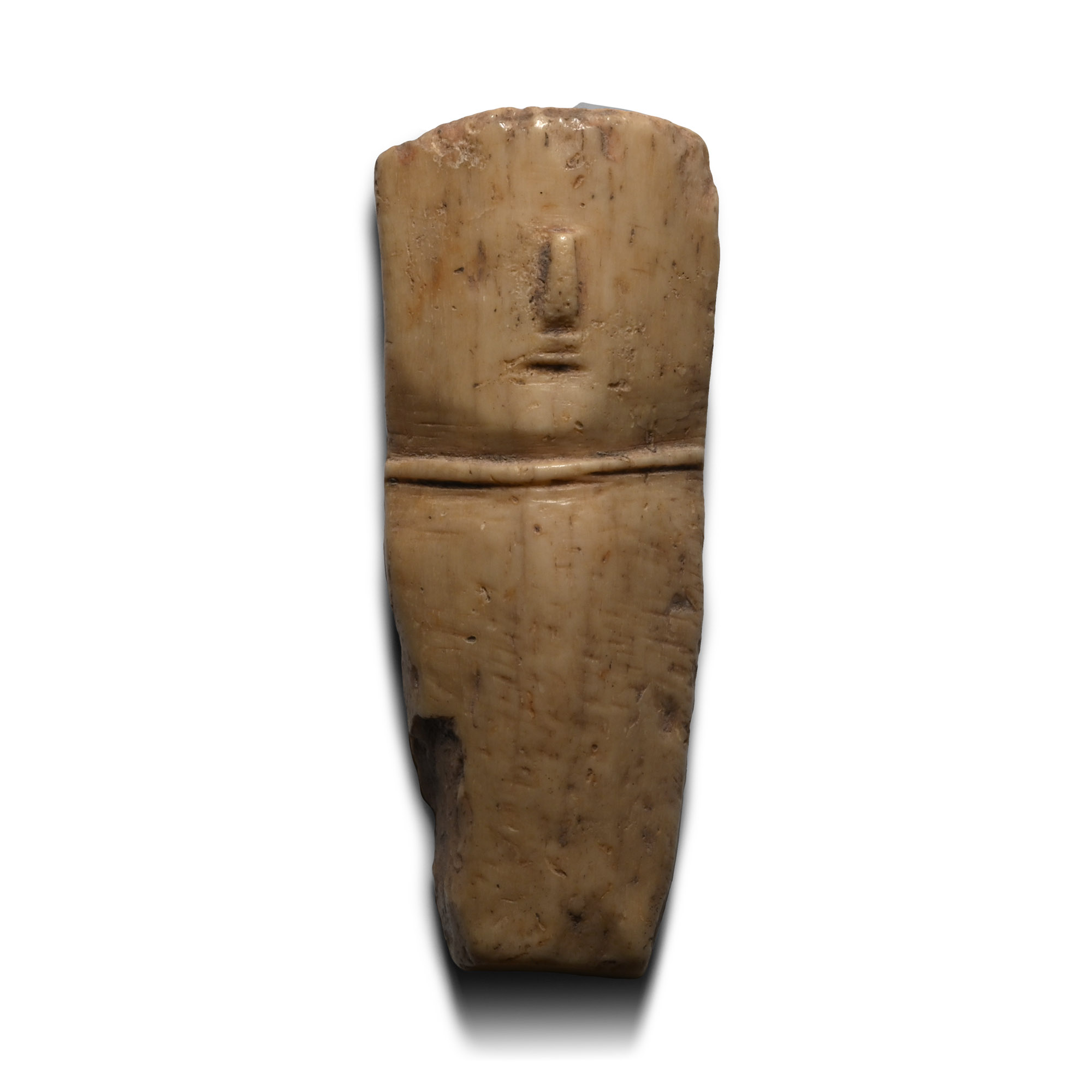
LOT 0501
Coptic Bone Doll
5TH-6TH CENTURY A.D.
2 3/8 in. (14.3 grams, 60 mm).
With a curved body and emphasised head, carved with a small slit mouth and a raised rectangular nose.
ProvenanceDr Amnon Rosen, Jerusalem.
Private collection, Europe.
TimeLine Auctions follows a vetting process to ensure the authenticity and legality of all items, reinforcing our commitment to integrity and responsible trading. Each antiquity, antique, and coin lot undergoes thorough examination by a vetting committee of at least ten external specialists, professional trade association members, scientists, and archaeologists: Our Vetting Process
AUCTIONS:
TimeLine is a leading auction house specialising in antiquities, ancient art, collectables, natural history, coins, medals, and books. Our auctions offer museums, collectors, historians, and enthusiasts the opportunity to acquire unique and historically significant pieces.
-
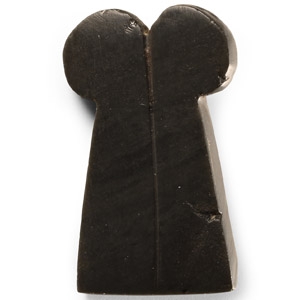
Egyptian Hardstone Double Plume Amulet
Late Period, 664-332 B.C.Estimate: £200 - 300 (+bp*)
Opening Bid: £100
Carved with integral ribbed loop to the reverse; unfinished. 4.4 grams, 31 mm
with Hotel des Ventes, Drouot, Paris, France. From the collection of Mr H. Naudy, Paris, France. Acquired at between 2004-2010. Property of a French collector.
This ancient amulet represents two ostrich feathers or shuty. Interestingly, these feathers were also present on the Atef crown of Osiris, the god of the afterlife and the dead. This suggests the amulet was believed to imbue the wearer with Osiris's divine power and protection. -
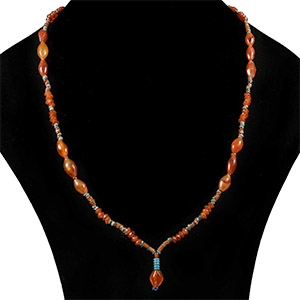
Egyptian Hardstone and Faience Necklace
Late Period, 664-332 B.C.Estimate: £450 - 650 (+bp*)
Opening Bid: £250
Comprising groups of three oval carnelian beads with interstitial biconvex and annular beads, a turquoise faience ribbed tubular bead and an irregular polyhedral carnelian centrepiece. 35 grams, 70 cm
From the private collection of the late Mrs Belinda Ellison, long time member of the Egyptian Exploration Society, c.1940-2020. -
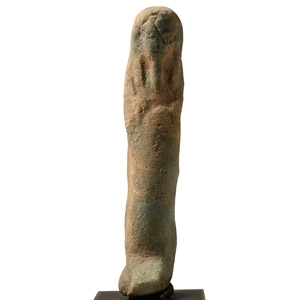
Egyptian Faience Blue Glazed Shabti
Ptolemaic Period, 323-30 B.C.Sold for (Inc. bp): £72
A typical mummiform figure with moulded facial detailing, a lappet wig, and hands holding a pick and hoe, the back with a possible hieratic inscription, mounted on a custom-made stand with label 'Ancient Egypt / (26th Dyn - Ptolem.) / circa 664-332 BC / Turquoise Faience / Ushabti Figure'. 91 grams total, 13 cm high including stand
Ex old UK collection. Acquired from Cestrian Antiques, Chester, UK, 2002. Ex Pemberton collection, Wales, UK. Accompanied by old information labels with collection reference C.234. Accompanied by the original Cestrian Antiques invoice.
