
Loading, please wait...
LOT 0422
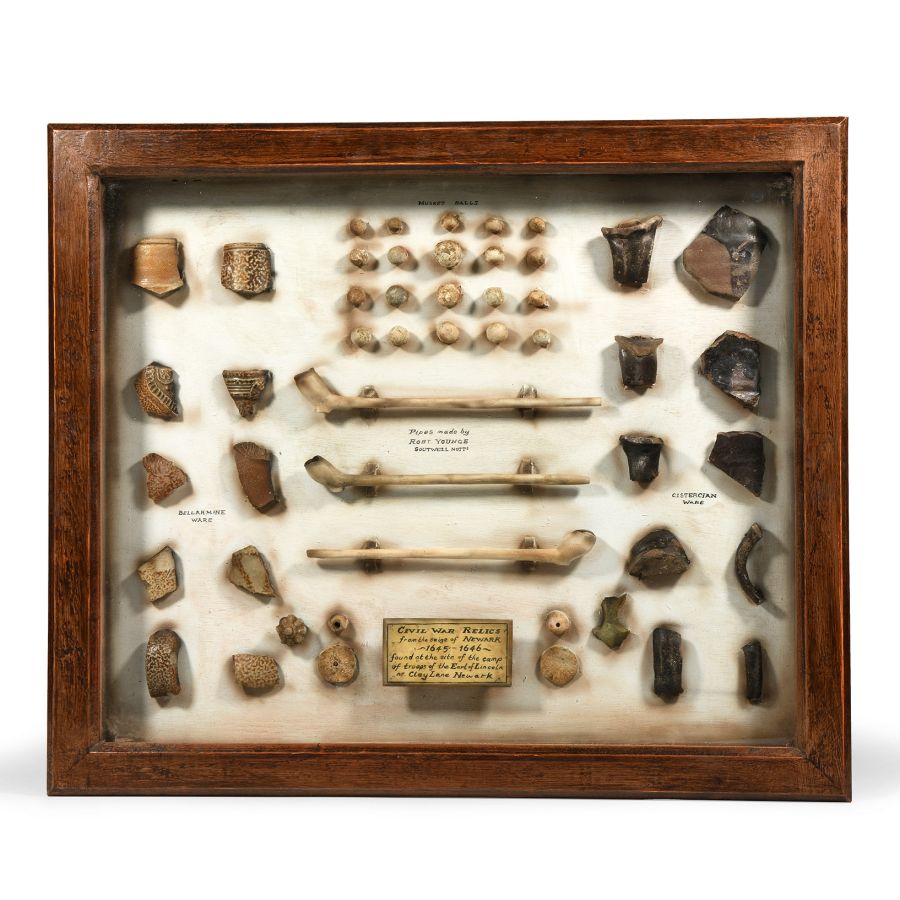
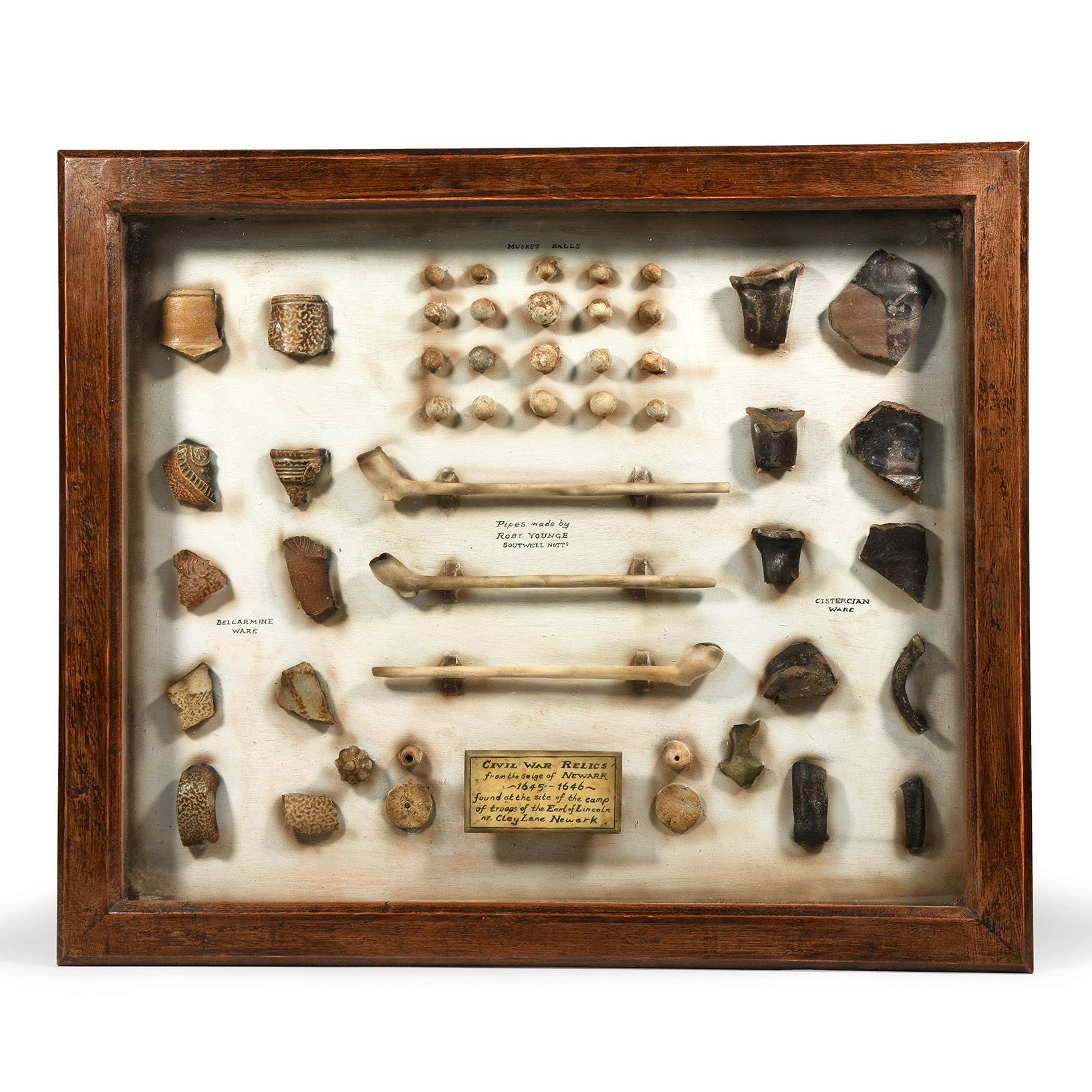
Civil War Relics From the Siege of Newark
CIRCA 1645-1646 A.D.
23 5/8 in. (5.7 kg, 60 cm).
In a glazed wooden case with various artefacts including musket balls, ceramic fragments, and three complete clay pipes by Robert Younge of Soutwell, Nottingham; at the bottom a raised plaque inscribed: 'CIVIL WAR RELICS / from the siege of NEWARK / 1645 - 1646 / found at the site of the camp / of troops of the Earl of Lincoln / nr. Clay Lane Newark'. [No Reserve]
ProvenanceFrom a 19th century collection based on the inscribed plaque and frame.
From an old collection of antiquities collected by the Gilstrap family, wine merchants in Newark, Nottinghamshire, UK.
The Third Siege of Newark was the longest and lasted 26th November 1645 - 8th May 1646. King Charles I's army had been destroyed at the Battle of Naseby and many of his important cities and fortresses had been lost. Newark was one of the last Royalist towns capable of resisting a Roundhead army. Newark was besieged by 17,000 soldiers made up of Roundheads from the surrounding East Midlands and London, plus the Scottish Presbyterians called Covenanters. The siege lasted six months and the people of Newark suffered hunger, an extremely cold winter and and outbreaks of disease. On the 6th May 1646, King Charles I surrendered to the Scots in the nearby town of Southwell. Two days later Newark surrendered.
CONDITIONTimeLine Auctions follows a vetting process to ensure the authenticity and legality of all items, reinforcing our commitment to integrity and responsible trading. Each antiquity, antique, and coin lot undergoes thorough examination by a vetting committee of at least ten external specialists, professional trade association members, scientists, and archaeologists: Our Vetting Process
AUCTIONS:
TimeLine is a leading auction house specialising in antiquities, ancient art, collectables, natural history, coins, medals, and books. Our auctions offer museums, collectors, historians, and enthusiasts the opportunity to acquire unique and historically significant pieces.
-
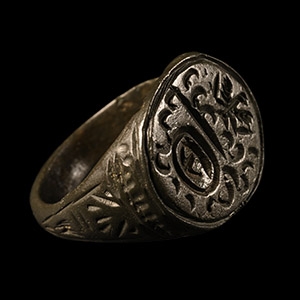
Tudor Period Bronze Signet Ring with Spread Eagle Over Device
Circa 16th century A.D.Sold for (Inc. bp): £182
With a D-section hoop expanding at the shoulders, inside linear decoration to each shoulder; oval bezel with a spread eagle over a device on textured field. 6.78 grams, 21.93 mm overall, 18.66 mm internal diameter (approximate size British Q 1/2, USA 8 1/4, Europe 18.12, Japan 17)
Private collection formed since the 1940s. UK art market. Property of an Essex gentleman. -
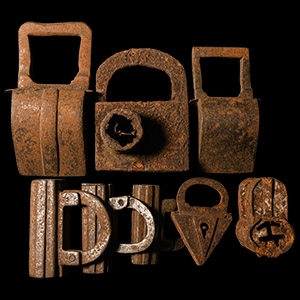
Tudor Period and Later Iron Padlock Collection
Circa 16th-17th century A.D.Sold for (Inc. bp): £98
Comprising a variety of types of padlocks, most retaining their arm and ceased in the locked position. 390 grams total, 45-80 mm
Acquired 1990s-early 2000s. East Anglian private collection. -
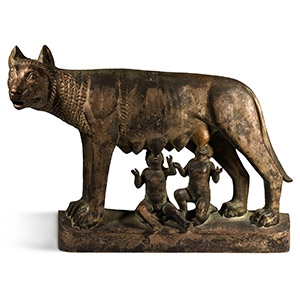
Large Bronze Roman Romulus and Remus Plaque
Late 19th-early 20th century A.D.Estimate: £1,500 - 2,000 (+bp*)
Opening Bid: £750
Modelled in the half-round and hollow to the reverse; the lupa she-wolf standing with head turned, infant twins suckling beneath on a chamfered base. 14.9 kg, 72 cm wide
Ex Weser auction, Germany. Ex French gallery, Paris.
The plaque is modelled on the famous Lupa Capitolina "the Capitoline Wolf", believed to be an Etruscan-inspired bronze of the 5th century B.C. with modifications in the 15th century AD by Antonio del Pollaiuolo. The twin boys are Romulus and Remus, abandoned by their mother and kept alive by the wolf. They went on to be founders of Rome; Romulus killed Remus in a dispute over the most appropriate hill (Palatine or Aventine) on which to base the city's layout.
