
Loading, please wait...
LOT 0380
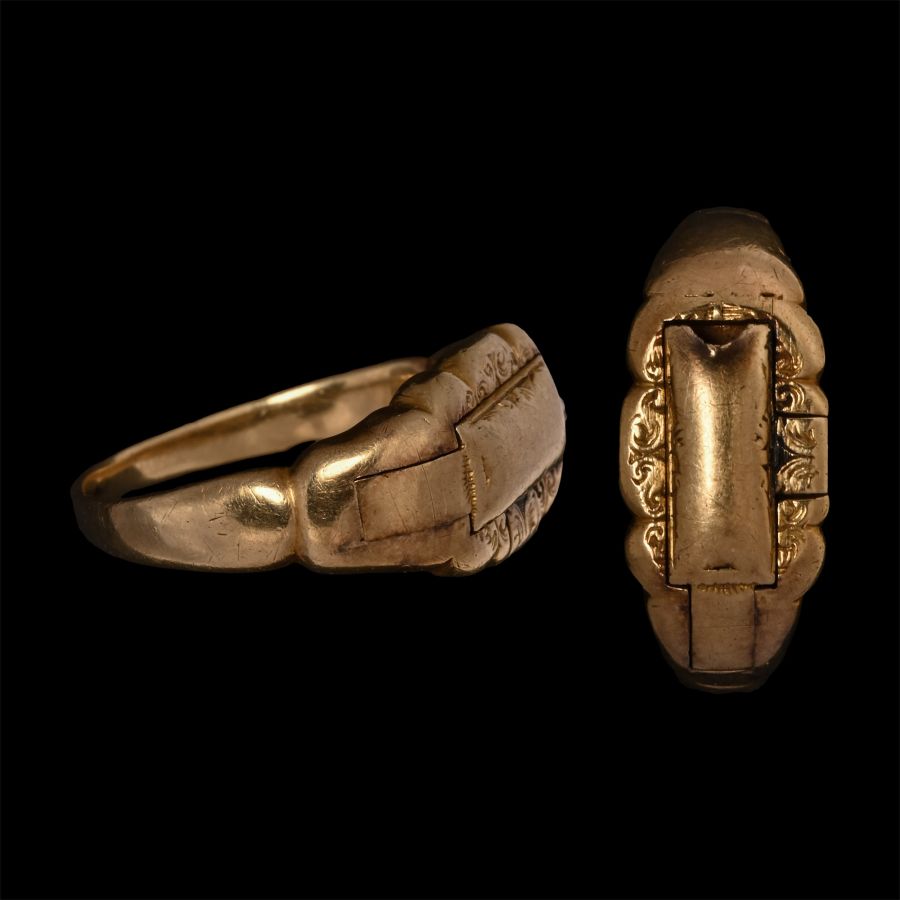
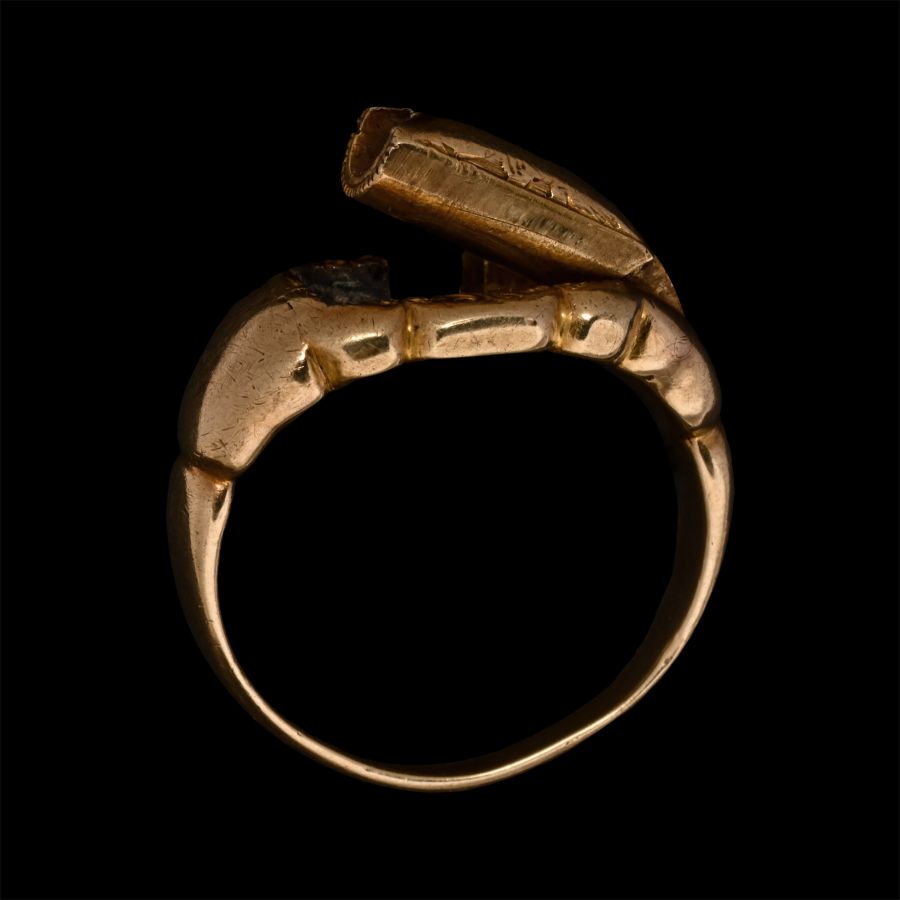
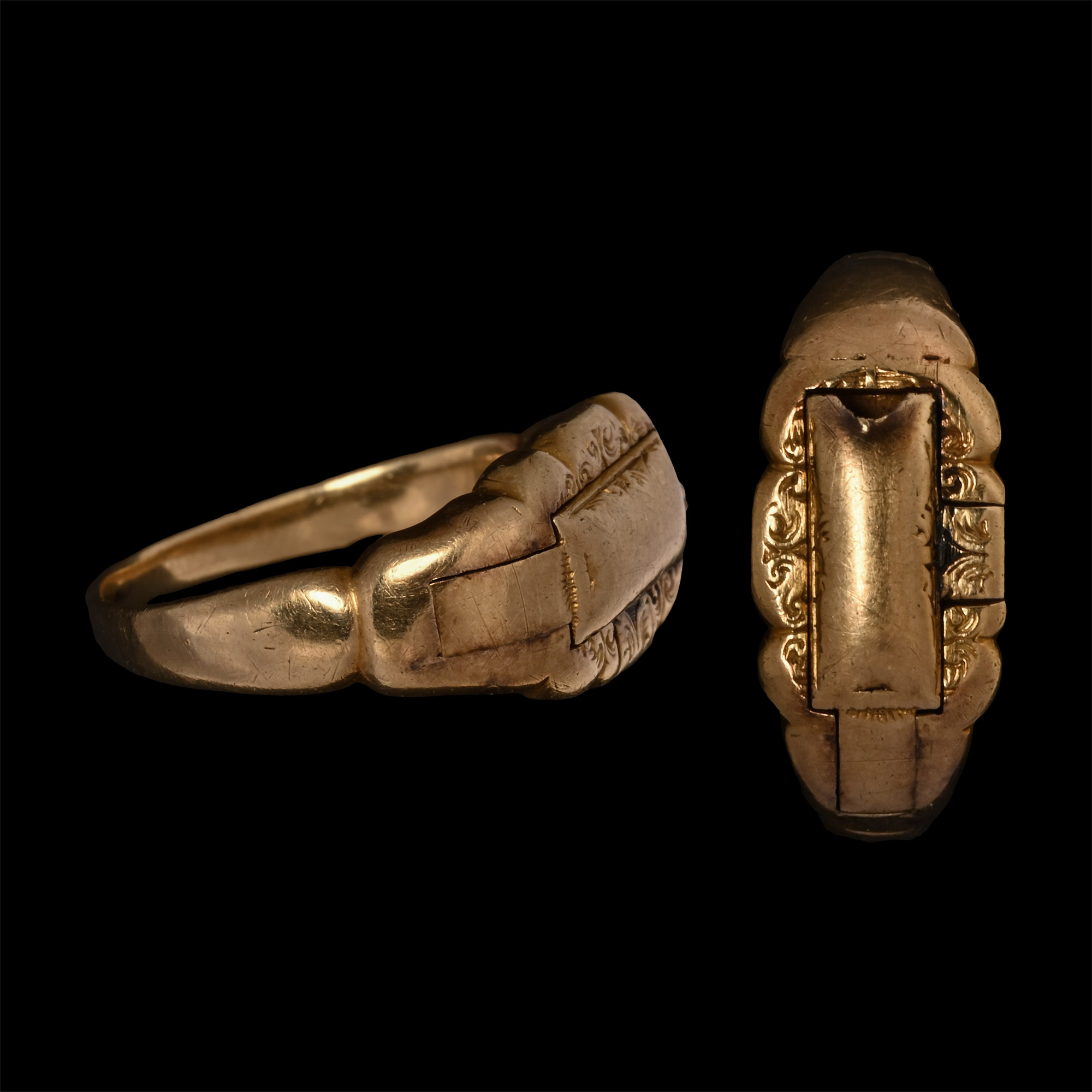
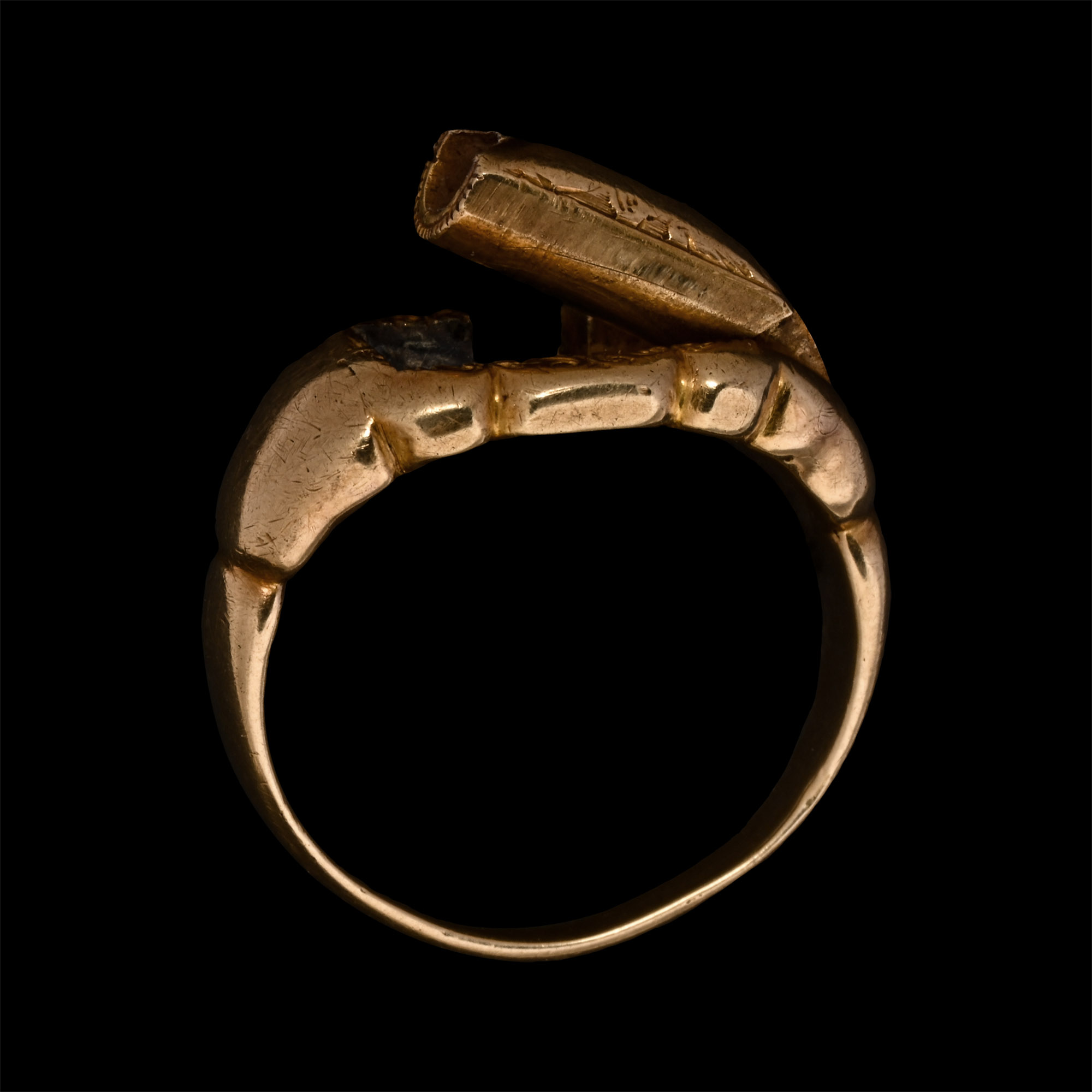
Civil War Period Gold Poison Ring
17TH CENTURY A.D.
7/8 in. (7.49 grams, 22.28 mm overall, 18.87 mm internal diameter (approximate size British N 1/2, USA 6 3/4, Europe 14.35, Japan 13)).
With expanding shoulders, scrolled outline to the plaque, hinged folding tube below the central panel.
ProvenanceFrom the private collection of N.Thomas, 1979-1987.
This lot has been checked against the Interpol Database of stolen works of art and is accompanied by search certificate number no.12481-229481.
This lot has been cleared against the Art Loss Register database, and is accompanied by an illustrated lot declaration signed by the Head of the Antiquities Department, Dr Raffaele D’Amato.
See Oman, C.C., Victoria and Albert Museum Catalogue of Rings, reprinted Ipswich, 1993, for discussion.
CONDITIONTimeLine Auctions follows a vetting process to ensure the authenticity and legality of all items, reinforcing our commitment to integrity and responsible trading. Each antiquity, antique, and coin lot undergoes thorough examination by a vetting committee of at least ten external specialists, professional trade association members, scientists, and archaeologists: Our Vetting Process
AUCTIONS:
TimeLine is a leading auction house specialising in antiquities, ancient art, collectables, natural history, coins, medals, and books. Our auctions offer museums, collectors, historians, and enthusiasts the opportunity to acquire unique and historically significant pieces.
-
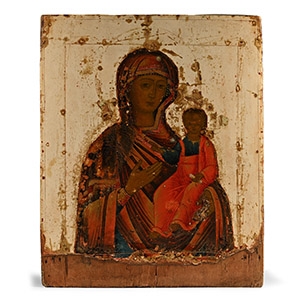
Russian Icon with Mother of God and Christ
Smolenskaya, early 19th century A.D.Estimate: £300 - 400 (+bp*)
Opening Bid: £150
Depicting nimbate Mary Theotokos with veiled head and wearing a red maphorion mantle over a dark blue robe with gold cuffs, inclined towards the infant Jesus supported by her left hand, wearing a bright red mantle and a blue tunic highlighted with gold, his left arm holding a roll and the right hand in a gesture of blessing; white field, tempera on wood, Smolenskaya type. 1.12 kg, 32 x 26 cm
Acquired from Portobello Road, London, circa 2000. Property of a London, UK, gentleman collector. This lot is accompanied by an illustrated lot declaration signed by the Head of the Antiquities Department, Dr Raffaele D’Amato.
The model for the icon, painted in 16th century style, is the one of the Mother of God of Smolensk, associated with the Byzantine icon of the Hodegetria ('She who shows the ways). According to the legend, the icon of Smolensk received the name after healing two blind men. The original icon of Smolensk was a gift of the Roman Emperor Constantine Monomachus to her daughter Anna when she married the Russian Prince Vsevolod. Later Anna presented the icon to his son Vladimir who put it in the Vladimir Cathedral. -
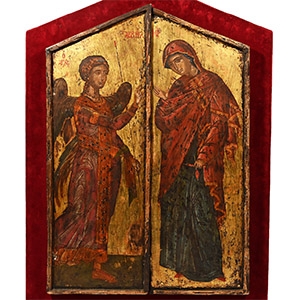
Doors with Annunciation of the Virgin Scene
Cretan School, 16th century A.D.Estimate: £10,000 - 14,000 (+bp*)
Opening Bid: £4,000
Painted onto a pair of gessoed wooden doors for the iconostasis, pentagonal in form with applied beading to the edges; Left: gilt field with advancing winged figure in ankle-length robes holding a slender wand and with thick curly hair, legend 'Ο ΑΡΧΗ' and 'ΓΑΒΡΗΛ'; Right: similar with Mary in floor-length blue robe and crimson mantle, holding a drop-spindle and winder, with legend 'Ω/MP'; representing the Annunciation of the Virgin by the Archangel Gabriel; mounted on a velvet-covered wooden frame. 9.15 kg total, 93.5 x 68.5 cm including frame
Acquired on the UK art market. Private collection, London, UK. Accompanied by an academic report by Dr Raffaele D'Amato. This lot has been checked against the Interpol Database of stolen works of art and is accompanied by a search certificate number no.12552-231939. This lot has been cleared against the Art Loss Register database, and is accompanied by an illustrated lot declaration signed by the Head of the Antiquities Department, Dr Raffaele D’Amato. -
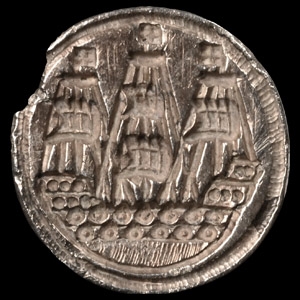
Stuart Silver Seal Matrix with Tall Ship
17th century A.D.Sold for (Inc. bp): £247
With hexagonal-section shank, collar and round suspension loop; to the circular face an intaglio design of a three-masted warship under sail with pennants to mastheads and with gunports to side; one facet stamped 'H', old collector's inked reference '815'. 5.29 grams, 25.16 mm
Formerly in a significant private English collection of seal matrices formed since 1987. Ex Horton collection, UK. Property of a Californian, USA, collector. This lot is accompanied by an illustrated lot declaration signed by the Head of the Antiquities Department, Dr Raffaele D’Amato.
