
Loading, please wait...

LOT 1511
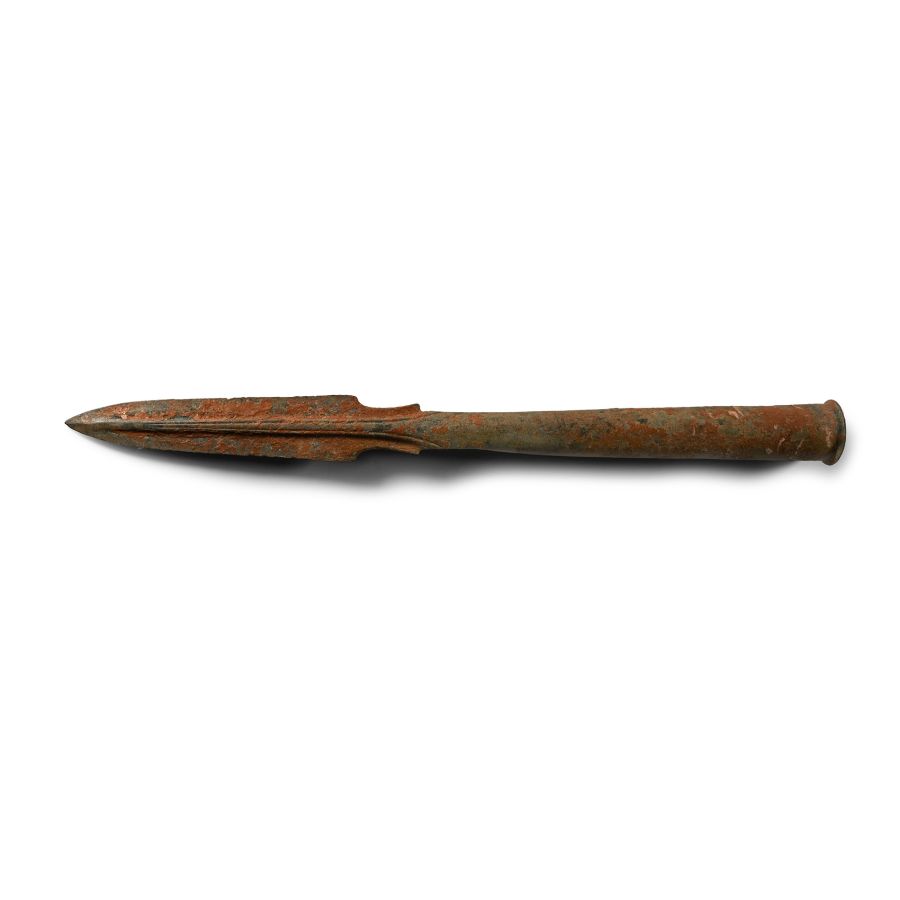
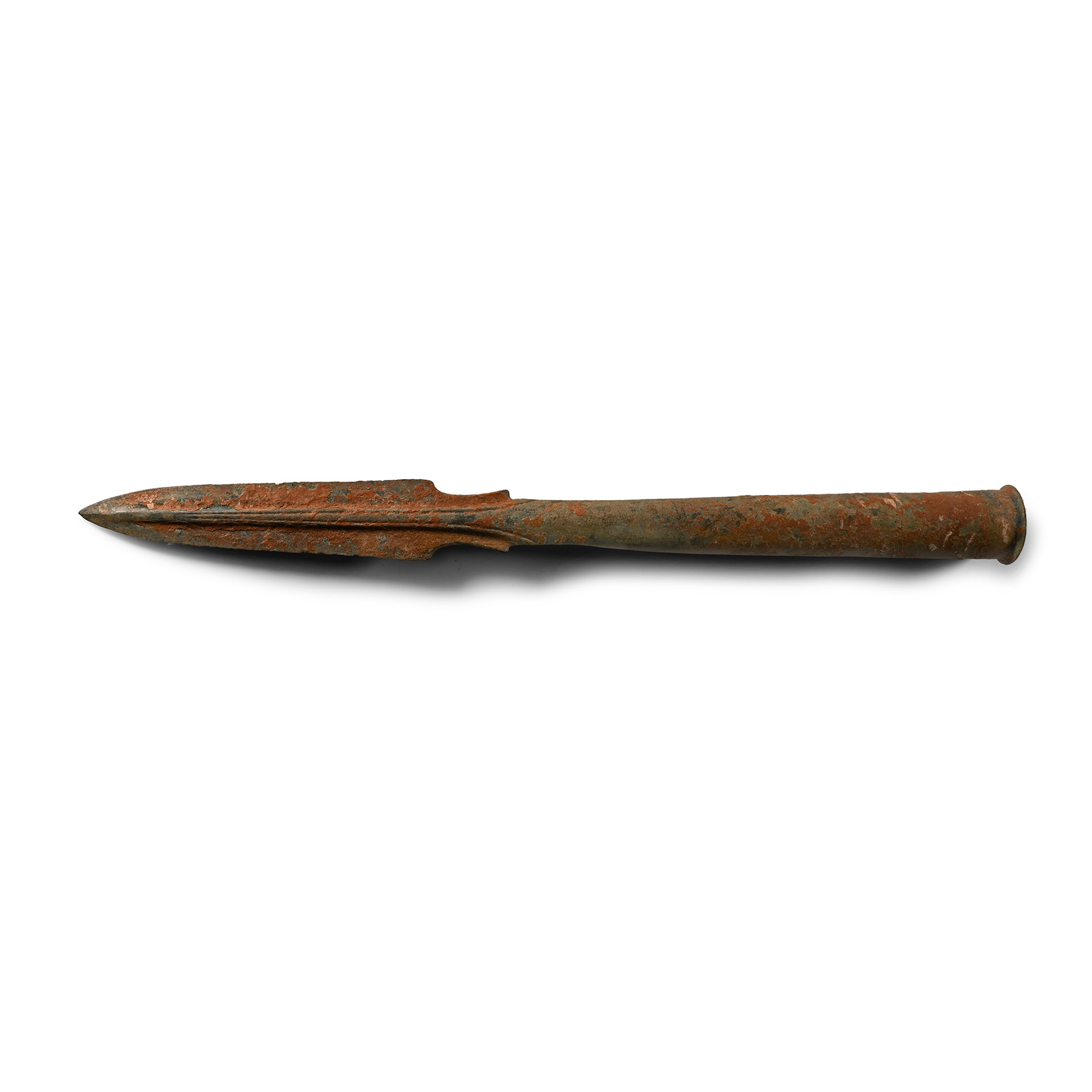
Chinese Zhou Bronze Socketted Spearhead
ZHOU DYNASTY, 1046-256 B.C.
12 1/2 in. (250 grams, 32 cm).
With thick midrib, leaf-shaped blade with lateral spurs, deep tubular socket with fastening hole for the attachment to the wooden shaft.
ProvenanceAcquired in the mid 1980s-1990s.
Private collection, Switzerland, thence by descent.
Private collection, since the late 1990s.
This lot is accompanied by an illustrated lot declaration signed by the Head of the Antiquities Department, Dr Raffaele D’Amato.
This lot is accompanied by an illustrated lot declaration signed by the Head of the Antiquities Department, Dr Raffaele D'Amato.
Cf. Gorelik, M., Weapons of Ancient East, IV millennium BC-IV century BC, Saint Petersburg, 2003, in Russian, (plate XXXVIII nos.47-48, for a similar spearhead from Wuchengqiao, country of Liuhe, Prov. Jiangsu, and Fengshuiling, near Changzhen, prov. Shanxi.
CONDITIONTimeLine Auctions follows a vetting process to ensure the authenticity and legality of all items, reinforcing our commitment to integrity and responsible trading. Each antiquity, antique, and coin lot undergoes thorough examination by a vetting committee of at least ten external specialists, professional trade association members, scientists, and archaeologists: Our Vetting Process
AUCTIONS:
TimeLine is a leading auction house specialising in antiquities, ancient art, collectables, natural history, coins, medals, and books. Our auctions offer museums, collectors, historians, and enthusiasts the opportunity to acquire unique and historically significant pieces.
LOT 1511
Chinese Zhou Bronze Socketted Spearhead
Estimate £500 - 700€580 - 810 (for guidance only)$680 - 950 (for guidance only)
-
Greek Slingshot with Serpent
4th-1st century B.C.Sold for (Inc. bp): £442
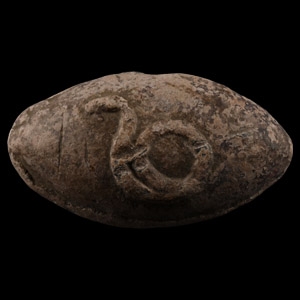
Lentoid in form with raised legend 'A[...]A' and to reverse, a coiled serpent; casting seam; the legend is probably 'AΓOPOY' (maker's name). 31.8 grams, 29 mm
Private collection, Austria. Private collection, Europe. This lot is accompanied by an illustrated lot declaration signed by the Head of the Antiquities Department, Dr Raffaele D'Amato. -
Western Asiatic Bronze Arrowhead Collection
2nd-1st millennium B.C.Sold for (Inc. bp): £85
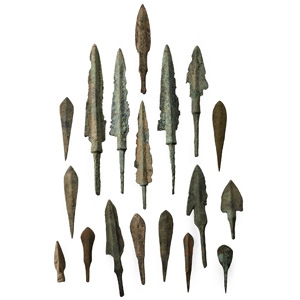
Comprising: four large tanged arrowheads, mainly of triangular type with mid-rib; six triangular, leaf-shaped, barbed, and paddle-shaped arrowheads with a flat, comparatively wide mid-rib; one small triangular arrowhead with rounded shoulders; two arrowheads with wings, resembling a stylised flying bird; one foliate with herringbone decoration on the midrib; a triangular type with flat mid-rib and raised corners; two small paddle-shaped arrowheads with flat mid-rib; an Achaemenid trilobate socketted arrowhead. 253 grams total, 3.7-15 cm
From the London art market, 1990s. This lot is accompanied by an illustrated lot declaration signed by the Head of the Antiquities Department, Dr Raffaele D'Amato.
The most interesting specimen is the foliate blade with herringbone decoration on the mid-rib. Two examples with similar decoration are published by Muscarella, that according to the publications of Ghirsman are typical of North-West Iranian Plateau. -

Byzantine 'Greek Fire' Ceramic Fire Bomb or Hand Grenade
9th-11th century A.D.Sold for (Inc. bp): £65
Bulbous body with domed mouth, incised circumferential bands above the shoulder; intended to be filled with explosive liquid and a wick, and used as a hand grenade. 392 grams, 10 cm
From an important specialist collection, London, UK, 1990s onwards. Accompanied by an academic paper by military specialist Dr Raffaele D'Amato, dated 15 July 2019 and titled 'Eastern Roman Empire - Greek Fire Bomb or Hand Grenade (μεσαίον kακάβιον) 9th-11th century AD'. This lot is accompanied by an illustrated lot declaration signed by the Head of the Antiquities Department, Dr Raffaele D'Amato.
Apart from the use of siphons or manual flame-throwers called cheirosiphona, special corps of Roman soldiers employed terracotta grenades, in the form of small jars, abundantly evidenced in archaeological excavations. They were called μεσαία kακαβιά or κυτροκακάβια where the former had a bulbous shape and the latter a more cylindrical form.
