
Loading, please wait...

LOT 1584
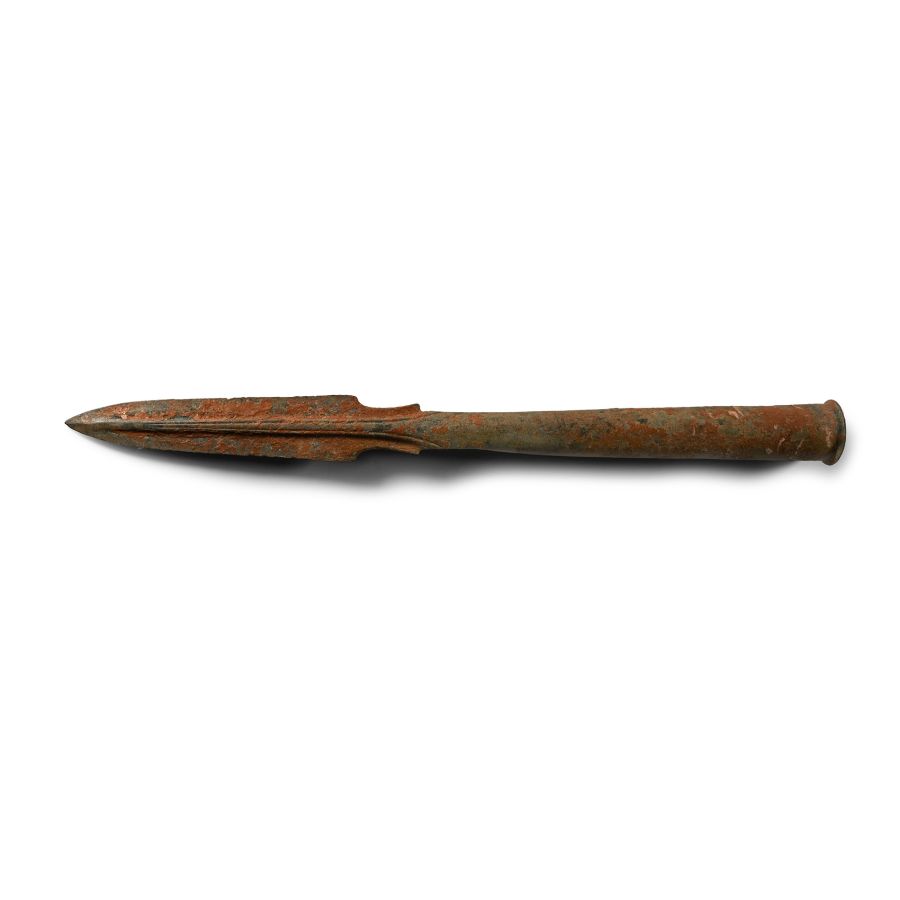
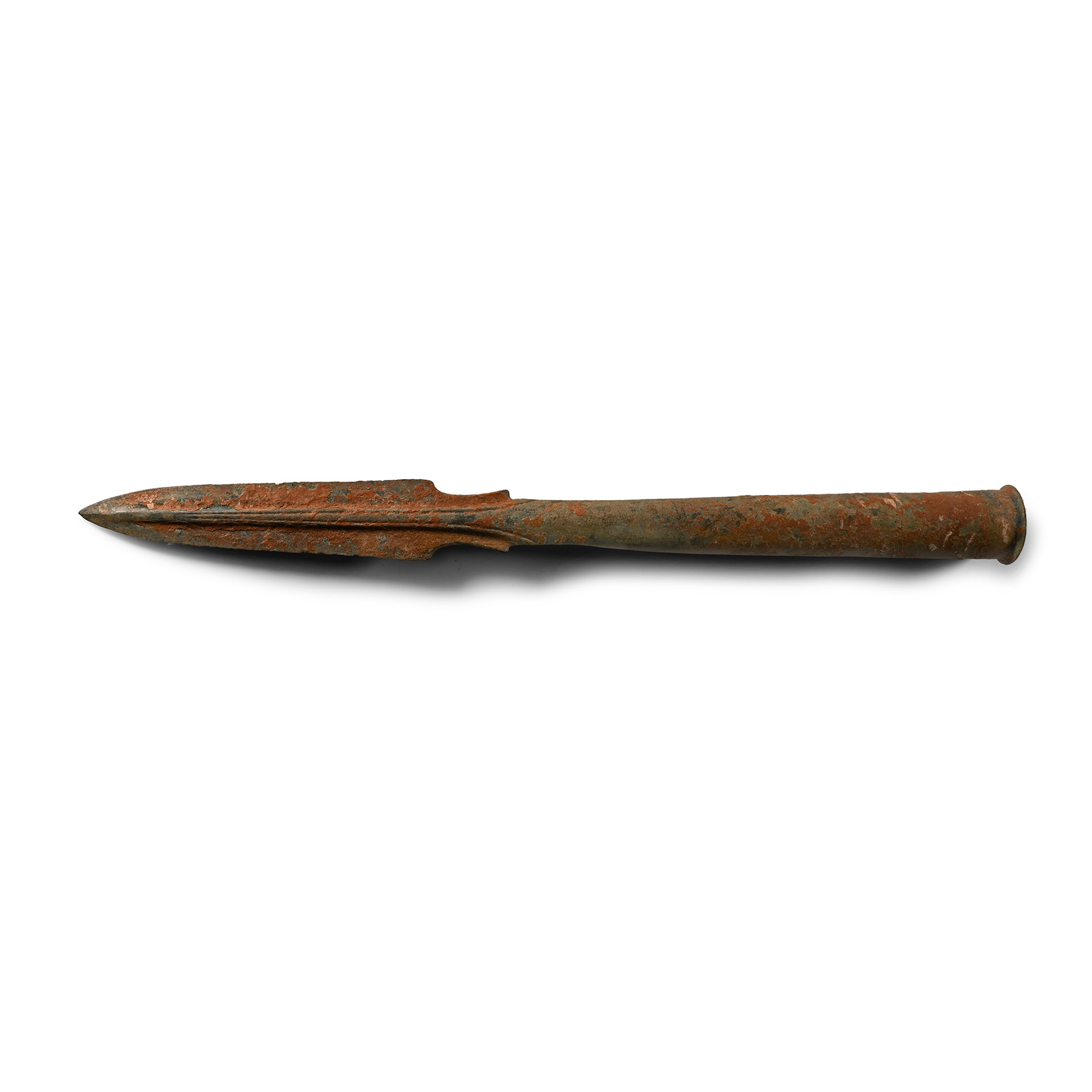
Chinese Zhou Bronze Socketted Spearhead
ZHOU DYNASTY, 1046-256 B.C.
12 1/2 in. (250 grams, 32 cm).
With thick midrib, leaf-shaped blade with lateral spurs, deep tubular socket with fastening hole for the attachment to the wooden shaft.
ProvenanceAcquired in the mid 1980s-1990s.
Private collection, Switzerland, thence by descent.
Private collection, since the late 1990s.
This lot is accompanied by an illustrated lot declaration signed by the Head of the Antiquities Department, Dr Raffaele D’Amato.
Cf. Gorelik, M., Weapons of Ancient East, IV millennium BC-IV century BC, Saint Petersburg, 2003, in Russian, (plate XXXVIII nos.47-48, for a similar spearhead from Wuchengqiao, country of Liuhe, Prov. Jiangsu, and Fengshuiling, near Changzhen, prov. Shanxi.
CONDITIONTimeLine Auctions follows a vetting process to ensure the authenticity and legality of all items, reinforcing our commitment to integrity and responsible trading. Each antiquity, antique, and coin lot undergoes thorough examination by a vetting committee of at least ten external specialists, professional trade association members, scientists, and archaeologists: Our Vetting Process
AUCTIONS:
TimeLine is a leading auction house specialising in antiquities, ancient art, collectables, natural history, coins, medals, and books. Our auctions offer museums, collectors, historians, and enthusiasts the opportunity to acquire unique and historically significant pieces.
LOT 1584
Chinese Zhou Bronze Socketted Spearhead
Estimate £600 - 800€700 - 930 (for guidance only)$810 - 1,080 (for guidance only)
-
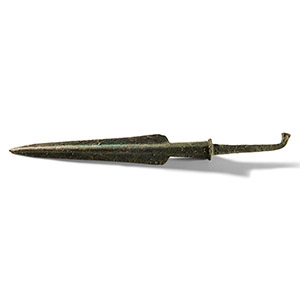
Western Asiatic Tanged Bronze Spearhead
1500-1000 B.C.Estimate: £250 - 350 (‡+bp*)
Opening Bid: £125
With heavily ridged and tapered blade, short collared shaft and tapered bent tang with round stud terminal. 247 grams, 28.5 cm
Acquired in Europe in 1997. European private collection. This lot is accompanied by an illustrated lot declaration signed by the Head of the Antiquities Department, Dr Raffaele D’Amato. -
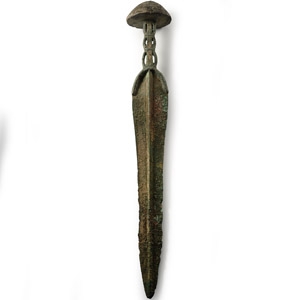
Luristan Bronze Sword
Late 2nd millennium B.C.Sold for (Inc. bp): £598
Later hilt with mushroom-shaped pommel, openwork grip with 'chain'-shaped pattern, crescentic guard, long sloping blade with rectangular-section mid-ridge. 1.05 kg, 55.2 cm
Acquired 1980-2015. Ex Abelita family collection. This lot is accompanied by an illustrated lot declaration signed by the Head of the Antiquities Department, Dr Raffaele D’Amato.
These bronze swords were characterised by a solid-cast hilt with penannular guard, a grip equipped with raised shaped figures and a conical, hollow-cast mushroom pommel. The blade had a very pronounced shaped central midrib. In the complete specimens the hilt was usually cast with the blade. -
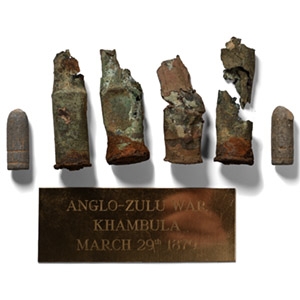
Anglo-Zulu War 'Battle of Khambula' Artefact Collection
29 March 1879 A.D.Sold for (Inc. bp): £98
Comprising: a Martini-Henry brass ‘boxer’ cartridge cases, one with firing mark to the base; two lead heads of bullets fired from the Martini-Henry rifle; supplied with brass nameplate 'Anglo-Zulu War / Khambula / March 29th 1879'. 120 grams total, 3-10.1 cm
Found by Zulu natives, Khambula, South Africa, 1990s-early 2000s. Ian Wilkinson collection, Nottinghamshire, UK, formed since 1985. This lot is accompanied by an illustrated lot declaration signed by the Head of the Antiquities Department, Dr Raffaele D’Amato.
Following defeats by the Zulu army at Isandlwana and Hiobane, the British were desperate for a victory, which they secured at Khambula.
