
Loading, please wait...
LOT 1590
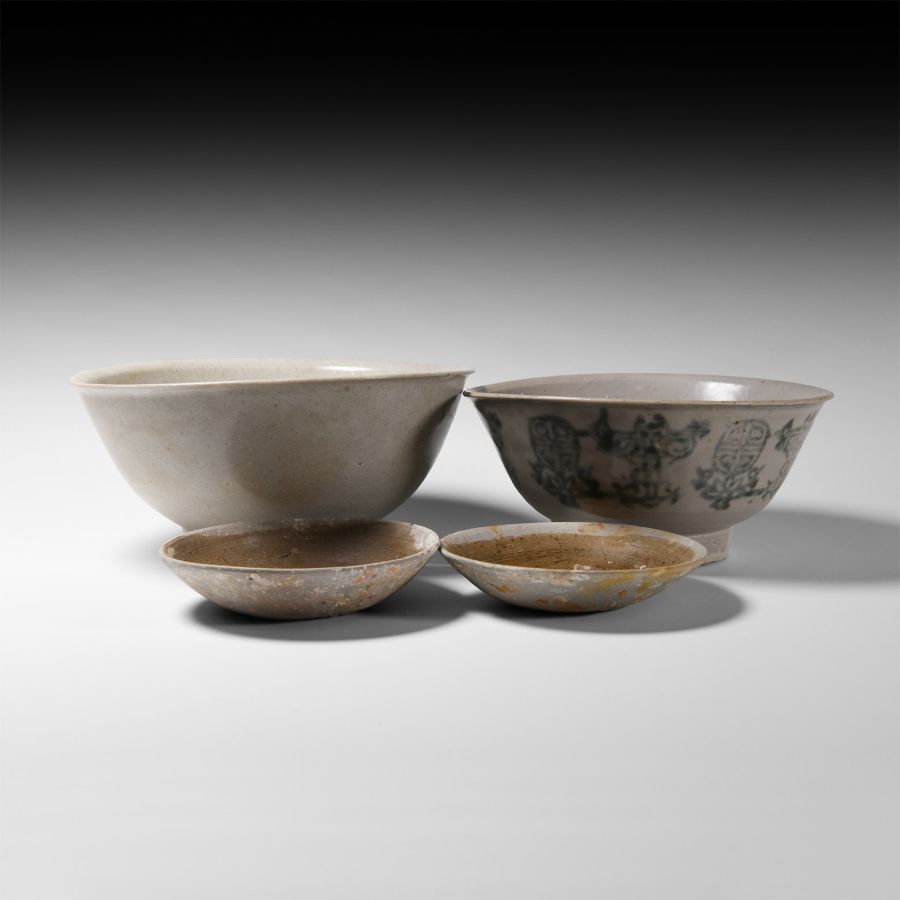
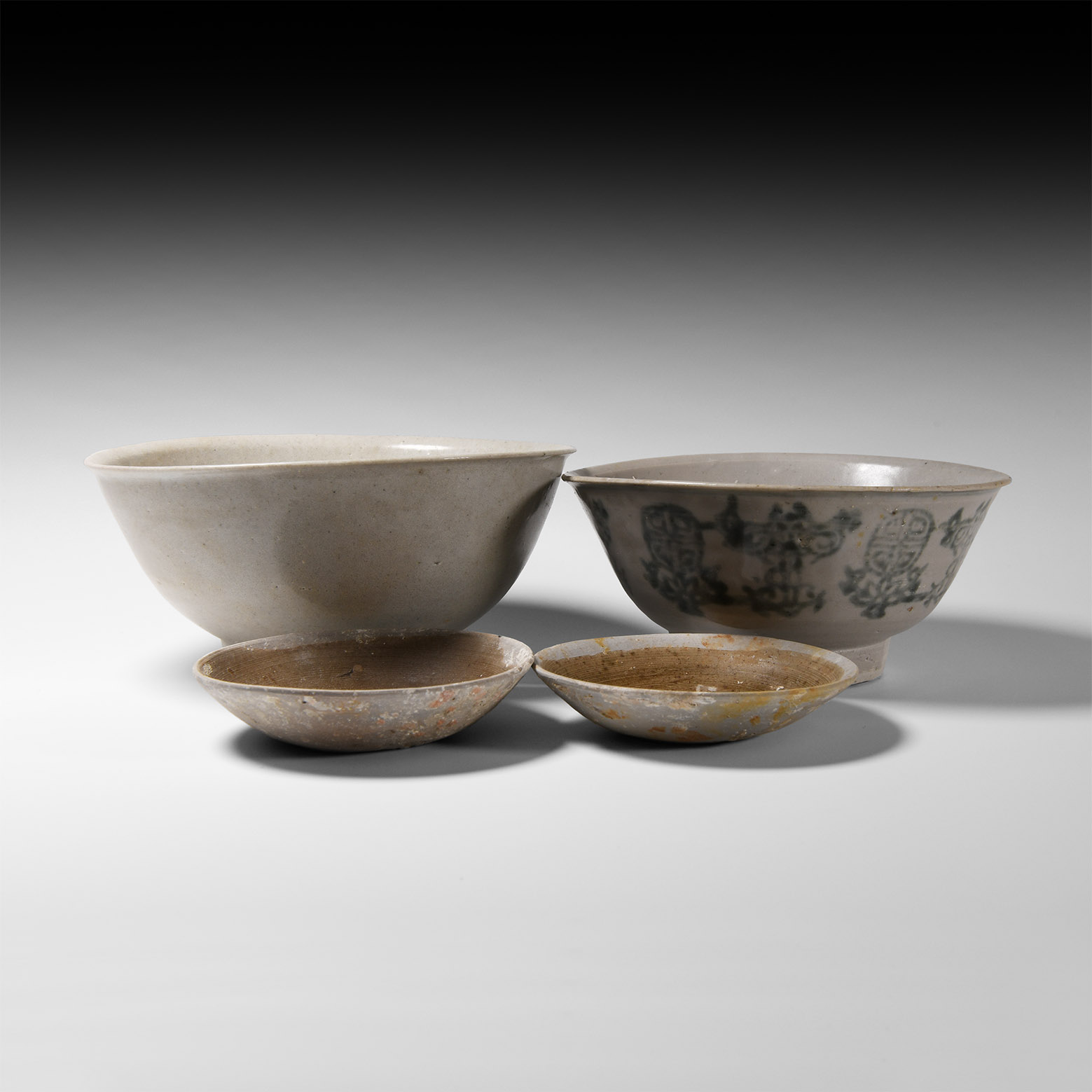
Chinese Tek Sing Shipwreck Pottery Collection
19TH CENTURY A.D.
3 5/8 - 6 1/4 in. (659 grams total, 9.1-16 cm wide).
A group of four glazed ceramic vessels: two shallow dishes and two footed bowls with everted rim and basal ring. [4]
ProvenanceAcquired 1980-2015.
Ex Abelita family collection.
The Tek Sing (True Star) wreck is one of the famous recovery stories of the 20th century. Sailing from the port of Xiamen (then known as Amoy) in February 1822 the vessel Tek Sing was bound for Jakarta, Indonesia laden with porcelain goods and 1600 Chinese emigrants. The captain decided to pass through the Gaspar Strait, between the Bangka-Belitung Islands, and ran aground on a reef. The vessel sank in about 100 feet of water. The next morning, February 7, an English East Indian vessel captained by James Pearl, passing through the same waters, encountered debris and some survivors and managed to rescue about 190 of the latter.
CONDITIONTimeLine Auctions follows a vetting process to ensure the authenticity and legality of all items, reinforcing our commitment to integrity and responsible trading. Each antiquity, antique, and coin lot undergoes thorough examination by a vetting committee of at least ten external specialists, professional trade association members, scientists, and archaeologists: Our Vetting Process
AUCTIONS:
TimeLine is a leading auction house specialising in antiquities, ancient art, collectables, natural history, coins, medals, and books. Our auctions offer museums, collectors, historians, and enthusiasts the opportunity to acquire unique and historically significant pieces.
LOT 1590
Chinese Tek Sing Shipwreck Pottery Collection
Estimate £100 - 140€120 - 160 (for guidance only)$140 - 190 (for guidance only)
-
.jpg)
Large Chinese Tang 'Pagoda' Reliquary Stupa
Tang to Liao Dynasty, circa 907-1125 A.D. or laterEstimate: £6,000 - 8,000 (+bp*)
Opening Bid: £2,000
A substantial hollow bronze 'pagoda' stupa with three-tiered square and stepped base showing bodhi leaves, flaming jewels and foliage tendrils respectively, surmounted by a pierced frieze, each side depicting a seated Buddha flanked by standing figures and clouds; with triple pitched and hipped roof elements rising above pierced wall panels; in turn all surmounted by a column with five graduated discs affixed and terminating in a four-lobed flammiform element. 4.9 kg, 59 cm
Fine condition.
Acquired 1960s to early 1970s. ‘Buckingham Collection’, the late Nik Douglas (1944-2012), renowned author, curator and Asian art expert. Accompanied by Nik Douglas's collection cataloguing pages. Accompanied by a copy of the relevant ‘Out of Uddiyana’ exhibition catalogue pages including an image of this lot featured in one of the display cases. This lot has also been checked against the Interpol Database of stolen works of art and is accompanied by search certificate number no. 10493-170984. -
Chinese Giant Banded Agate Bead Necklace
20th century A.D. or laterSold for (Inc. bp): £111
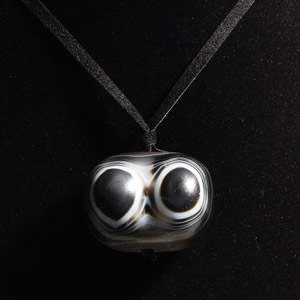
A large banded agate bead of roughly oval form, two domed 'eyes' to one face; suspended on a felt thong. 97 grams, 66 cm long
Ex London, UK, gallery. Property of a London gentleman. -
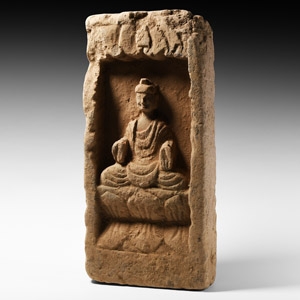
Chinese Wei Buddha Brick
Wei Dynasty, 534-550 A.D.Sold for (Inc. bp): £165
A rectangular ceramic Buddha brick displaying Buddha seated cross-legged on a lotus flower base beneath a canopy, in raised relief within a rectangular niche, his hands held in the varada mudra of charity and compassion. 3.83 kg, 32 cm high
Fair condition.
Acquired in the 1970s. From a Hong Kong collection. London collection, 1990s-2000s.
