
Loading, please wait...
LOT 2310
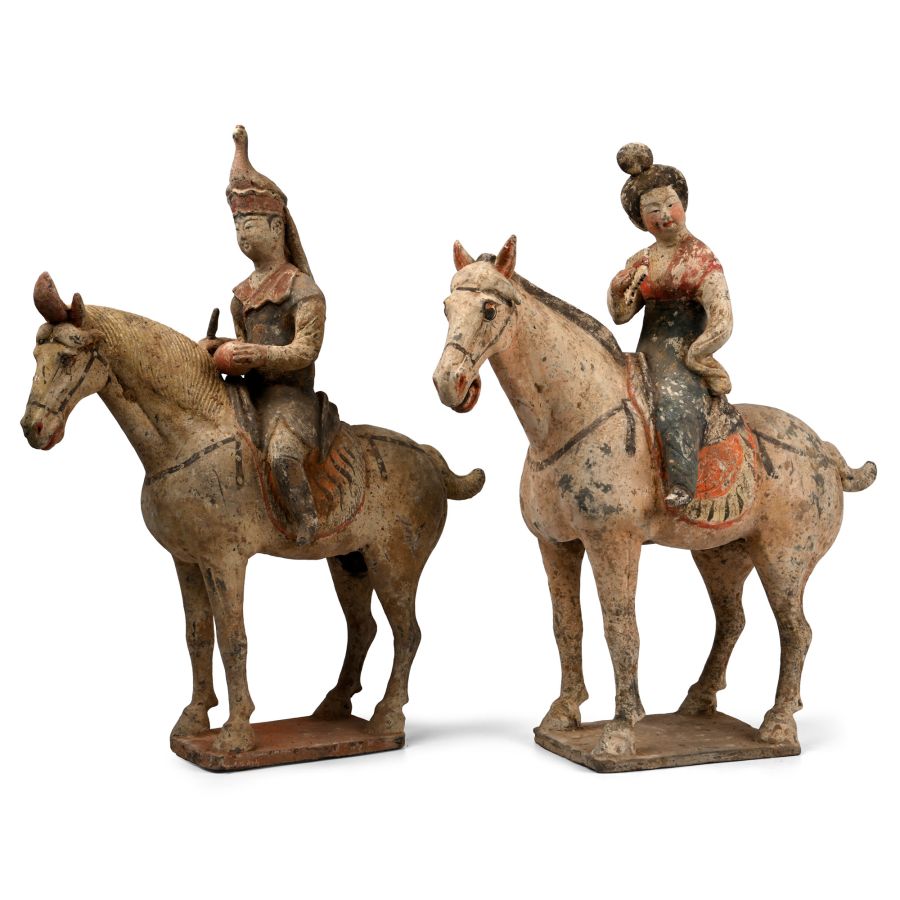
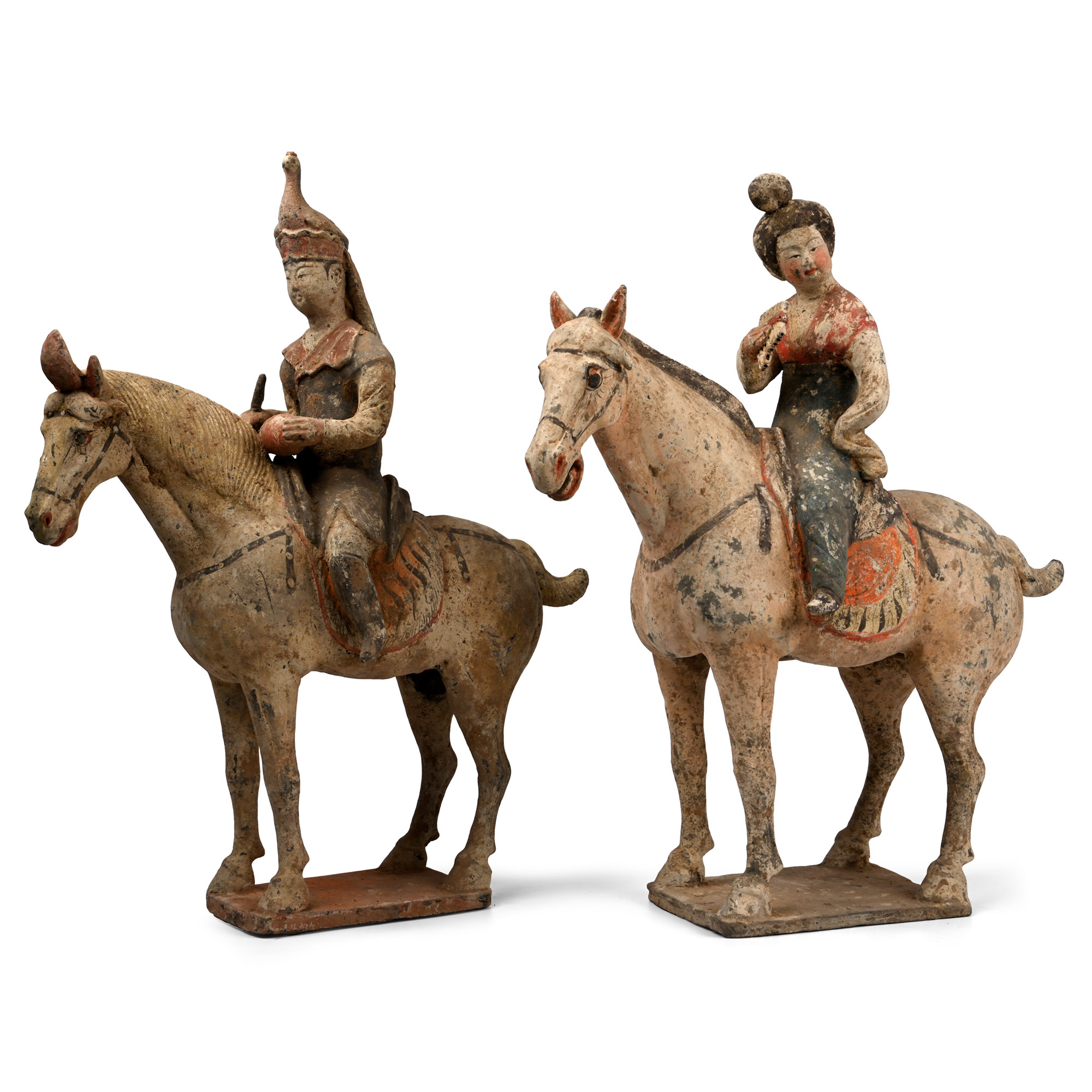
Chinese Tang Terracotta Horse and Rider Pair
TANG DYNASTY, 618-907 A.D.
17 1/2 - 18 3/4 in. (6.9 kg total, 44.5-47.5 cm).
Pair of mounted musicians comprising: male on tall, stocky horse with painted harness and fur saddlecloth and plume between the ears, wearing riding boots and jacket, headdress depicting a roosting bird, holding a small drum in one hand and drumstick in the other; female on similar horse wearing an ankle-length robe wound tightly about her legs, one hand covered by the long sleeve of her dress, the other raised and holding a set of pipes. [2]
ProvenancePrivate collection, Hong Kong, acquired in the 1990s-2000s.
Private collection, London, acquired in the 2000s.
Accompanied by an original thermoluminescence analysis report no.C125k86 by Oxford Authentication for one of the figures.
This lot has been checked against the Interpol Database of stolen works of art and is accompanied by a search certificate number no.12884-240554.
This lot has been cleared against the Art Loss Register database, and is accompanied by an illustrated lot declaration signed by the Head of the Antiquities Department, Dr Raffaele D'Amato.
TimeLine Auctions follows a vetting process to ensure the authenticity and legality of all items, reinforcing our commitment to integrity and responsible trading. Each antiquity, antique, and coin lot undergoes thorough examination by a vetting committee of at least ten external specialists, professional trade association members, scientists, and archaeologists: Our Vetting Process
AUCTIONS:
TimeLine is a leading auction house specialising in antiquities, ancient art, collectables, natural history, coins, medals, and books. Our auctions offer museums, collectors, historians, and enthusiasts the opportunity to acquire unique and historically significant pieces.
LOT 2310
Chinese Tang Terracotta Horse and Rider Pair
Estimate £5,000 - 7,000€5,800 - 8,120 (for guidance only)$6,750 - 9,450 (for guidance only)
-

Tibetan Rock Crystal Ceramonial Purba Dagger
20th century A.D.Sold for (Inc. bp): £91
Triangular in section with lobed point and three radiating masks beneath a quadrate crown. 85 grams, 12.5 cm
From the private collection of Kenneth Machin (1936-2020), Buckinghamshire, UK; his collection of antiquities and natural history was formed since 1948; thence by descent. This lot is accompanied by an illustrated lot declaration signed by the Head of the Antiquities Department, Dr Raffaele D'Amato. -

Chinese Han Style Bronze Belt Hook with Inscription
20th century A.D.Estimate: £500 - 700 (+bp*)
Opening Bid: £250
Fluted teardrop shape with hooked narrow end, fixing stud to the reverse, three columns of later stamped text to the face. 107 grams, 18 cm
From an important West Country collection, 1980s. This lot is accompanied by an illustrated lot declaration signed by the Head of the Antiquities Department, Dr Raffaele D'Amato. -
Northern Thai Gold Dragon-Headed Bracelets with Rubies and Sapphires
18th century A.D.Sold for (Inc. bp): £7,800
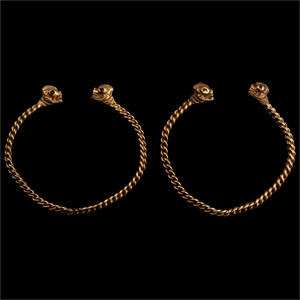
A matched pair of penannular bracelets, each formed in tightly-bound plaited gold wire with terminals formed as the crested heads of makara, their eyes set with rubies; mounted in a lined presentation case. 24.18 grams total, 64-65mm
Habsburg, Feldman, GOLD, Important Ancient and Ethnic Jewellery and Works of Art in Precious Metal, Hotel des Bergues, Geneva, 14 May 1990, no.105, 111. Acquired by the current owner from the above sale. This lot has been checked against the Interpol Database of stolen works of art and is accompanied by search certificate number no.12800-241416. This lot has been cleared against the Art Loss Register database, and is accompanied by an illustrated lot declaration signed by the Head of the Antiquities Department, Dr Raffaele D'Amato.
Gold jewellery in northern Thailand holds both aesthetic and cultural significance, deeply rooted in regional identity, status, and spiritual belief. Traditionally crafted by skilled artisans, such pieces were not only symbols of wealth and social standing but also believed to offer protection and merit. In Lanna culture (the historic kingdom of northern Thailand), gold was closely associated with religious offerings, marriage rituals, and rites of passage, often passed down through generations as cherished heirlooms. The intricate designs—frequently featuring floral and mythical motifs—reflect both indigenous styles and broader Southeast Asian influences, underscoring gold’s enduring role in both personal adornment and communal heritage.
