
Loading, please wait...
LOT 0411
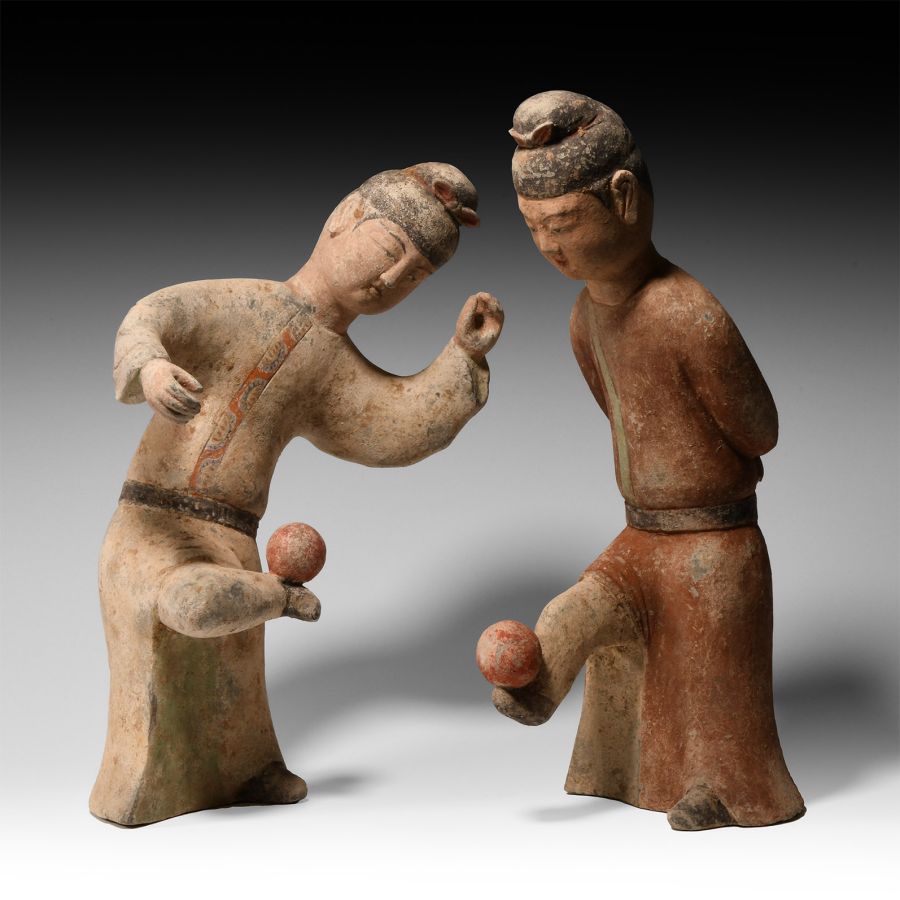
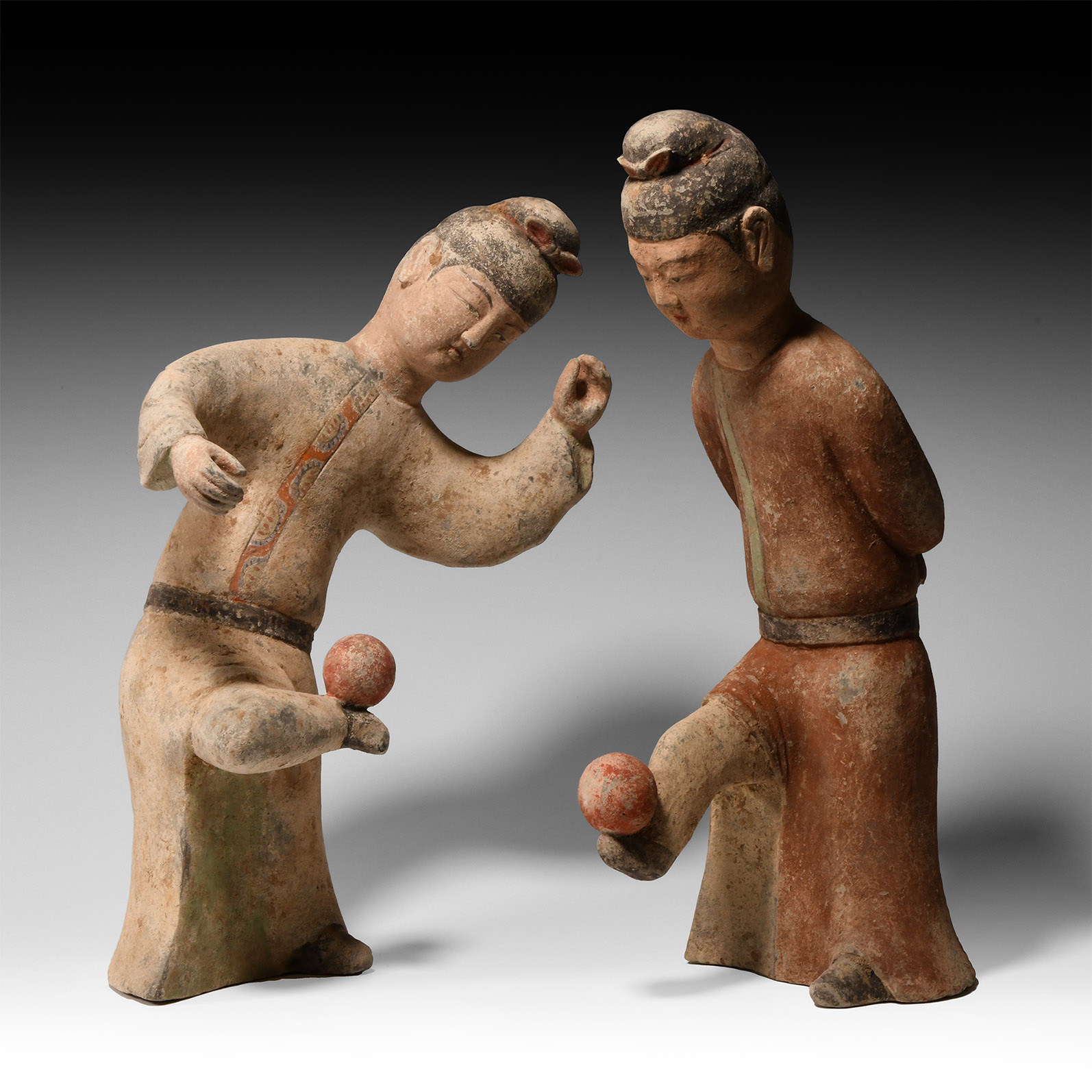
Chinese Tang Cuju Football Player Pair
TANG DYNASTY, 618-907 A.D.
15 1/8 - 16 3/4 in. (6.85 kg total, 38.5-42.5 cm high).
A pair of ceramic male figures modelled standing in dynamic poses, likely playing a game of cuju, each wearing a floor-length robe and balancing a ball on one foot; one figure leaning forwards with his arms held behind his back, looking down towards the ball balanced on the end of his raised right foot; one figure moving his arms in opposite directions in an attempt to regain his balance, head leaning left, his right leg bent across his body at the knee, balancing a ball on the heel of his foot; each with semi-naturalistic facial features and hair tied in a top knot; extensive remains of polychrome pigmentation. [2]
ProvenanceEx Hong Kong collection.
London Mayfair gallery, UK.
Accompanied by thermoluminescence analysis report nos. C122k26 and C122k25 from Oxford Authentication.
This lot has been checked against the Interpol Database of stolen works of art and is accompanied by search certificate number no.11697-199217.
See Prodan, M., The Art of the Tang Potter, London, 1960, for similarly styled figures and discussion; see the Fifa Museum online for discussion and historical depictions of the game in various media.
FootnotesCuju is the earliest recorded game of football which involved kicking a ball through a net without the use of the hands.
CONDITIONTimeLine Auctions follows a vetting process to ensure the authenticity and legality of all items, reinforcing our commitment to integrity and responsible trading. Each antiquity, antique, and coin lot undergoes thorough examination by a vetting committee of at least ten external specialists, professional trade association members, scientists, and archaeologists: Our Vetting Process
AUCTIONS:
TimeLine is a leading auction house specialising in antiquities, ancient art, collectables, natural history, coins, medals, and books. Our auctions offer museums, collectors, historians, and enthusiasts the opportunity to acquire unique and historically significant pieces.
-
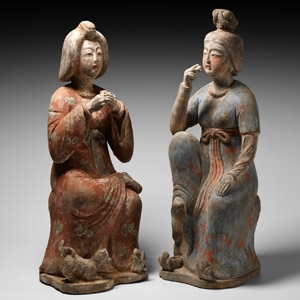
Chinese Tang Pair of Courtly Ladies
Tang Dynasty, 618-907 A.D.Estimate: £3,000 - 4,000 (+bp*)
Opening Bid: £1,600
A group of two hollow-formed ceramic figures: one a courtly lady sitting on a stool with right foot crossed over the left knee, holding a small goblet in both hands, cat beside her right foot; the other sitting with right foot raised to the seat of the stool, grape held between the fingers being raised to the mouth. 2.98 kg total, 29-30.2 cm high
Ex Hong Kong collection. London Mayfair gallery, UK. Accompanied by thermoluminescence analysis report no.C122k22, for one of the figures. This lot has been checked against the Interpol Database of stolen works of art and is accompanied by search certificate number no.11698-199215. -
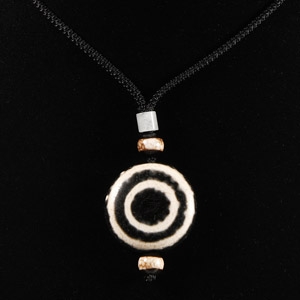
Chinese Giant 'Eye' Agate Bead Necklace
20th century A.D.Sold for (Inc. bp): £33
A large, bifacial banded agate bead, chemically treated to show the circular 'eye' design; suspended on a cord, additional beads above and below. 30 grams, 62 cm long
Ex London, UK, gallery. Property of a London gentleman. -
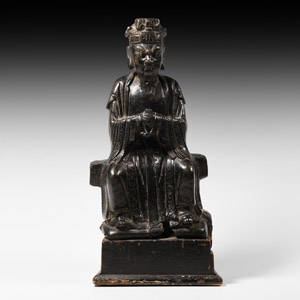
Chinese Ming Seated Magistrate Figurine
Ming Dynasty, 16th-17th century A.D.Sold for (Inc. bp): £1,170
A bronze figure of a seated magistrate, holding a sceptre, wearing a robe with details of lotus scrolls to the hem; cap inscribed 'Wang Ping Jiang', the reverse inscribed 'Jing Yi'; mounted on a custom-made wooden stand. 2.3 kg, 32 cm high
Fine condition; old repair, cracked at lower edges.
Formerly in a private Dutch collection. Property of a private Rotterdam collector. This lot has been checked against the Interpol Database of stolen works of art and is accompanied by search certificate no.11565-196103.
