
Loading, please wait...
LOT 1175
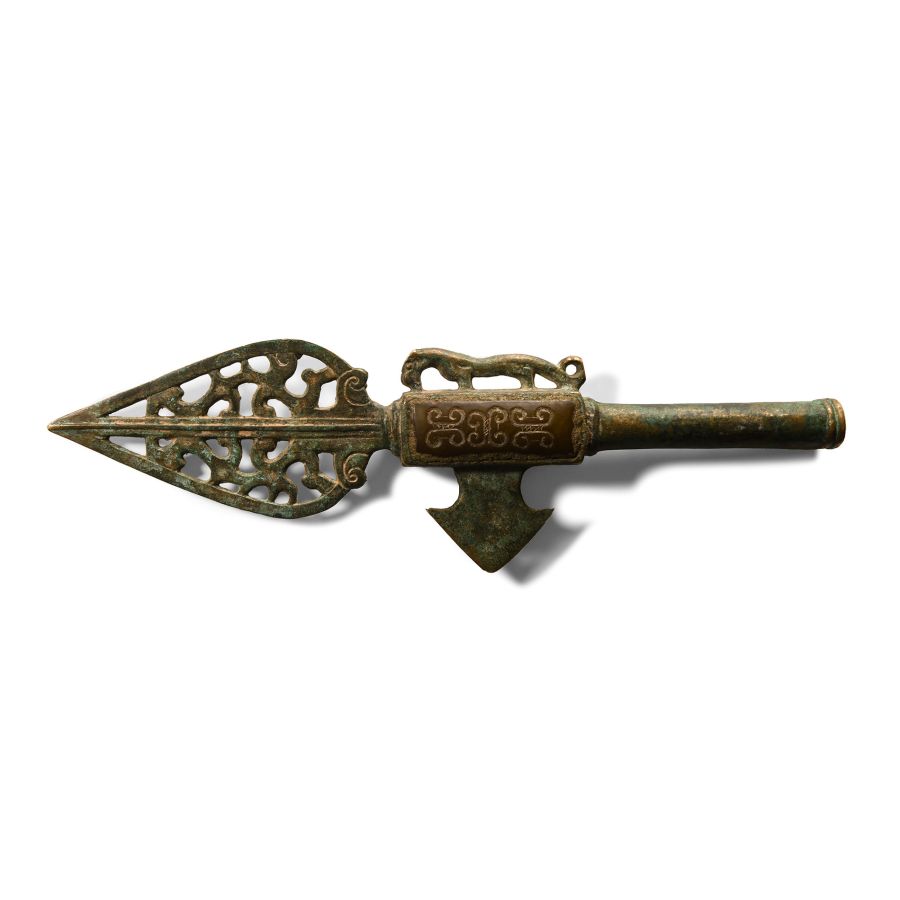
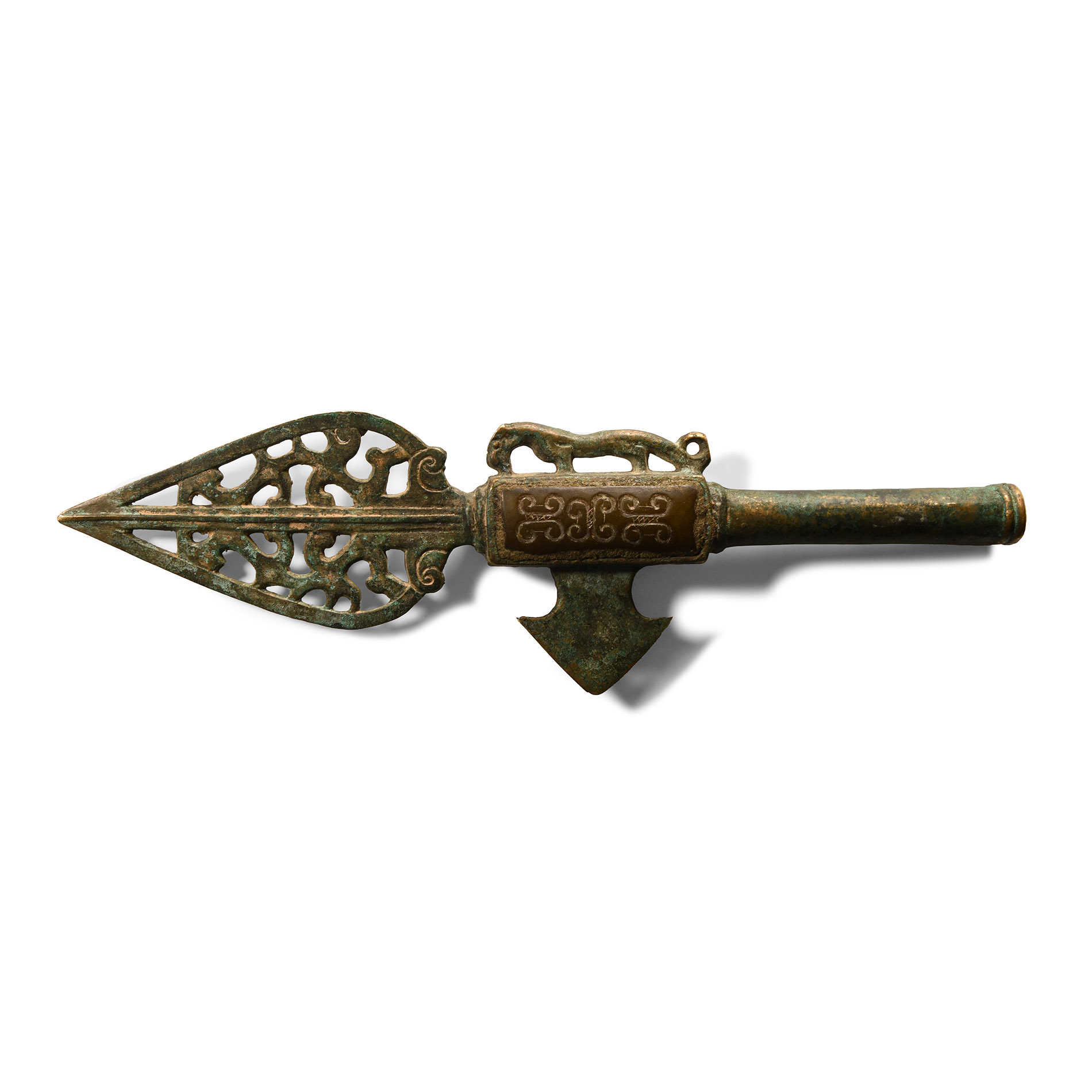
Chinese Style Bronze Ceremonial Halberd Sceptre Head
20TH CENTURY A.D.
11 in. (293 grams, 28 cm).
The leaf-shaped head displaying sinuous openwork animals on either side, rectangular collar with etched ornament, possibly a nameplate, repeated on both faces, a feline to one side and a flat-section arrow to the other, tubular socket below. [No Reserve]
ProvenanceAcquired in Germany.
Property of RWM Collection.
During the Warring States Period (475-221 B.C.), Chinese warfare evolved. Kings and princes were replaced on the battlefield by infantries lead by military generals. New arms and armour were invented, including the halberd and crossbow. This sceptre head has a spearhead finial that features an openwork motif that is both decorative as well as functional, since it decreases the weight of the bronze, making the spear cheaper to produce and lighter to use.
CONDITIONTimeLine Auctions follows a vetting process to ensure the authenticity and legality of all items, reinforcing our commitment to integrity and responsible trading. Each antiquity, antique, and coin lot undergoes thorough examination by a vetting committee of at least ten external specialists, professional trade association members, scientists, and archaeologists: Our Vetting Process
AUCTIONS:
TimeLine is a leading auction house specialising in antiquities, ancient art, collectables, natural history, coins, medals, and books. Our auctions offer museums, collectors, historians, and enthusiasts the opportunity to acquire unique and historically significant pieces.
-
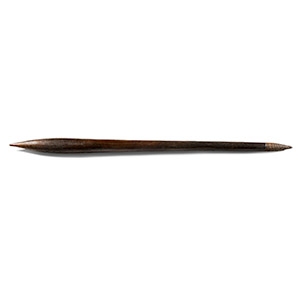
Australian Aboriginal Throwing Club
19th century A.D.Sold for (Inc. bp): £117
The round-section shaft with one tapered end and a pointed, bulbous head. 435 grams, 69 cm
Acquired UK market. Property of a Kent collector.
Used for hunting and in warfare. Possibly engraved using a possum tooth. -
.jpg)
Archaic Greek Modified Bronze Corinthian Helmet
Late 7th-early 6th century B.C.Estimate: £4,000 - 6,000 (+bp*)
Opening Bid: £2,222
Consisting of two sections joined with bronze rivets; above a domed section with row of rivets; below, a folded band with rolled rim, with rivets to the rear holding two halves; line of holes to the base for securing an inner lining. 2.2 kg total, 31.5 cm high including stand
Acquired in the 1970s. Ex private Austrian collection. The Kusmirek Collection, UK. Accompanied by an academic report by Dr Raffaele D'Amato. Accompanied by a metal analysis and appraisal by Dr Brian Gilmour. This lot has been checked against the Interpol Database of stolen works of art and is accompanied by search certificate number no.11764-203980.
The upper part of the helmet was probably modified in antiquity, the lower part of the eye holes and the cheek pieces have been cut away, and replacement cheek pieces, now lacking, were once crudely rivetted to the sides. -
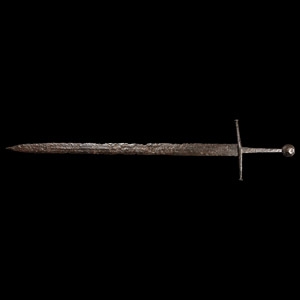
Medieval Iron Hand and Half Sword with Polyhedral Pommel
Late 14th-early 15th century A.D.Sold for (Inc. bp): £2,860
Of Oakeshott's Type XVIIIa or b, cross style 11, pommel style I1; strongly tapering pointed blade with straight edges and evident battle nicks; straight cross guard, long grip and an octagonal pommel. 1.26 kg, 1 m
From the private collection of a London gentleman, from his grandfather's collection formed before the early 1970s.
This magnificent example was well-suited to a cut-and-thrust style of fighting, a logical development of the Oakeshott XVI typology. This is mainly visible in the specimens of typology XVIIIb, typical of English effigies and brasses between 1370-1425. Because the previous types of swords were practically useless against the fully armoured man-at-arms, Western European warfare needed a sword capable of piercing the weak points of the enemy's protective equipment, leading to the development of types XV, XVI and XVII, and eventually of type XVIII. The subtypes XVIIIa and b had a longer blade, and type XVIIIb was a very long-gripped bastard sword. This word (often referred to as ‘hand-and-a-half sword’) was applied through the late Middle Ages to the long-gripped weapons. Marc de Vulson, writing on the occasion of a duel fought in 1549 before Henry II of France, stated 'Deux epées bâtardes, pouvant servir à une main ou à deux' (two bastard swords able to serve with one hand or with two).
