
Loading, please wait...
LOT 0418
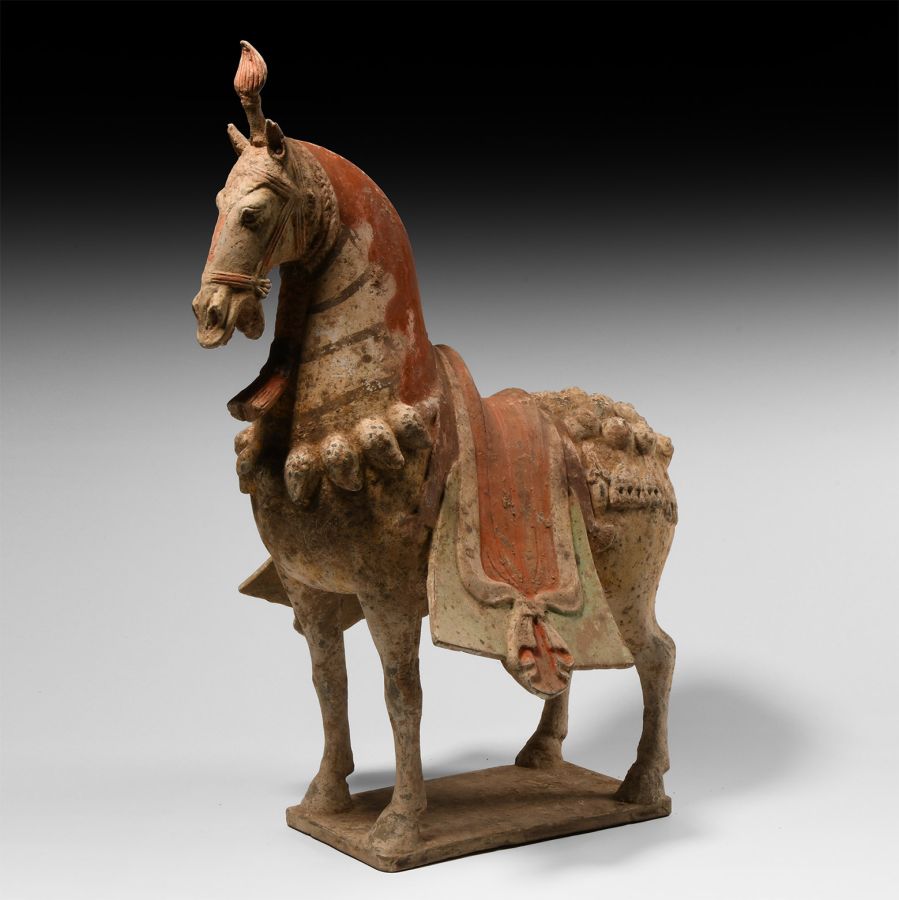
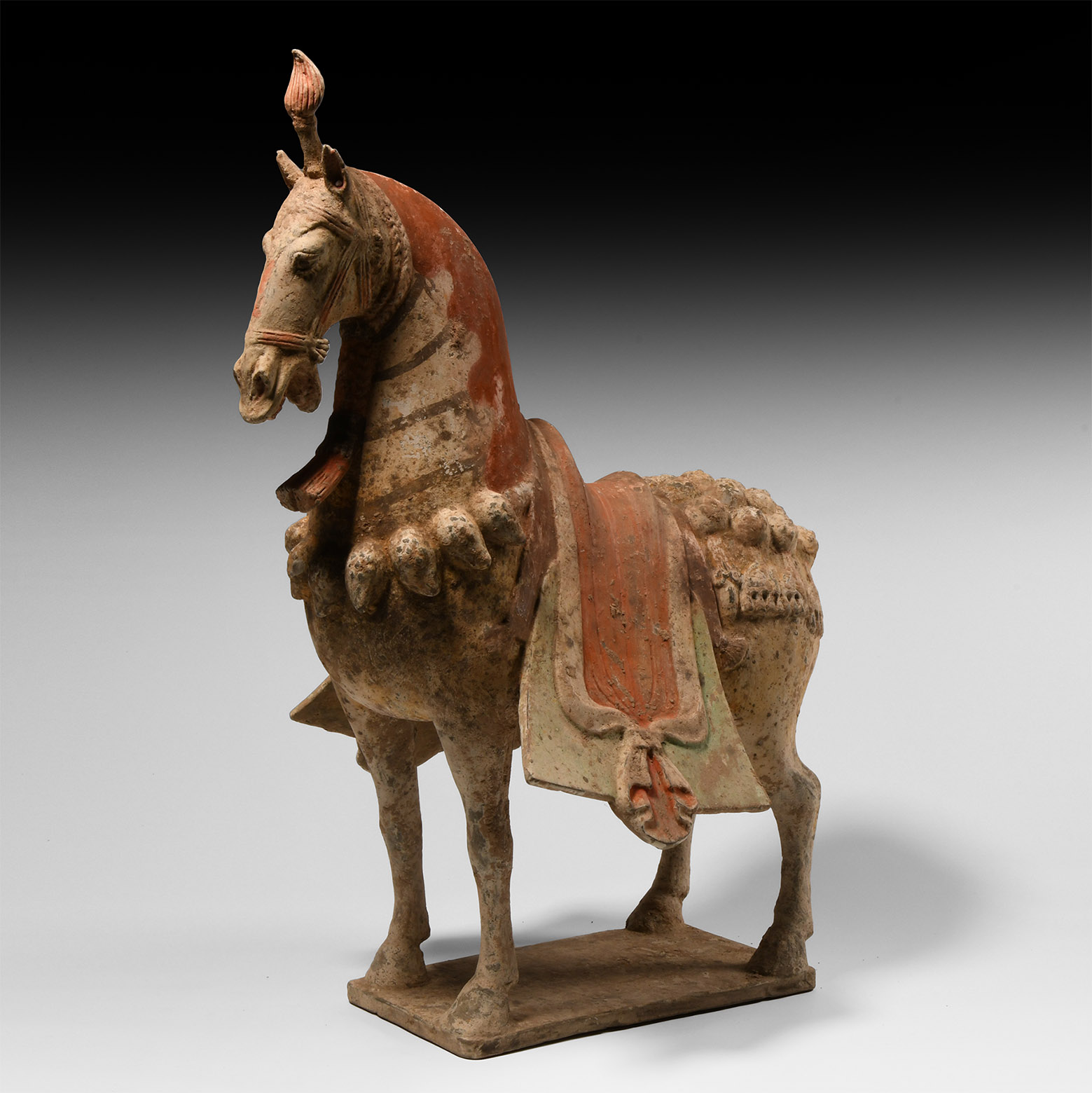
Chinese Northern Qi Caparisoned Horse
NORTHERN QI DYNASTY, 550-577 A.D.
15 3/8 in. (2.85 kg, 39 cm high).
A large ceramic figurine of a horse with head raised, mouth open and ears pricked, integrally modelled saddle, caparison, bridle and plume; tail absent.
ProvenanceAcquired 1980s-1990s.
Ex West Country collection.
Accompanied by an original thermoluminescence analysis report no.C122g65 from Oxford Authentication.
This lot has been checked against the Interpol Database of stolen works of art and is accompanied by search certificate number no.11701-199226.
Cf. Arthur M. Sackler Museum, From Court to Caravan: Chinese Tomb Sculptures from the Collection of Anthony M. Solomon, Cambridge, 2002, p. 92, no. 19, for a similar horse; cf. J.J. Lally & Co., Early Dynastic China Exhibition: Works of Art from Shang to Song, New York, 26 March - 26 April 1996, no. 5.
CONDITIONTimeLine Auctions follows a vetting process to ensure the authenticity and legality of all items, reinforcing our commitment to integrity and responsible trading. Each antiquity, antique, and coin lot undergoes thorough examination by a vetting committee of at least ten external specialists, professional trade association members, scientists, and archaeologists: Our Vetting Process
AUCTIONS:
TimeLine is a leading auction house specialising in antiquities, ancient art, collectables, natural history, coins, medals, and books. Our auctions offer museums, collectors, historians, and enthusiasts the opportunity to acquire unique and historically significant pieces.
LOT 0418
Chinese Northern Qi Caparisoned Horse
Estimate £3,000 - 4,000€3,480 - 4,640 (for guidance only)$4,050 - 5,400 (for guidance only)
-
Chinese Ming Figure Pair
Late Ming Dynasty-early Qing Dynasty, 16th-17th century A.D.Estimate: £200 - 300 (+bp*)
Opening Bid: £100
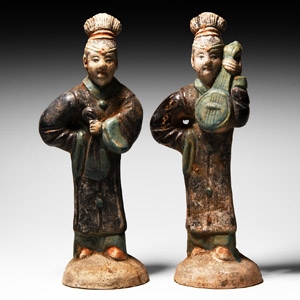
A pair of glazed ceramic figures on domed bases; one a dancer in floor-length robe standing with right hand in the folds of the sleeve and left hand gathering folds of cloth; the other with a stringed instrument in the left hand. 914 grams total, 22.5-23 cm
Acquired 1970s. West Country, UK, collection. -
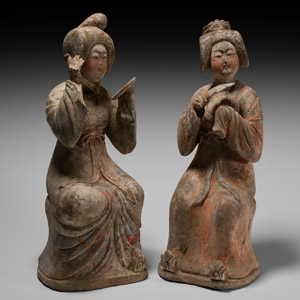
Chinese Tang Pair of Courtly Ladies
Tang Dynasty, 618-907 A.D.Estimate: £3,000 - 4,000 (+bp*)
Opening Bid: £1,600
A group of two painted ceramic figurines depicting courtly ladies in flowing robes seated on stools, one with a rosette-shaped fan and the other with mirror and comb dressing her hair. 2.97 kg total, 30-30.5 cm high
Ex Hong Kong collection. London Mayfair gallery, UK. Accompanied by thermoluminescence analysis report no.C122k21, for one of the figures. This lot has been checked against the Interpol Database of stolen works of art and is accompanied by search certificate number no.11699-199216. -
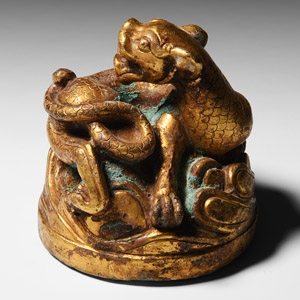
Chinese Han Style Gilt Coiled Lionesque Creature
20th century A.D. or earlierEstimate: £250 - 350 (+bp*)
Opening Bid: £125
A Han Dynasty style sinuous gilt bronze lionesque beast, modelled in a dynamic coiled posture on a circular base from which fingers of water rise in response to the animal's muscular movements, its slender body with a dense covering of scales, its long and scaly tail curled upwards and its roaring mouth ajar, revealing a row of squared teeth and a protruding tongue, its eyes bulbous and large ears pricked. 367 grams, 66 mm
Fine condition.
Acquired 1970s. West Country, UK, collection.
