Loading, please wait...
LOT 1538
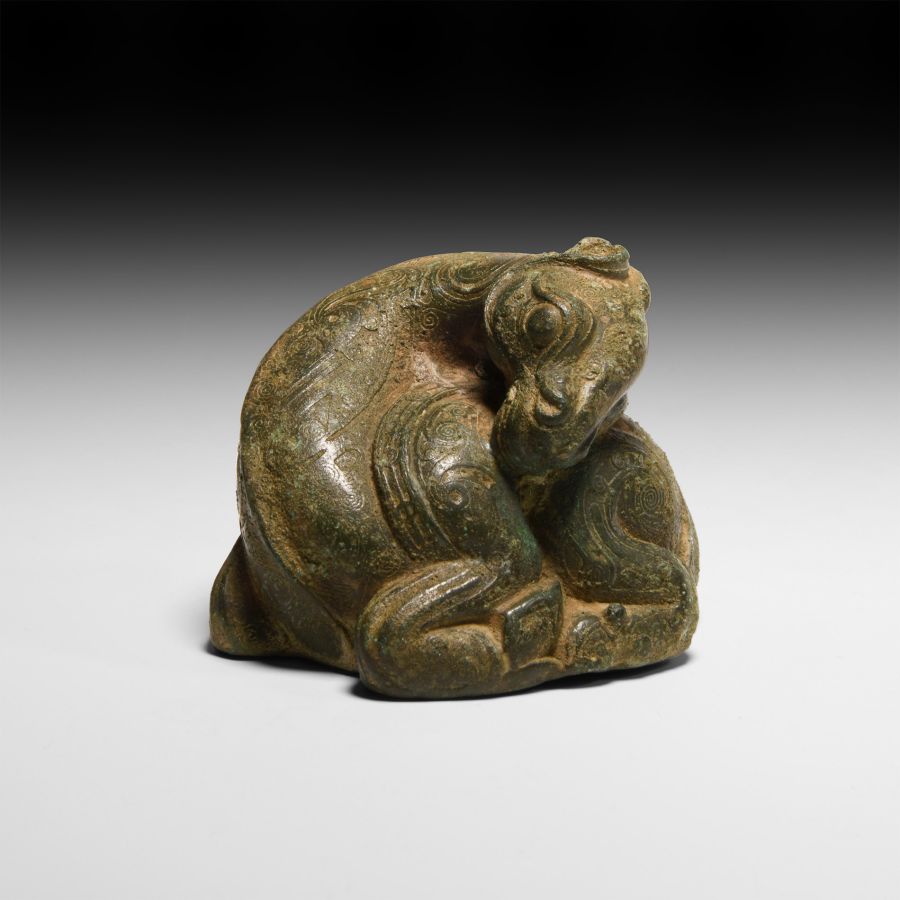
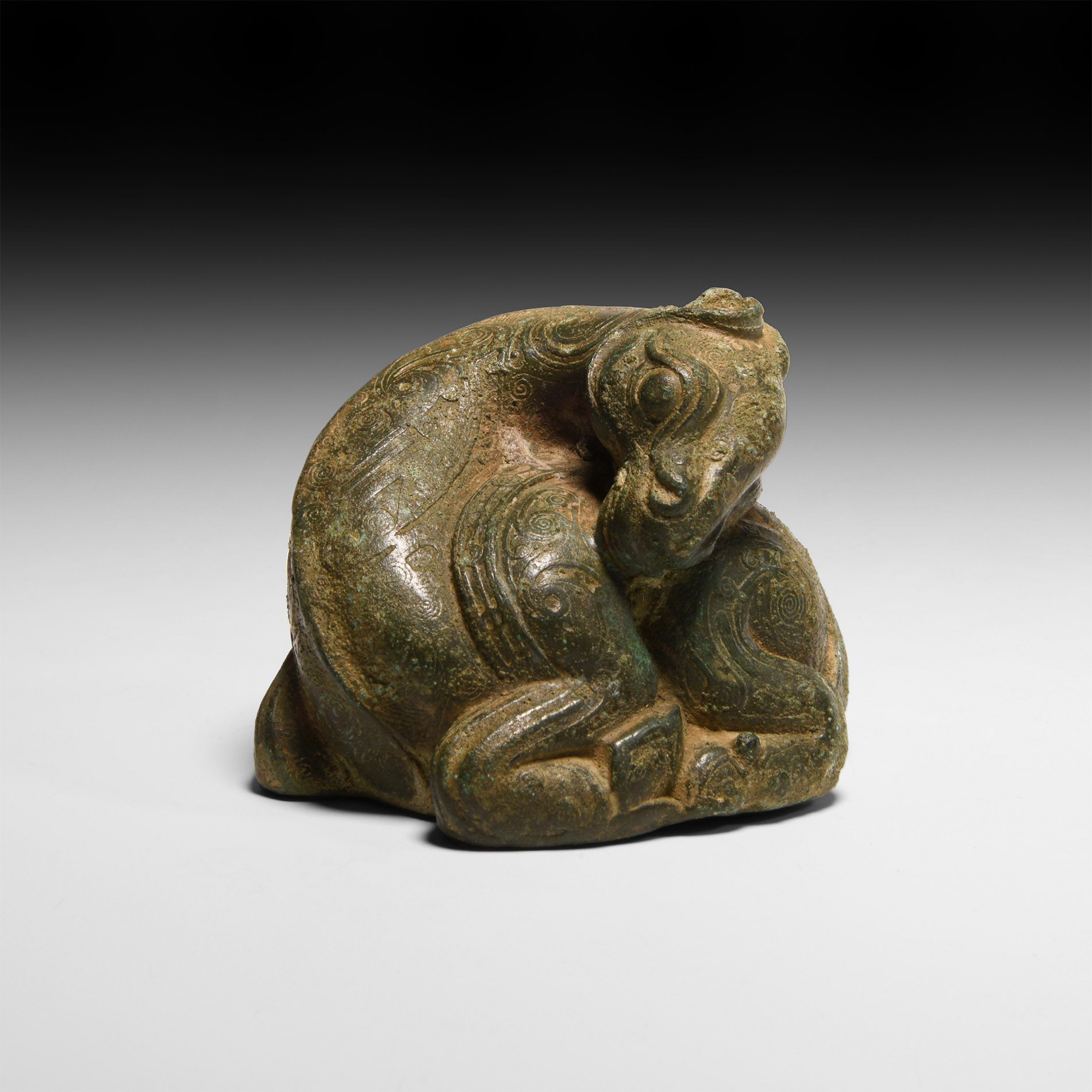
Chinese Han Style Bronze Horse Weight
19TH-20TH CENTURY A.D.
3 in. (203 grams, 78 mm).
A Han style bronze weight modelled as a reclining horse, all four legs tucked beneath its body, neck and head leaning backwards and to one side of the body; the animal displaying a characterful face with bulging eyes and flared nostrils; a dense and intricate series of geometric motifs adorning the body; hollow-formed.
ProvenanceAcquired 1980-1990s.
From a West Country collection.
TimeLine Auctions follows a vetting process to ensure the authenticity and legality of all items, reinforcing our commitment to integrity and responsible trading. Each antiquity, antique, and coin lot undergoes thorough examination by a vetting committee of at least ten external specialists, professional trade association members, scientists, and archaeologists: Our Vetting Process
AUCTIONS:
TimeLine is a leading auction house specialising in antiquities, ancient art, collectables, natural history, coins, medals, and books. Our auctions offer museums, collectors, historians, and enthusiasts the opportunity to acquire unique and historically significant pieces.
-
Chinese Wei Shakyamuni Buddha on Lion Throne
Northern Wei Dynasty, 386-534 A.D.Sold for (Inc. bp): £3,380
A gilt-bronze figure (after the Gandharan style, or that of the neighbouring Uddiyana region), of Shakyamuni Buddha modelled with his hands clasped together in dhyana mudra and seated in the dhyanasana posture on a throne flanked by two roaring lions; robes with U-shaped folds in the Mathuran style and the head with a prominent ushnisha. 95 grams, 70 mm
Fine condition.
Acquired for the ‘Buckingham Collection’ by the late Nik Douglas (1944-2012), renowned author, curator and Asian art expert; the collection formed from the early 1960s to early 1970s; displayed at the major exhibition ‘The Buddha Image: Out of Uddiyana’, Tibet House, 22 West 15th Street, New York, 16 September-20 October 2010, extended to 16 November and again to 7 January 2011; where the collection of one hundred pieces was publicly valued at US$ 15M; this piece was scheduled to be included in an exhibition titled ‘On the Silk Route; Birth of The Buddha’, to be held in London from November 2012, but sadly his death prevented this. Accompanied by copies of several press releases and articles for the exhibition, including Artnet News, This Week in New York, Huffpost, Buddhist Art News, and copies of the relevant London and Tibet House exhibition catalogue pages. This lot has been checked against the Interpol Database of stolen works of art and is accompanied by search certificate number no.10907-168639.
Gandhara was a principal gateway through which Buddhism spread to China. Academic research conducted after the death of Nik Douglas (above) explains that Gandharan sculpture has been found in neighbouring regions, such as in Uddiyana. Sculpture from the Gandharan and Uddiyana regions has similar characteristics and as a result has often remained undifferentiated. As a result of this recent research however, it is becoming more feasible to identify distinctions between the sculpture of these different regions. -
Javanese Dragon-Headed Bracelets with Rubies
17th-19th century A.D.Estimate: £5,000 - 7,000 (+bp*)
Opening Bid: £2,400
A matched pair of gold bracelets, each a penannular braised-wire shank with finials formed as grotesque heads with teeth bared, inset garnet eyes. 42.17 grams total, 63-65 mm
Habsburg, Feldman, GOLD, Important Ancient and Ethnic Jewellery and Works of Art in Precious Metal, Hotel des Bergues, Geneva, 14 May 1990, lots 105, and 111. Private collection, acquired from the above sale. Important North West London collection. Accompanied by a copy of the relevant Habsburg, Feldman, GOLD, Important Ancient and Ethnic Jewellery and Works of Art in Precious Metal catalogue pages. This lot has been checked against the Interpol Database of stolen works of art and is accompanied by search certificate number no.11048-184610. -
Chinese Tang Cuju Football Player Pair
Tang Dynasty, 618-907 A.D.Sold for (Inc. bp): £5,200
A pair of ceramic male figures modelled standing in dynamic poses, likely playing a game of cuju, each wearing a floor-length robe and balancing a ball on one foot; one figure leaning forwards with his arms held behind his back, looking down towards the ball balanced on the end of his raised right foot; one figure moving his arms in opposite directions in an attempt to regain his balance, head leaning left, his right leg bent across his body at the knee, balancing a ball on the heel of his foot; each with semi-naturalistic facial features and hair tied in a top knot; extensive remains of polychrome pigmentation. 6.85 kg total, 38.5-42.5 cm high
Ex Hong Kong collection. London Mayfair gallery, UK. Accompanied by thermoluminescence analysis report nos. C122k26 and C122k25 from Oxford Authentication. This lot has been checked against the Interpol Database of stolen works of art and is accompanied by search certificate number no.11697-199217.
Cuju is the earliest recorded game of football which involved kicking a ball through a net without the use of the hands.