
Loading, please wait...
_900x900.jpg "Chinese Han Style Bronze Bear Finial")
_200x200.jpg "Chinese Han Style Bronze Bear Finial")
.jpg "Chinese Han Style Bronze Bear Finial")
LOT 1591
Chinese Han Style Bronze Bear Finial
19TH-20TH CENTURY A.D.
2 1/4 in. (135 grams, 58 mm).
A bronze finial formed as a bear in a seated position, one leg drawn up beside its body with left paw resting upon it, the other pushed out to the side of its body, the right paw resting upon it, large head with gaping mouth exposing teeth and tongue, pricked ears and bulging eyes, sagging breasts resting atop the creature's pot-belly, incised fur detailing and a short tail to the reverse; hollow-formed.
ProvenanceAcquired 1980-1990s.
From a West Country collection.
TimeLine Auctions follows a vetting process to ensure the authenticity and legality of all items, reinforcing our commitment to integrity and responsible trading. Each antiquity, antique, and coin lot undergoes thorough examination by a vetting committee of at least ten external specialists, professional trade association members, scientists, and archaeologists: Our Vetting Process
AUCTIONS:
TimeLine is a leading auction house specialising in antiquities, ancient art, collectables, natural history, coins, medals, and books. Our auctions offer museums, collectors, historians, and enthusiasts the opportunity to acquire unique and historically significant pieces.
LOT 1591
Chinese Han Style Bronze Bear Finial
Estimate £250 - 300€290 - 350 (for guidance only)$340 - 410 (for guidance only)
-
.jpg)
Chinese Blue and White Glazed Jar
15th-17th century A.D.Estimate: £80 - 100 (+bp*)
Opening Bid: £44
A glazed ceramic Yuan style provincial ware jar with carinated profile and narrow foot, deep shoulder and raised rim, painted floral and tendril motifs to the body. 1.1 kg, 18 cm
Fine condition.
Ex North London collection of ceramics, 1990s. -
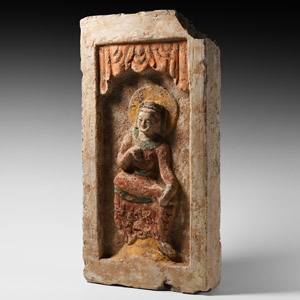
Chinese Wei Buddha Brick
Wei Dynasty, 534-550 A.D.Estimate: £150 - 200 (+bp*)
Opening Bid: £83
A rectangular ceramic Buddha brick with rectangular niche, displaying a seated Buddha figure beneath a canopy; remains of vibrant polychrome pigmentation. 4.69 kg, 34 cm high
Fair condition.
Acquired in the 1970s. From a Hong Kong collection. London collection, 1990s-2000s. -
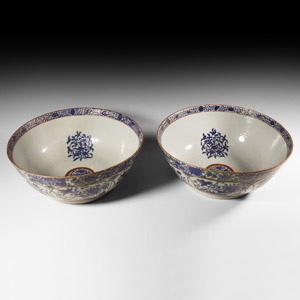
Large Chinese Decorated Porcelain Bowl Pair
Early 19th century A.D.Estimate: £2,000 - 3,000 (+bp*)
Opening Bid: £1,000
A pair of enamelled export porcelain bowls, decorated with a polychrome frieze of scalloped cartouches displaying birds perched amongst fruiting vegetation, insects in the field, repeated around the neck with flowering plants alternating with cartouches depicting birds amongst vegetation; interior with gilt roundel to base with floral spray, three plants around. 4.9 kg total, 35.5 cm wide
From a UK private collection. This lot has been checked against the Interpol Database of stolen works of art and is accompanied by search certificate number no.11717-198623.
