
Loading, please wait...
LOT 1529
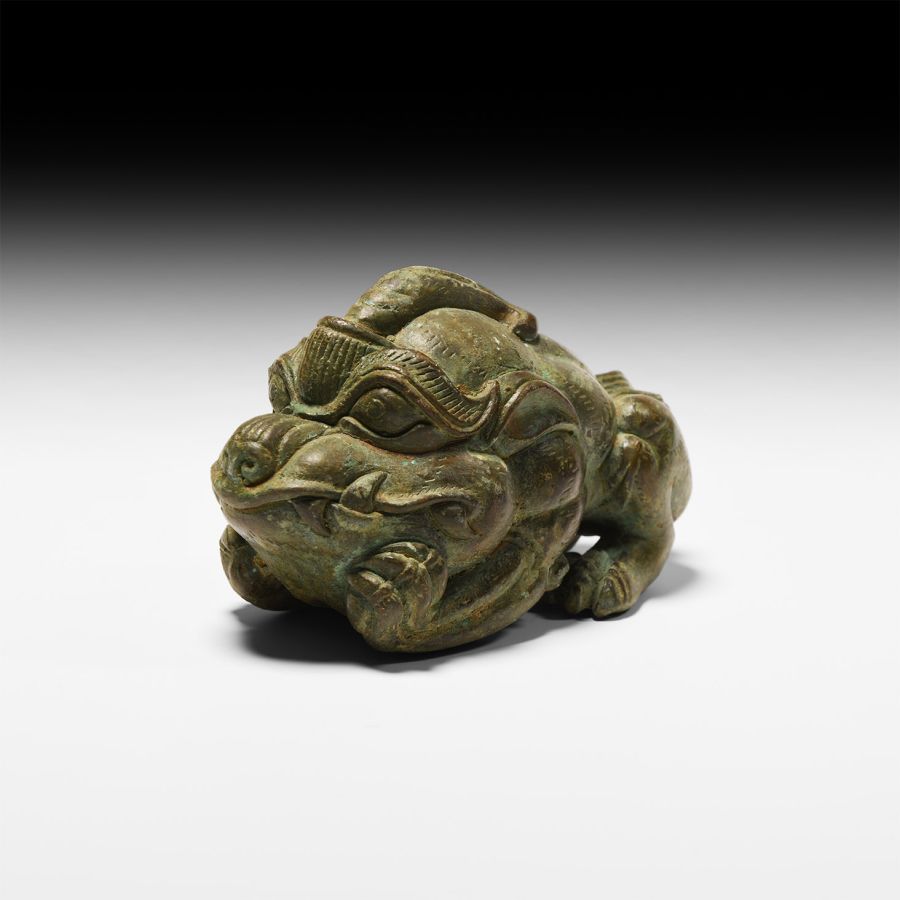
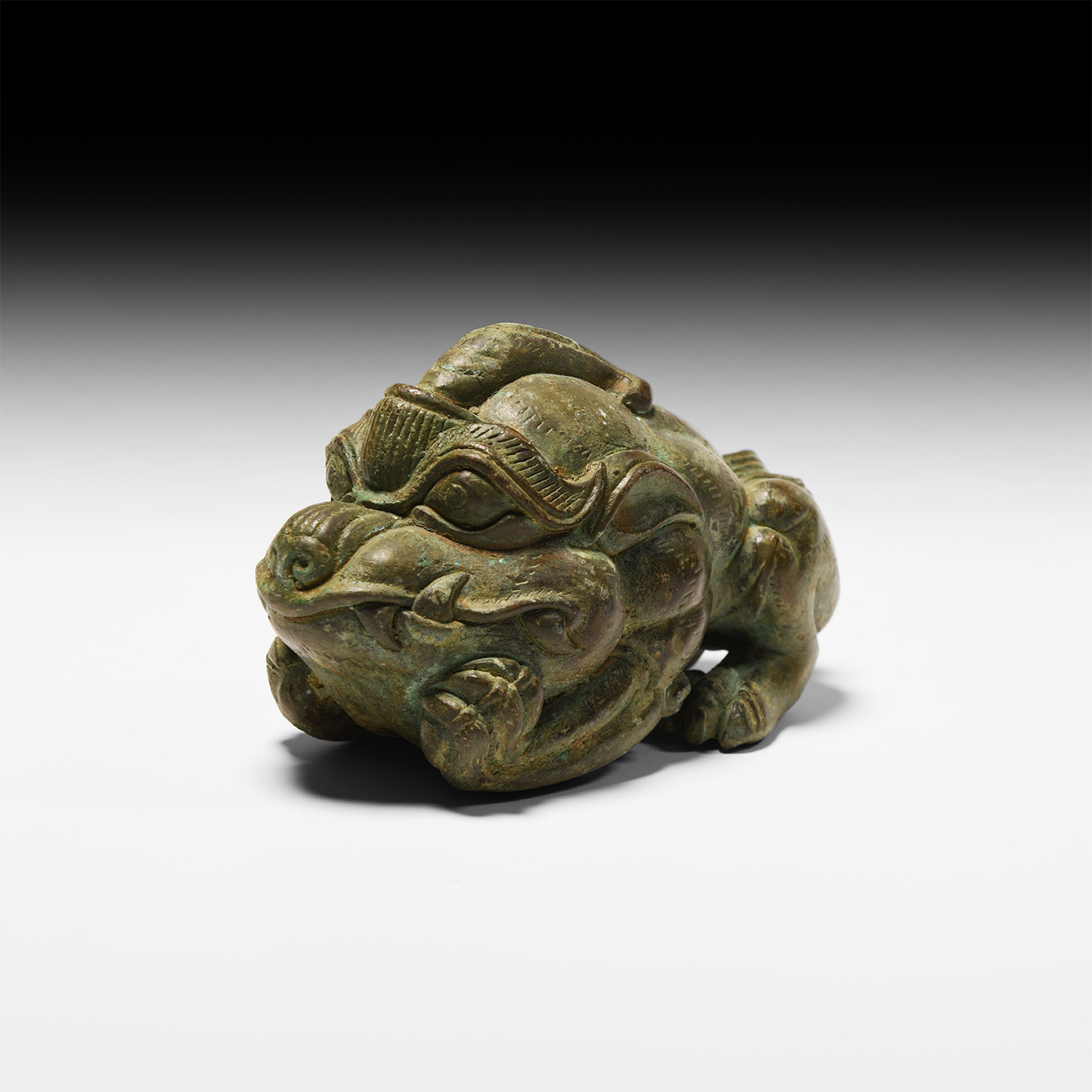
Chinese Han Style Beast Weight
20TH CENTURY A.D.
4 3/4 in. (679 grams, 12.1 cm).
A bronze weight formed as a stylised beast with exaggerated facial features, curved tusks, bristles to the back; hollow to the underside.
ProvenanceAcquired 1980-1990s.
From a West Country collection.
TimeLine Auctions follows a vetting process to ensure the authenticity and legality of all items, reinforcing our commitment to integrity and responsible trading. Each antiquity, antique, and coin lot undergoes thorough examination by a vetting committee of at least ten external specialists, professional trade association members, scientists, and archaeologists: Our Vetting Process
AUCTIONS:
TimeLine is a leading auction house specialising in antiquities, ancient art, collectables, natural history, coins, medals, and books. Our auctions offer museums, collectors, historians, and enthusiasts the opportunity to acquire unique and historically significant pieces.
LOT 1529
Chinese Han Style Beast Weight
Estimate £250 - 350€290 - 410 (for guidance only)$340 - 470 (for guidance only)
-
South East Asian Dragon Terminal
11th-12th century A.D.Sold for (Inc. bp): £33
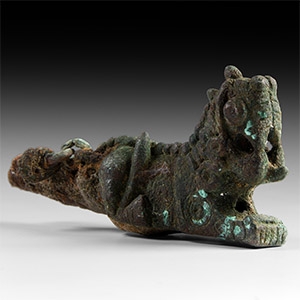
A copper-alloy terminal formed as a couchant dragon modelled with forepaws outstretched, stylised head with bulging eyes and four huge fangs, tail curved to one side of the body, chain with dangle to rear and tapering cylindrical bar. 186 grams, 10 cm wide
Essex gallery, early 2000s. -
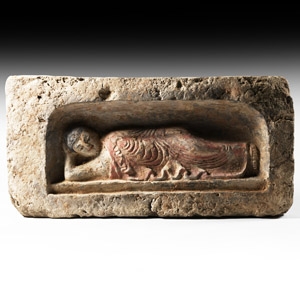
Chinese Wei Brick with Buddha in Paranirvana
Wei Dynasty, 534-550 A.D.Sold for (Inc. bp): £416
A rectangular ceramic brick bearing a high-relief image of Buddha in Paranirvana, set within a rectangular niché, head resting on raised arm and hand, detailing to the face, ushnisha, hands, feet and robes; remains of painted pigmentation. 5.2 kg, 35.5 x 17 cm
Acquired 1970-1990s. Ex Hong Kong collection. From a private West Country collection. -

Chinese Wei Shakyamuni Buddha on Lion Throne
Northern Wei Dynasty, 386-534 A.D.Sold for (Inc. bp): £3,380
A gilt-bronze figure (after the Gandharan style, or that of the neighbouring Uddiyana region), of Shakyamuni Buddha modelled with his hands clasped together in dhyana mudra and seated in the dhyanasana posture on a throne flanked by two roaring lions; robes with U-shaped folds in the Mathuran style and the head with a prominent ushnisha. 95 grams, 70 mm
Fine condition.
Acquired for the ‘Buckingham Collection’ by the late Nik Douglas (1944-2012), renowned author, curator and Asian art expert; the collection formed from the early 1960s to early 1970s; displayed at the major exhibition ‘The Buddha Image: Out of Uddiyana’, Tibet House, 22 West 15th Street, New York, 16 September-20 October 2010, extended to 16 November and again to 7 January 2011; where the collection of one hundred pieces was publicly valued at US$ 15M; this piece was scheduled to be included in an exhibition titled ‘On the Silk Route; Birth of The Buddha’, to be held in London from November 2012, but sadly his death prevented this. Accompanied by copies of several press releases and articles for the exhibition, including Artnet News, This Week in New York, Huffpost, Buddhist Art News, and copies of the relevant London and Tibet House exhibition catalogue pages. This lot has been checked against the Interpol Database of stolen works of art and is accompanied by search certificate number no.10907-168639.
Gandhara was a principal gateway through which Buddhism spread to China. Academic research conducted after the death of Nik Douglas (above) explains that Gandharan sculpture has been found in neighbouring regions, such as in Uddiyana. Sculpture from the Gandharan and Uddiyana regions has similar characteristics and as a result has often remained undifferentiated. As a result of this recent research however, it is becoming more feasible to identify distinctions between the sculpture of these different regions.
