
Loading, please wait...
LOT 1075
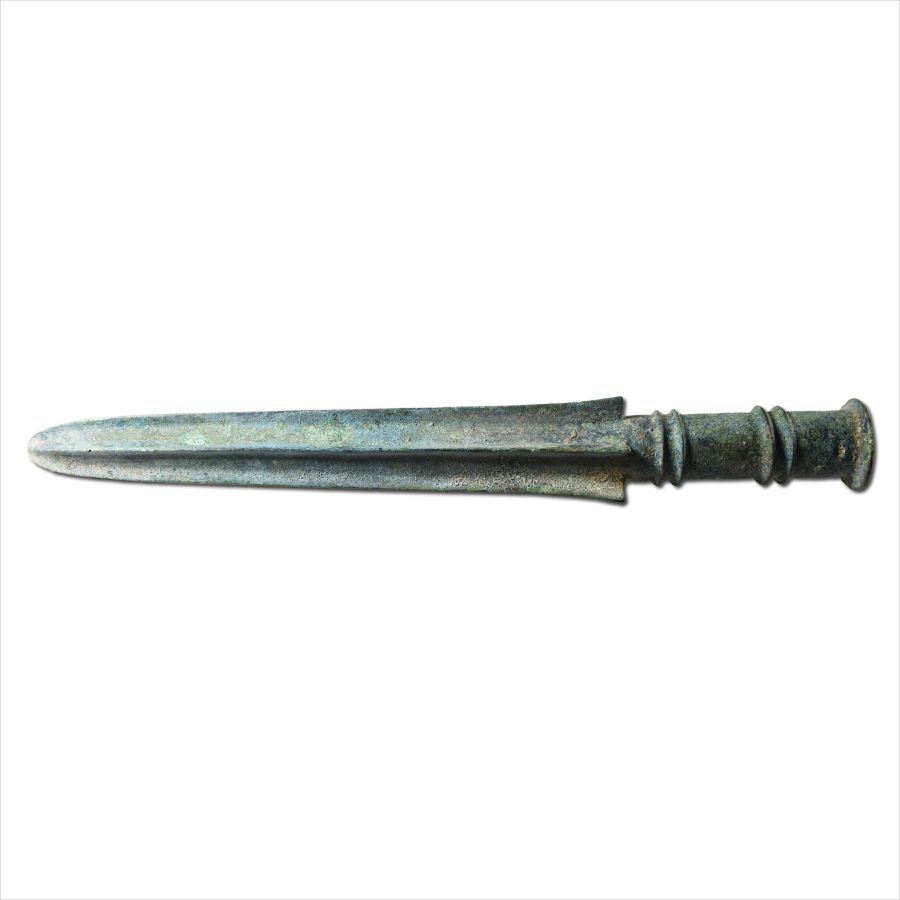
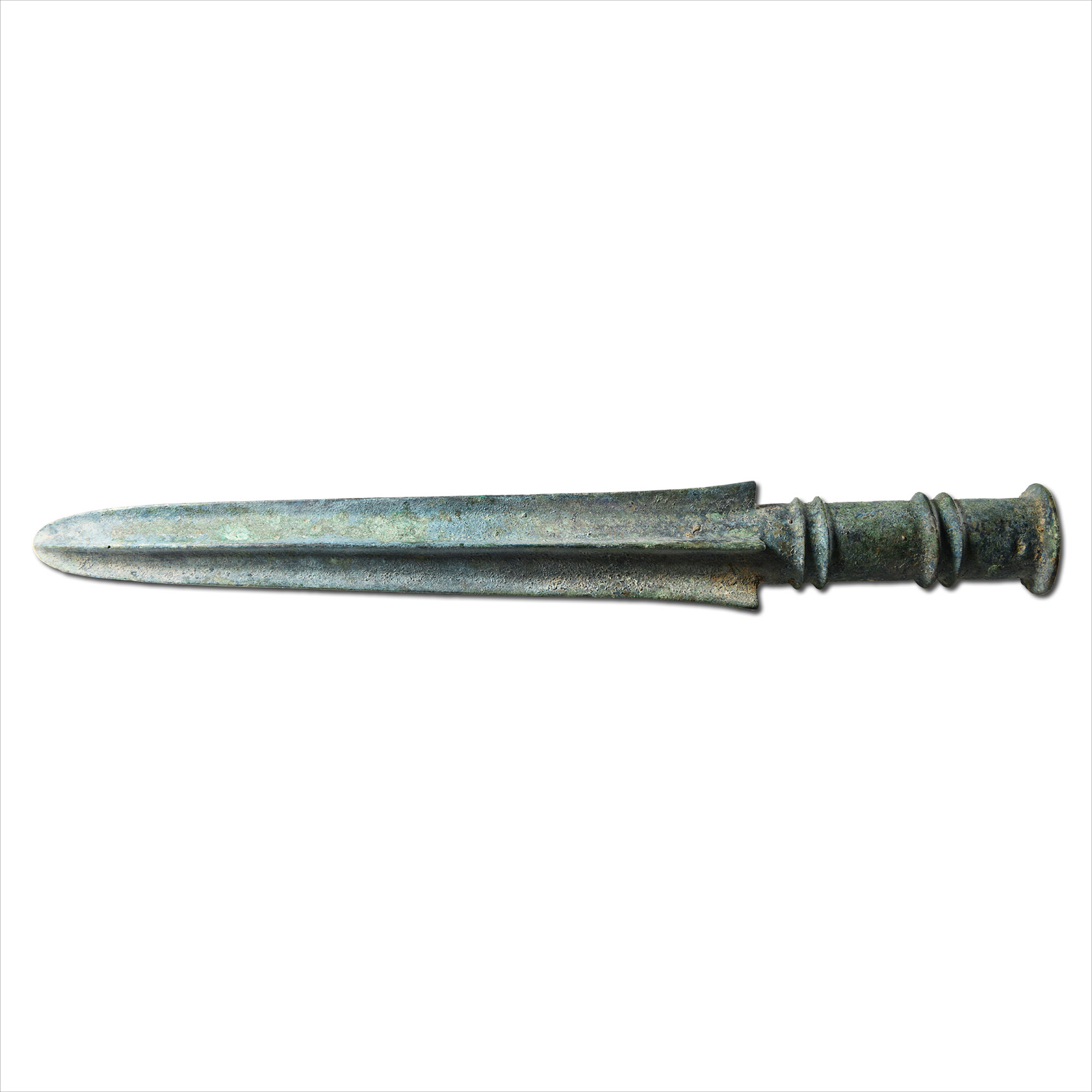
Chinese Bronze Military Flag or Banner Finial
CIRCA 5TH-3RD CENTURY B.C. OR LATER
13 3/8 in. (873 grams, 34 cm).
Composed of a socketted blade divided into six sections with sharp grooves, the shaft with four circumferential bands.
ProvenanceEx old English collection.
London art market, pre 2000.
Property of a London, UK, gentleman.
Cf. Gorelik, M., Weapons of Ancient East, IV millennium BC-IV century BC, Saint Petersburg (2003), pl.XXXVIII, nos.54, 58-59, for similar.
FootnotesThe Chinese, having adopted the use of chariot from the west, judging by the monuments and literature used it primarily for archery combat, as evidenced by the absence of spearheads in chariot burials of the Yin Kingdom. But already from the early Zhou Dynasty chariot warriors used a spear. Massive Yin spears were the weapon of dense infantry formations. The shape of our specimen, probably used as standard finial, recalls that of a spear from Zhongzhoulu, Luoyang, Prov. Henan, dated at the 5th-4th centuries B.C., and of two spears from the Zheng fortress of Xinzheng Country, dated to the 4th-3rd century B.C.
CONDITIONTimeLine Auctions follows a vetting process to ensure the authenticity and legality of all items, reinforcing our commitment to integrity and responsible trading. Each antiquity, antique, and coin lot undergoes thorough examination by a vetting committee of at least ten external specialists, professional trade association members, scientists, and archaeologists: Our Vetting Process
AUCTIONS:
TimeLine is a leading auction house specialising in antiquities, ancient art, collectables, natural history, coins, medals, and books. Our auctions offer museums, collectors, historians, and enthusiasts the opportunity to acquire unique and historically significant pieces.
-
Roman Praetorian Guard Terracotta Sling Shot with Scorpion
1st century A.D.Sold for (Inc. bp): £286
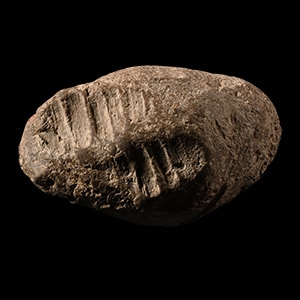
Lentoid section with a raised 'keel' to one end, depicting a stylised scorpion. 25.75 grams, 43 mm
Ex Simmons Gallery, London E11, UK, in the 1990s. From a North London collection.
The sling (funda) with its lead (plumbea pondera) and stone missiles was used by special funditores, illustrated on Trajan’s Column where they are dressed in broad tunics with no armour, but carry a shield. Interestingly, this glans has the emblem usually associated with the Praetorian Guard - the scorpion. It was an emblem also used in Ptolemaic Egypt, and it is not impossible that this bullet could be Ptolemaic or Romano-Egyptian. We believe this bullet could be associated with the Praetorian regiments which means this could be one of the first pieces of evidence for their use. -
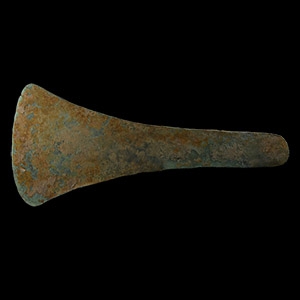
Western Asiatic Bronze Flat Axe
2nd millennium B.C.Sold for (Inc. bp): £117
Flat in cross-section with a convex cutting edge and rounded butt. 178 grams, 20.3 cm
Acquired 1980-2015. Ex Abelita family collection.
This flat axe belongs to Type 1, sub-type a.4 of the Çetin-Bilgi classification of flat axes. They have concave-sided blade, rectangular in section, a splayed cutting edge and a narrow butt. The first examples of axe-type weapons appear in the last phase of the Late Chalcolithic Age in the Middle East and Anatolia. -
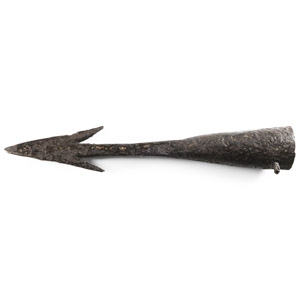
Late Roman Iron Socketted Javelin
4th-6th century A.D.Sold for (Inc. bp): £208
Fitted with a triangular blade with two barbs, expanding tubular socket. 213 grams, 23.5 cm
From the private collection of a London gentleman, from his grandfather's collection formed before the early 1970s.
Since the third century, Roman soldiers increasingly started to use long shafted socketed weapons with barbed heads. These weapons were called bebrae by Vegetius, according to whom they were able to cut heads with a single stroke. They first appeared in Northern Europe, as shown by numerous finds of barbed heads in graves and peat-bogs, especially Danish, and were introduced to the Roman army by Germanic mercenaries.
