
Loading, please wait...


LOT 0383
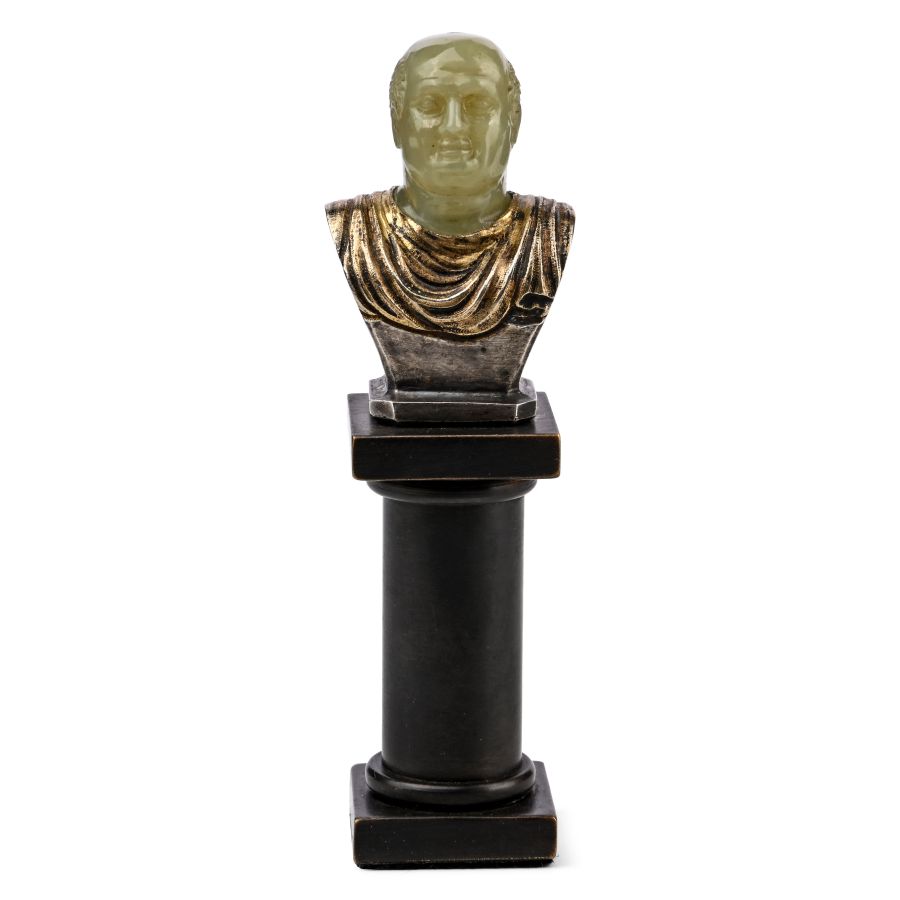
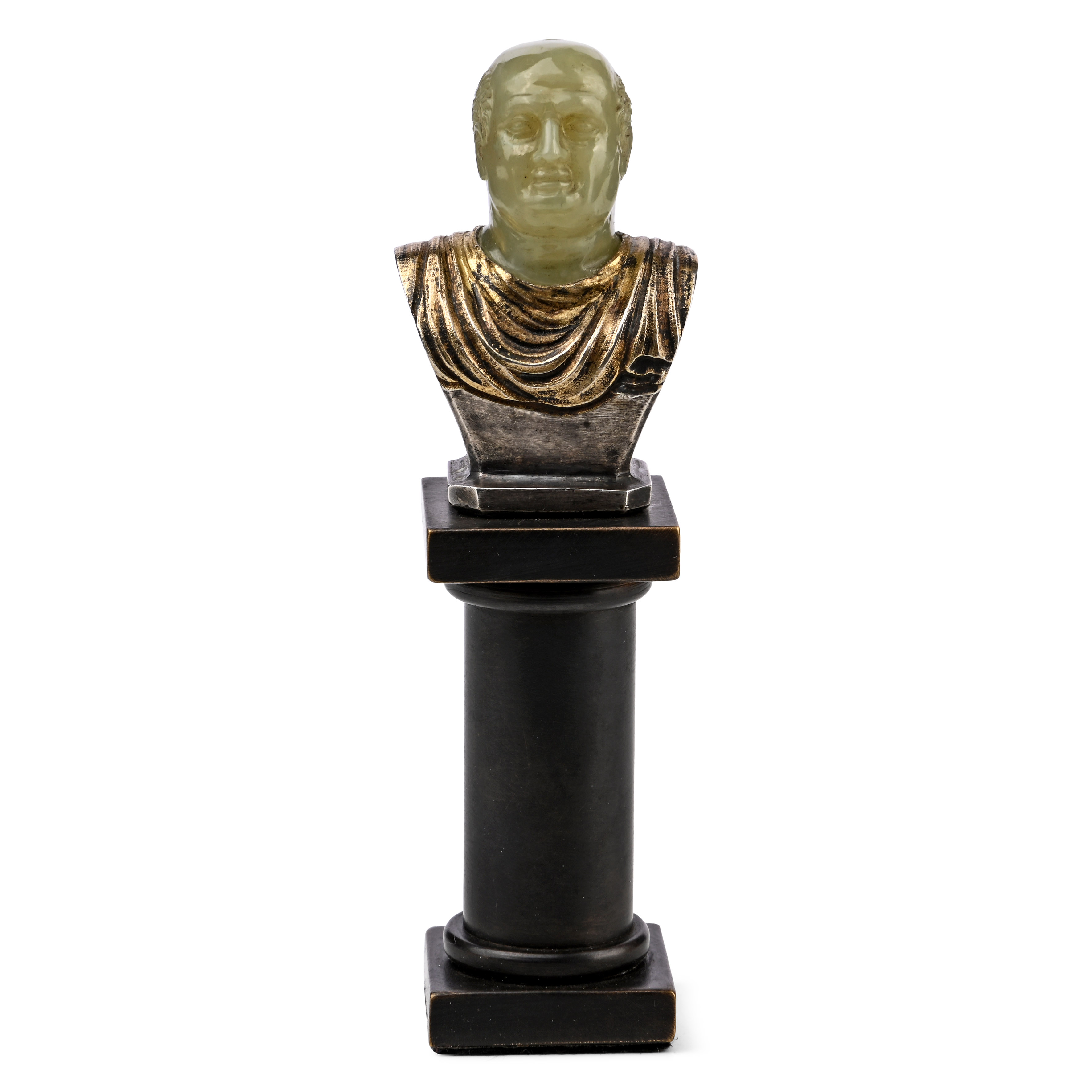
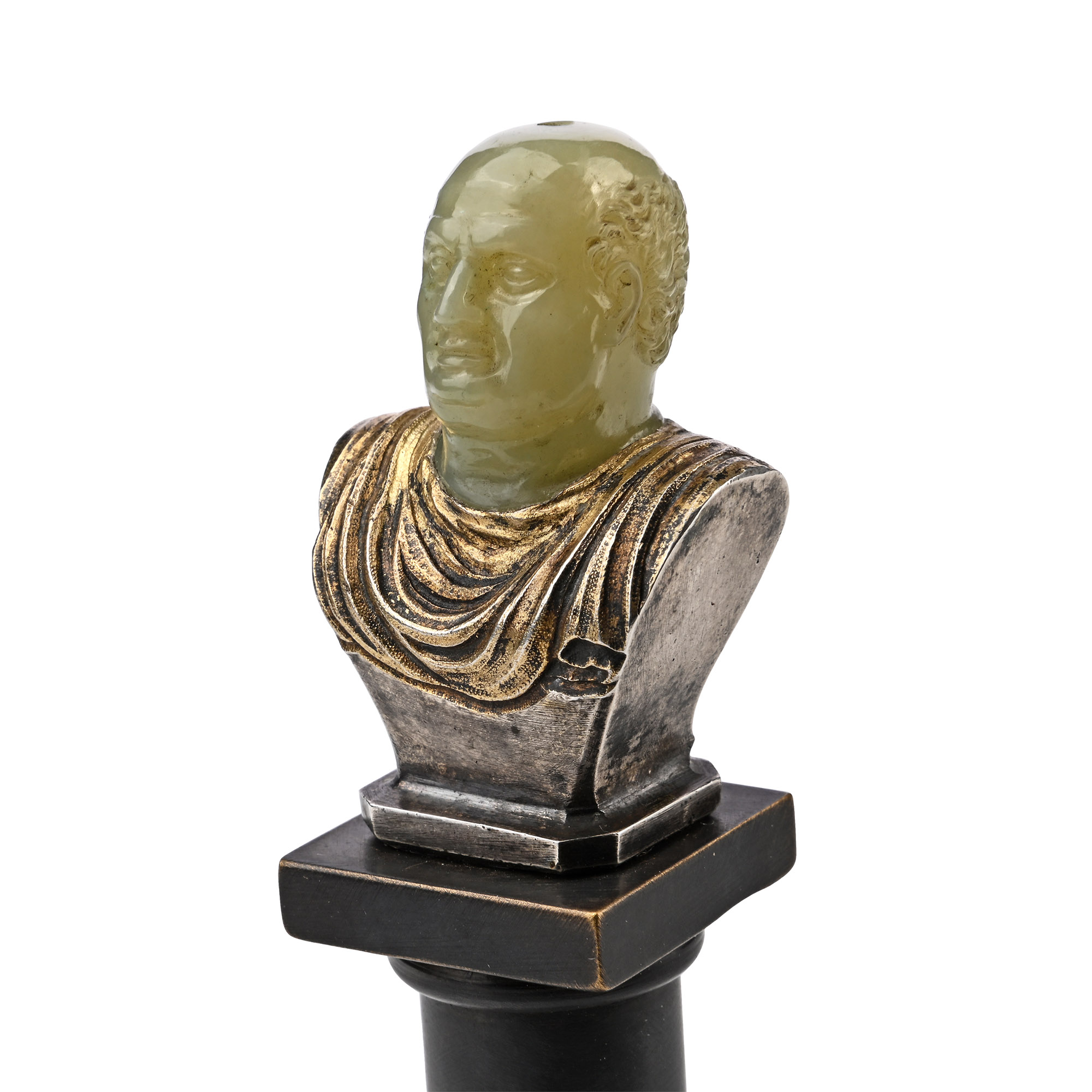
Chalcedony and Silver-Gilt Bust of the Emperor Vespasian
ITALY, 17TH-18TH CENTURY A.D.
4 1/4 in. (208 grams total, 10.9 cm high including stand).
The head, carved from pale green chalcedony, polished to a smooth lustre and with a drilled aperture at the crown, the hair in tight curls around the nape and crown; the silver-gilt torso dressed in a draped toga carefully chased with deep folds and traces of gilding across the high points; mounted on a later patinated bronze column stand in the neoclassical manner.
ProvenanceAcquired on the European art market.
LiteratureSee for comparable mounted hardstone busts of emperors, frequently combining chalcedony, agate or jade with gilt-metal or bronze mounts, in the Munich Residenz Treasury and the Grünes Gewölbe, Dresden, both collections rich in small-scale lapidary works of the seventeenth and eighteenth centuries.
FootnotesThis small-scale portrait evokes the Roman tradition of imperial portraiture and the early modern fascination with the ancient world. From the seventeenth century onwards, artists and collectors revived classical subjects through hardstone and gilt-metal compositions, often intended for display in Kunstkammer or Grand Tour contexts. The combination of a reused ancient or earlier element with a later mount was a practice typical of the Renaissance and Baroque periods, reflecting the period’s reverence for antiquity and its imaginative recontextualisation of ancient forms.
CONDITIONTimeLine Auctions follows a vetting process to ensure the authenticity and legality of all items, reinforcing our commitment to integrity and responsible trading. Each antiquity, antique, and coin lot undergoes thorough examination by a vetting committee of at least ten external specialists, professional trade association members, scientists, and archaeologists: Our Vetting Process
AUCTIONS:
TimeLine is a leading auction house specialising in antiquities, ancient art, collectables, natural history, coins, medals, and books. Our auctions offer museums, collectors, historians, and enthusiasts the opportunity to acquire unique and historically significant pieces.
LOT 0383
Chalcedony and Silver-Gilt Bust of the Emperor Vespasian
Estimate £1,500 - 2,000€1,740 - 2,320 (for guidance only)$2,030 - 2,700 (for guidance only)
-
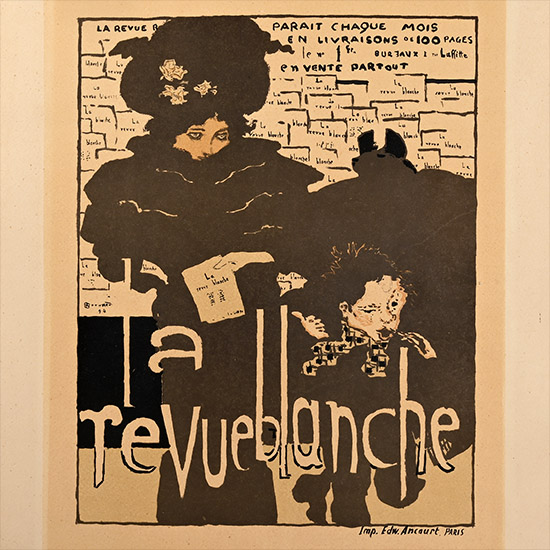
Pierre Bonnard, Les Maitres de l'Affiche, Plate 38 - Original La Revue Blanche Poster
1896 A.D.Sold for (Inc. bp): £468
Buff-coloured paper reproduction poster with grey, sepia and black image of a woman in hat and fur coat with a child at her side; large lettering to lower centre 'La Revue Blanche'; title in handwritten script 'La Revue parait chaque mois en livraisons de 100 pages le No 1ere nureaux 3 rue Laffitte en vente partout'; 'bottom right blind stamp 'Imp. Edw. Ancourt, Paris'; bottom left 'Les Maîtres de l'Affiche Pl.38 / Imprimerie Chaix / (Encres Lorilleux & Cie.)' 49 grams, 39.6 x 29 cm
Acquired on the UK art market. Property of a Harwich, UK, collector. -
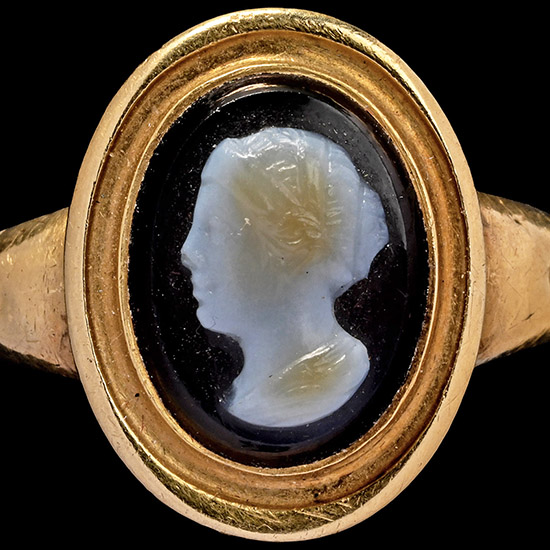
Post Medieval Banded Agate Cameo of a Woman in Gold Ring
18th century A.D.Estimate: £600 - 800 (+bp*)
Current Winning Bid: £30
Hollow-formed with pie-dish bezel and inset cameo. 3.17 grams, 21.26 mm overall, 17.72 mm internal diameter (approximate size British L, USA 5 3/4, Europe 11.24, Japan 10)
Private collection, Europe. Acquired on the English art market.
The cameo is Italian and carved in the classical style of the 2nd century AD, although it dates to the 18th century. Her hair is tied back, and she is wearing a double-banded diadem. The agate displays a deep umber hue, with the bust depicted in light bluish white with highlights of light caramel. In the late 18th century, interest in the classical world became exponentially high, and demand became great for objects from or relating to the ancient world. The high-carat gold ring dates to the late 18th century; there is a small dent to the shoulder of the band. -
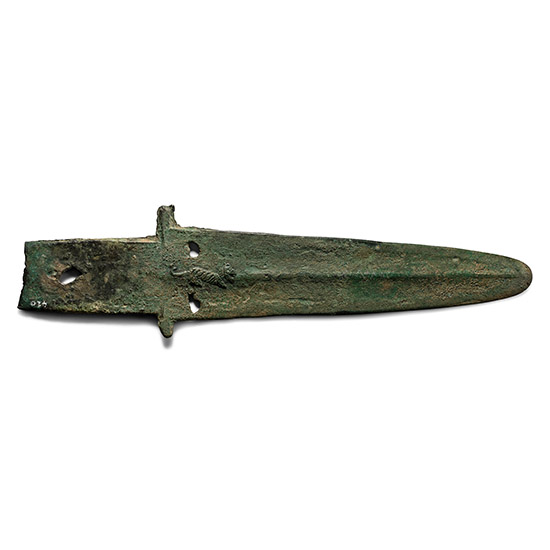
Chinese Bronze Warring States Style Dagger
20th century A.D. or earlierSold for (Inc. bp): £234
Flat-section blade with a rounded tip and a wide, pierced tang. 110 grams, 22.2 cm
Ex Ma Gallery, Bath, UK. From a private Wiltshire, UK, collection, 1990s.
