
Loading, please wait...
LOT 1048
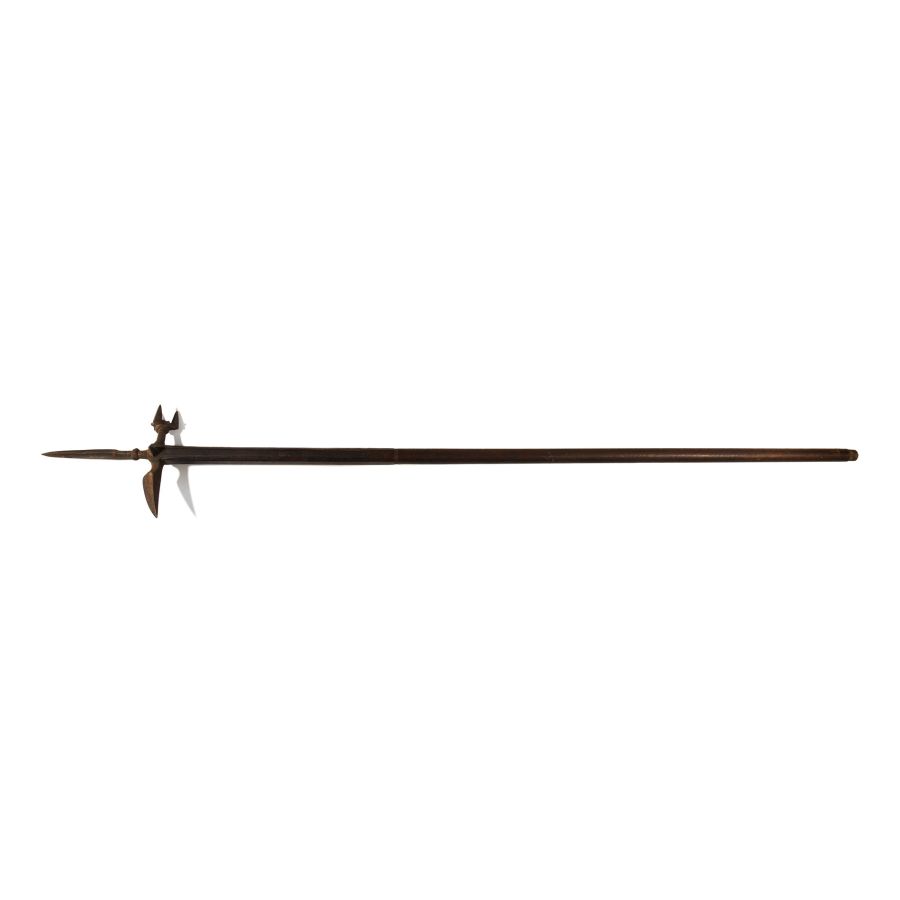
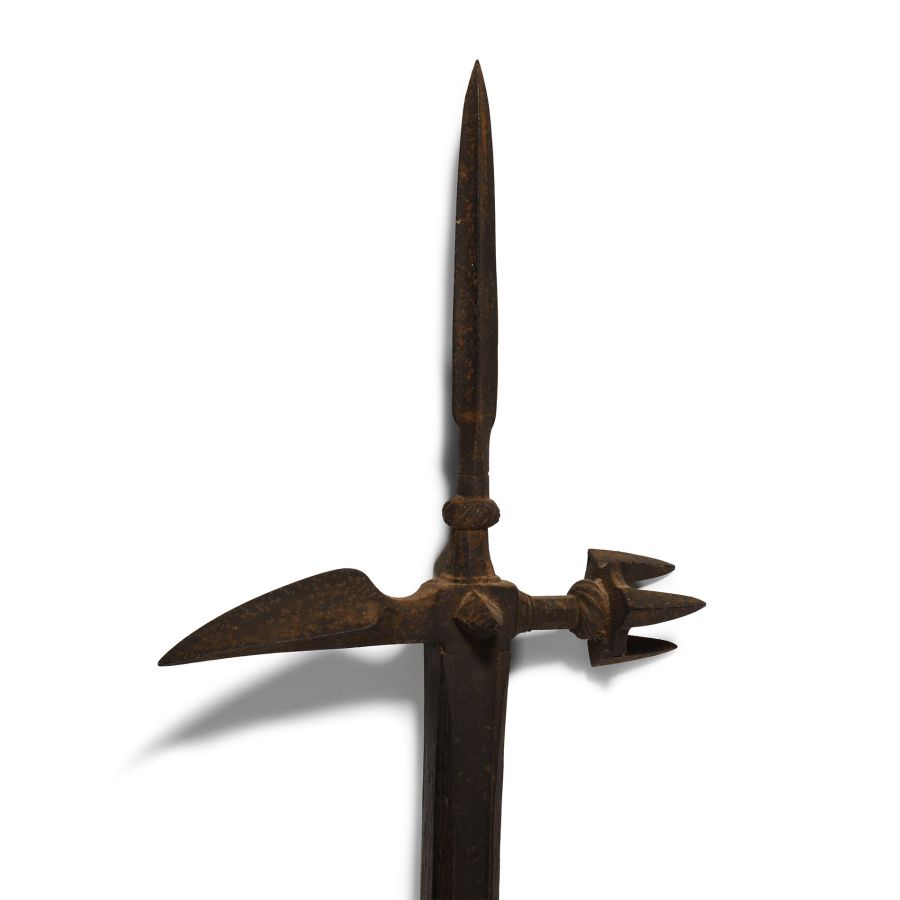
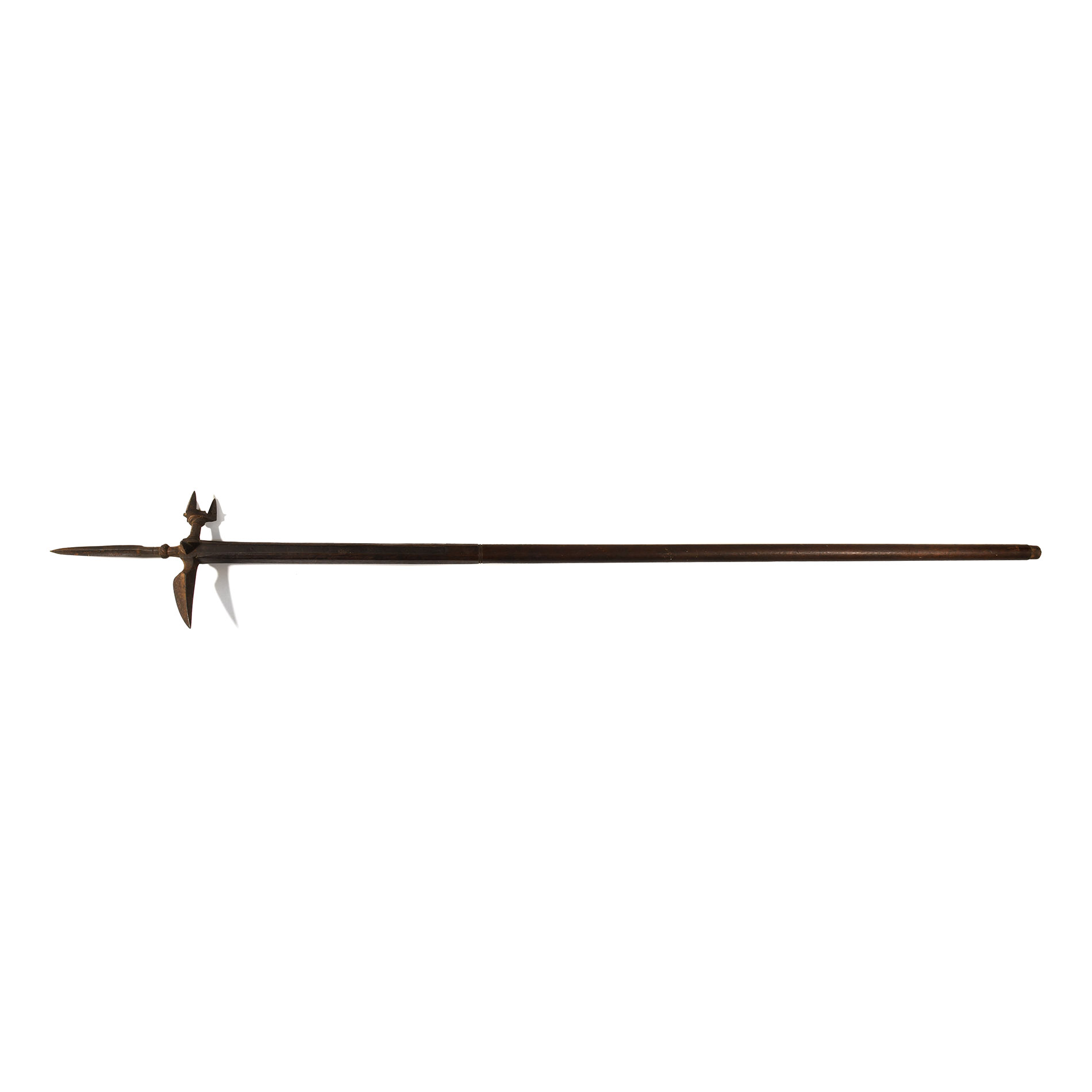
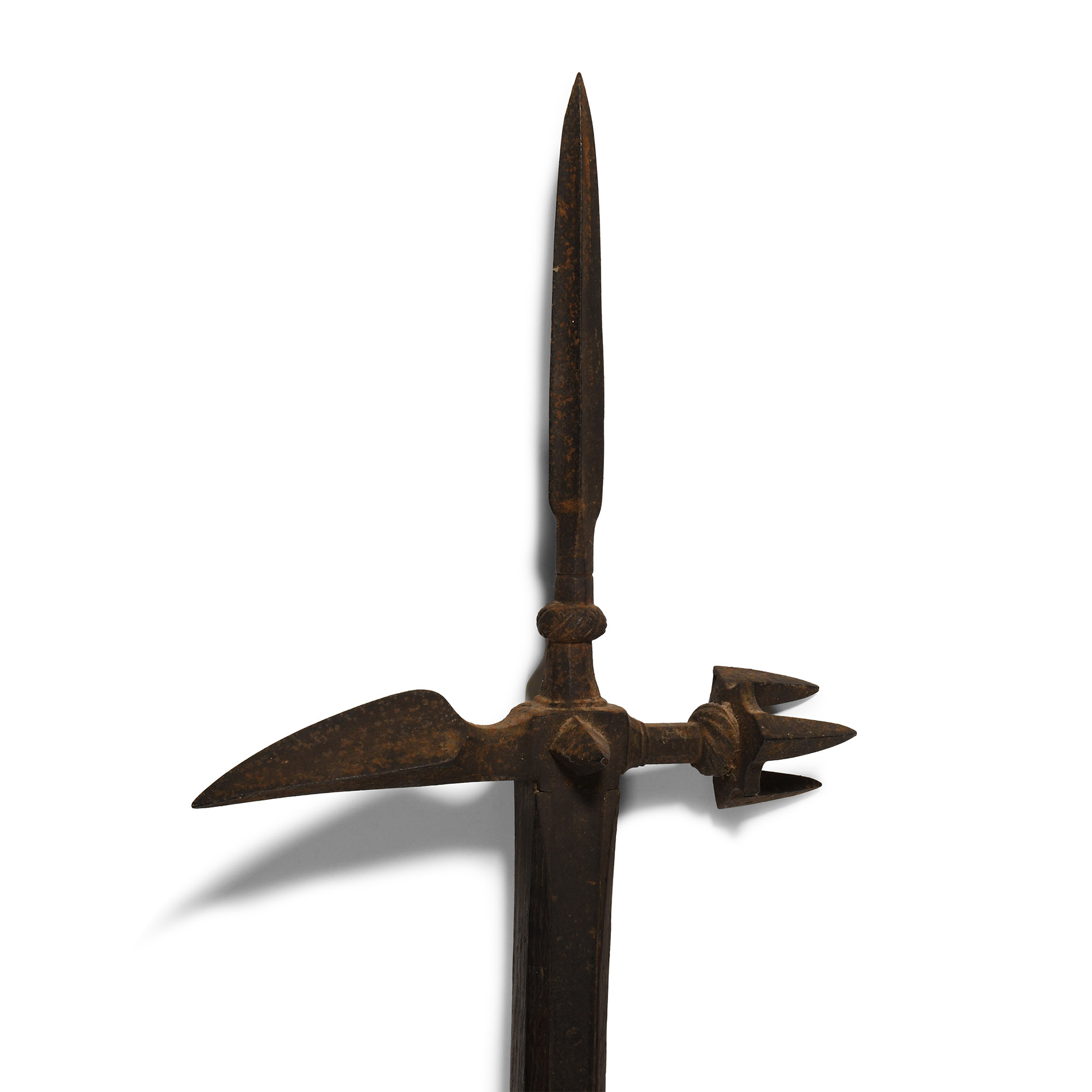
Ceremonial Polearm with Wooden Shaft
CIRCA 18TH CENTURY A.D.
70 7/8 in. (2 kg, 1.8 m).
Iron-headed 'Lucerne hammer' on a short wooden shaft; the hammer-face with three sturdy spikes, square-section spearhead above and curved bec de corbin to the rear with two short lateral spikes, languets extending down the faces of the shaft.
ProvenanceAcquired UK art market, 1980s-1990s.
Property of a Suffolk, UK, gentleman collector.
Cf. Oakeshott, E., European Weapons and Armour, London, 1980, p. 51.
CONDITIONTimeLine Auctions follows a vetting process to ensure the authenticity and legality of all items, reinforcing our commitment to integrity and responsible trading. Each antiquity, antique, and coin lot undergoes thorough examination by a vetting committee of at least ten external specialists, professional trade association members, scientists, and archaeologists: Our Vetting Process
AUCTIONS:
TimeLine is a leading auction house specialising in antiquities, ancient art, collectables, natural history, coins, medals, and books. Our auctions offer museums, collectors, historians, and enthusiasts the opportunity to acquire unique and historically significant pieces.
-
.jpg)
Western Asiatic Bronze Arrowheads, Javelin Heads and Daggers
3rd millennium-7th century B.C.Estimate: £180 - 240 (+bp*)
Opening Bid: £90
Comprising ten slender tanged arrowheads, javelin heads and daggers, some lozenge-section and some with raised midribs. 329 grams total, 14-21.5 cm
Acquired 1980-2015. Ex Abelita family collection.
Most of these blades are bipartite, but the definition of the bipartite type is not absolute as it brings together weapons of very different and unrelated designs. In fact, some weapons do not have a sufficiently characteristic shape to be interpreted as a spear, dagger, or long arrowhead. The javelin heads classified by Gernez as type Type L 3 are characterized by the simplicity of their design. They have a sharp and/or pointed active part, a flat, elliptical or rhomboidal cross-section and an elongated tang with a rectangular, square or circular section, ending in a pointed, widened, curved or folded blade. -
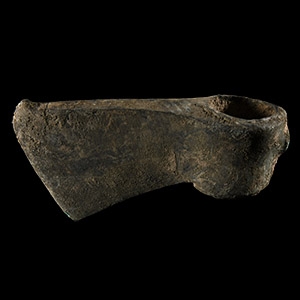
Heavy Western Asiatic Bronze Axehead
Late 3rd millennium B.C.Estimate: £100 - 140 (+bp*)
Opening Bid: £50
With swept blade, large socket with shallow raised circumferential rib and a vertical rib to the rear. 741 grams, 14.5 cm
Acquired 1980-2015. Ex Abelita family collection.
In the middle of the 3rd millennium B.C., the most widespread types of axes were those made for splitting and those for cutting. In the last third of this millennium there emerged a sharp differentiation between such axes. Such a sharp division by function should be associated with the influence of the Syro-Palestinian tradition. Such differentiation, in the absence of some multifunctional forms can be observed from the end of the 4th millennium B.C. and during the 3rd millennium B.C. -
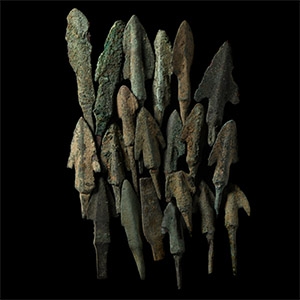
Western Asiatic Bronze Arrowhead Group
10th-9th century B.C.Sold for (Inc. bp): £117
Comprising mainly tanged arrowheads, the most of them having large elongated triangular blades and raised midrib, sharp central groove, cylindrical or squared stem for the shaft, barbed shoulders and convex sides; others with lanceolate head and rounded shoulders with long tang and foliate-section. 103 grams total, 29-68 mm
Acquired 1980-2015. Ex Abelita family collection.
The most of these arrowheads, having a lozenge-section midrib with thin blades filed sharp at the edges, are typical of the early Iron Age in Luristan. These arrowheads seem to belong to the type V, subcategory types A, C and D according to the classification of Khorasani and Negahban. In the four categories of triangular bronze arrowheads from Luristan, Marlik, and Northern Iran individuated by Negahban, subtypes C and D of type V are larger arrow or javelin heads, C with barbed shoulders and D with round shoulders. Subtype A is substantially similar to C, but smaller. Similar arrowheads are also visible in the Western Iberian and Balkan cultures in the Early Iron Age.
