
Loading, please wait...
LOT 0923
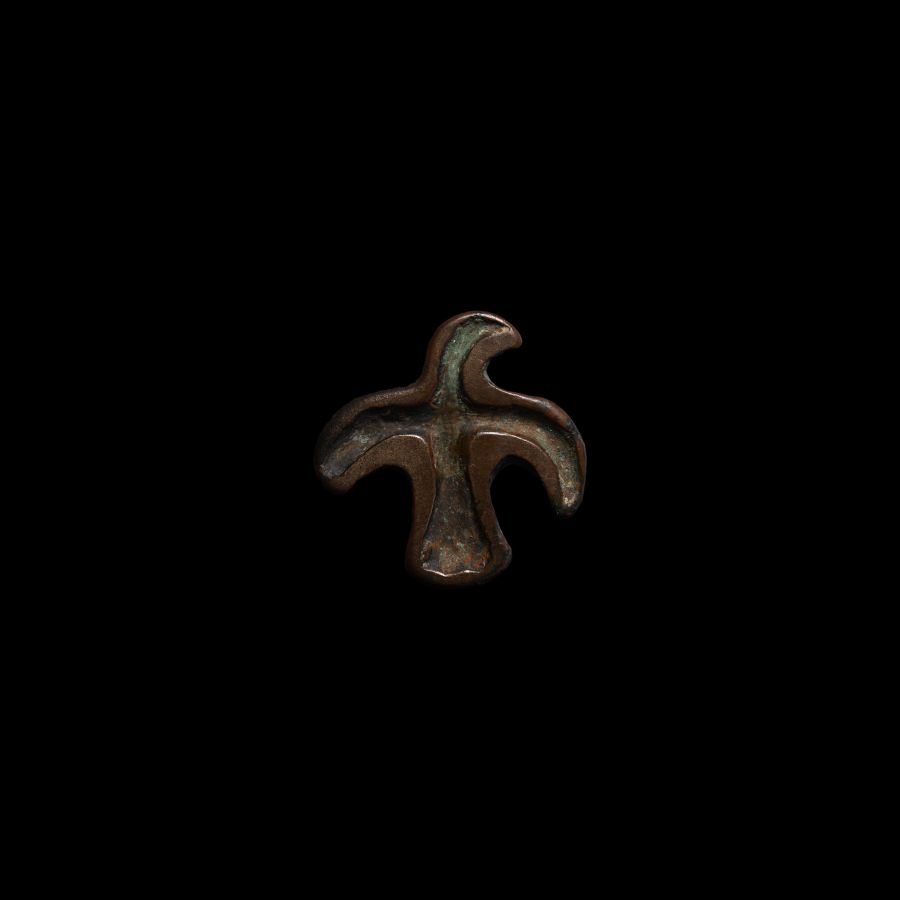
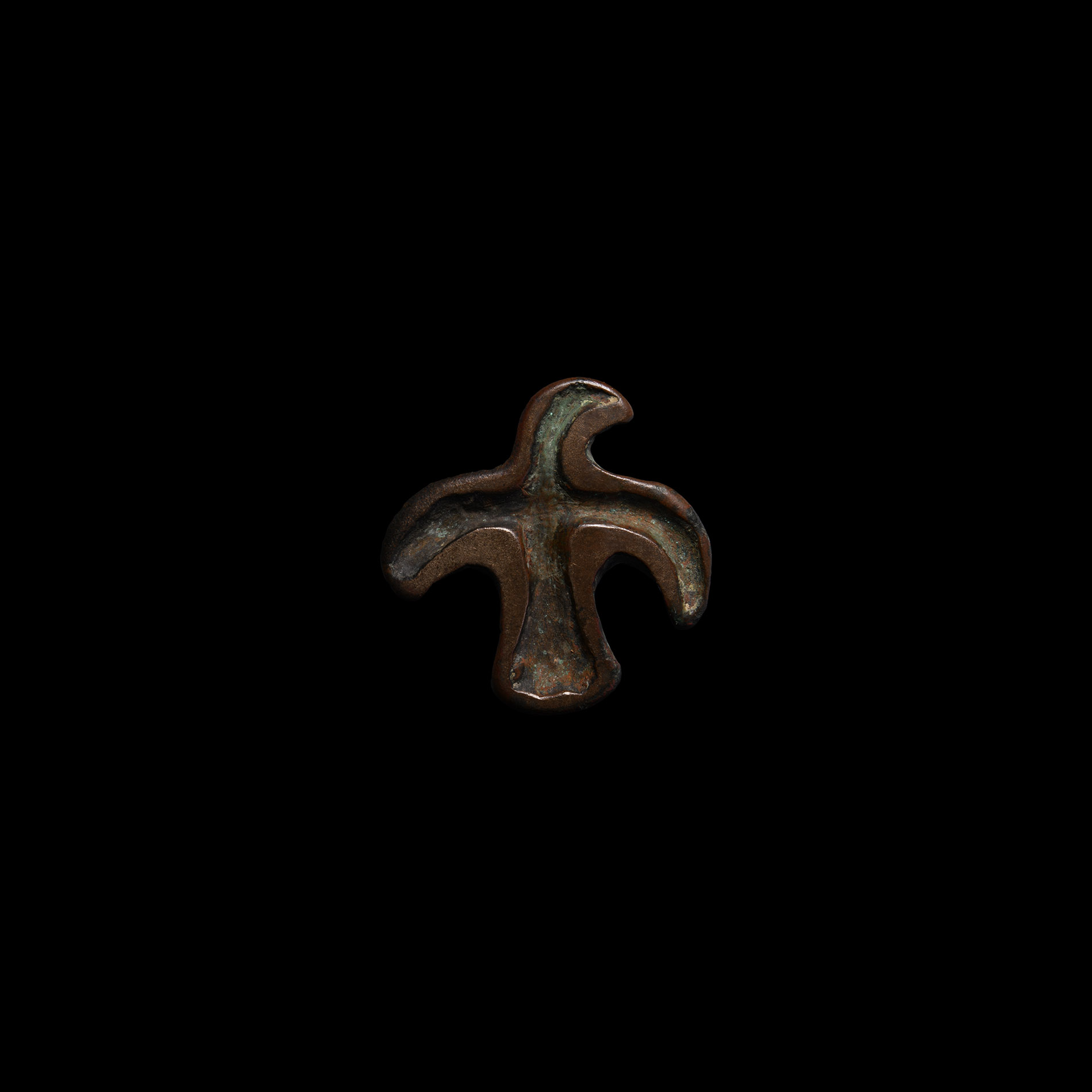
Central Asian Seal Pendant with Spread Eagle
23RD-20TH CENTURY B.C.
1 1/8 in. (13.6 grams, 28 mm).
A bronze seal pendant in the form of an eagle with spread wings, with suspension loop to reverse; accompanied by a typed and signed scholarly note by W.G. Lambert, the late Professor of Assyriology at the University of Birmingham, 1970-1993, which states: '...This has the shape of a heraldic eagle: head sideways at the top, wings spread out, and tail feathers down. The face is flat and the eagle shape is hollowed out away from the edges. The back is generally convex, and has a big loop handle attached. The seal comes from west-central Asia and dates to c.2300-2000 B.C. It is an attractive piece and is in very good condition.' [No Reserve]
Provenance1980s-early 1990s collection, UK.
Accompanied by an original typed and signed scholarly note issued by the late Professor W.G. Lambert.
TimeLine Auctions follows a vetting process to ensure the authenticity and legality of all items, reinforcing our commitment to integrity and responsible trading. Each antiquity, antique, and coin lot undergoes thorough examination by a vetting committee of at least ten external specialists, professional trade association members, scientists, and archaeologists: Our Vetting Process
AUCTIONS:
TimeLine is a leading auction house specialising in antiquities, ancient art, collectables, natural history, coins, medals, and books. Our auctions offer museums, collectors, historians, and enthusiasts the opportunity to acquire unique and historically significant pieces.
-
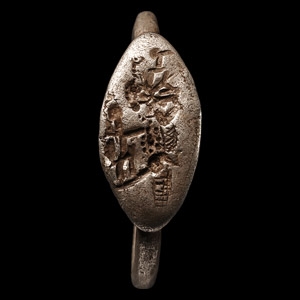
Achaemenid Silver Ring with Warriors
7th-4th century B.C.Estimate: £200 - 300 (+bp*)
Opening Bid: £110
A silver finger ring with scaphoid bezel, incuse image of an armoured warrior with shield and spear, a horseman and a hatched gate or wall. 4.12 grams, 25.84 mm overall, 21.41 mm internal diameter (approximate size British V, USA 10 1/2, Europe 23.77, Japan 22)
Acquired 1980-2015. Ex Abelita family collection. -
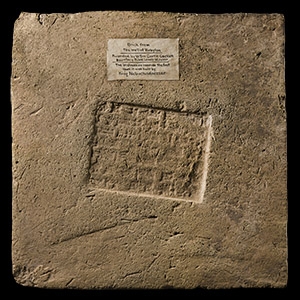
Large 'King Nebuchadnezzar the Great' Brick from the Wall of Babylon
604-562 B.C.Sold for (Inc. bp): £5,980
A large fired clay brick from the Wall of Babylon bearing six lines of stamped Babylonian cuneiform inscription to one face which reads: 'AG - ku -dur-ri-URU' / 'LUGAL ba-bi-lu' / 'za-ni-nu é-sag-ila' / 'u e-zi-da IBILA' / 'SAG.KAL. sa AG-IBILA-URU' / 'LUGAL ba-bi-lu ana-ku', which translates: 'Nebuchadnezzar, king of Babylon, who provides for Esagila and Ezida, the eldest son of Nabopolassar, king of Babylon, am I'; traces of bitumen on the blank side; accompanied by an old label which reads: 'Brick from the Wall of Babylon / Presented by W.Bro. Gentle-Cackett Secretary Bible Lands Mission / The impression records the fact that it was built by King Nebuchadnezzar [II]'. 13.6 kg, 33.5 x 33 cm
Ex Reverend Samuel W. Gentle-Cackett (1871-1943), in the 1930s. Gentle-Cackett was the secretary of the Bible Lands Missions’ Aid Society, 76 The Strand, London, WC2 (1904-1943), author of Palestine Portrayed, 1936, and Worshipful Brother of the Lodge of Sincerity 174. This brick formed part of an old collection of Masonic ephemera, and is believed to have originated from the Lodge of Sincerity 174. Property of a Sussex, UK, teacher. Accompanied by a copy of the book Palestine Portrayed, 1936, written by S.W. Gentle-Cackett. Accompanied by copies of the relevant pages from the book They Wrote on Clay, showing similar bricks in situ.
Genesis 11:3: "And they said to one another, 'Come, let us make bricks, and burn them thoroughly', and they had brick for stone and bitumen for mortar." In the 1920s, Cackett read reports of Christian Armenians being orphaned as a result of attacks from Turks and in response he set up a refuge in Bedfont, where he was able to rehome 1500 children. -
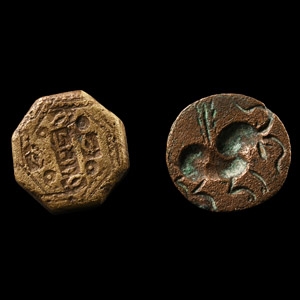
Western Asiatic Animal Seal and Weight Group
Late 1st millennium B.C. and laterSold for (Inc. bp): £78
A group of two copper-alloy artefacts comprising: a discoid stamp seal with suspension lug to reverse, incuse winged and horned quadruped to base; and an 6th-9th century A.D. octagonal weight with pseudo(?) characters to both principal faces and each side facet. 26 grams total, 17-18 mm
Early 1990s London collection. Acquired on the UK art market. From a private collection, Lancashire, UK.
