
.jpg "Celtic Northeast Gaul. Ambiani AR Fraction.")
LOT 3008
Celtic Northeast Gaul. Ambiani AR Fraction. Circa 75-50 BC. Picardy Horse Face type.
Stylised helmet head right, horse's head forming eye and nose / Horse right, with long beaded mane, six armed 'star' in front with ring at centre, two rings above, small horse's head below. LT 8500/8515 var.; BMC 156; Sch/ GB 51, fig. 330; DT 189; Allen 'Les pièces d'argent minces du comté de Hampshire', Revue Numismatique, VI série, VII (1965), p.79-93, pl.V, no.29. Good Very Fine. Toned, great horse, full 'star'. Very rare.(0.48gr, 13mm, 11h.).
ProvenanceEx Chris Rudd, 118, lot 5, ref. no.15074.
From the private collection of John Meredith, acquired since the 1990s; thence by descent.
As Derek Allen (1965) says, this extraordinary type was ultimately derived from the Pallas Athene silver coins of the Aulerci Cenomani (cf. LT 5967, 5973, 5980, 5985) and heavily influenced the Hampshire Thin Silver series of the British Belgae (ABC 911) and the Chichester Chariot Wheel thin silver of the Regini (ABC 701). This lovely example of the Picardy Horse Face explicitly shows a horse's head emerging from the forehead of the stylised head. The spear is also clearly displayed as part of the helmet. The spidery 'star' symbol in front of the horse can be seen again before the horse on the Yarmouth gold stater of the Regini (ABC 518).
TimeLine Auctions follows a vetting process to ensure the authenticity and legality of all items, reinforcing our commitment to integrity and responsible trading. Each antiquity, antique, and coin lot undergoes thorough examination by a vetting committee of at least ten external specialists, professional trade association members, scientists, and archaeologists: Our Vetting Process
AUCTIONS:
TimeLine is a leading auction house specialising in antiquities, ancient art, collectables, natural history, coins, medals, and books. Our auctions offer museums, collectors, historians, and enthusiasts the opportunity to acquire unique and historically significant pieces.
-
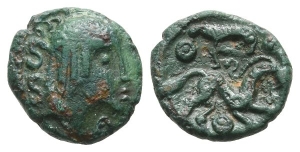
Celtic Northeast Gaul. Ambiani AE Unit. 100-50 BC.
Sold for (Inc. bp): £143
Head of Apollo to right; Ss around / Horse galloping to right, pellet-in-annulets around; above, bird to right. LT 8424; DT 356. 2.58gr, 15mm, 3h.
Good Very Fine. Beautiful green patina with brown highlights.
Ex cgb.fr. (bga_241404). From the private collection of John Meredith, acquired since the 1990s; thence by descent. -
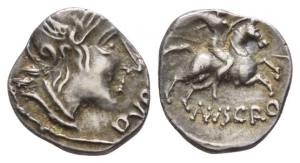
Celtic Southern Gaul. Allobroges AR Quinarius. Circa 75-60 BC.
Sold for (Inc. bp): £104
Helmetted head of Roma to right; DVRNACVS before / Horseman galloping to right, holding spear; AVSCRO below. LT 5762; DT 3157; RIG 148. 1.99gr, 15mm, 3h.
Good Very Fine. Attractive old cabinet toning.
Ex cgb.fr. (bga_238803). From the private collection of John Meredith, acquired since the 1990s; thence by descent. -

Celtic Britannia. Proto Boar, Shaggy Chevron Tail Type AR Unit. Circa 55-45 BC.
Sold for (Inc. bp): £338
Boar right, with 'pin cushion' hackles, beaded ring above / Horse left, with 'pin cushion' mane and shaggy chevron tail, solar rings above, ringed-pellet below. ABC-; VA-; MBC-; S-. 1.09gr, 13mm, 10h.
Good Very Fine. Bright silver, bristly boar, bushy-tailed horse. Extremely rare.
Found Alcaster, Lincolnshire, UK. Ex Chris Rudd, 127, lot 33, ref. no.16072. From the private collection of John Meredith, acquired since the 1990s; thence by descent.
This Shaggy Chevron Tail Type is unlisted by the major catalogues. A superbly strange piece.
