
Loading, please wait...


LOT 0277
Celtic Bronze Openwork Chariot Teret Ring
IRON AGE, 1ST CENTURY B.C.-1ST CENTURY A.D.
2 1/2 in. (64.6 grams, 63 mm).
Comprising: a substantial ring, the upper section formed as a series of conjoined bulbs, the lower portion lentoid in section springing from a bulb; the bulb mounted on a base, C-shaped in section, carinated and recurved at each end to terminate in a knop attached to the underside of the ring; the base developing to a vertical strap with flanking crescent horns meeting at a ribbed collar; beneath the bulb, a rectangular loop to accept a bridle strap; one side of base absent.
ProvenanceAcquired on the UK art market.
Property of a Lancashire, UK, collector.
Cf. Megaw, R.& V., Celtic Art. From its Beginnings to the Book of Kells, London, 1989, item 225, for type.
FootnotesThe design features of the terret are consistent with Insular La Tène art of the last centuries B.C., such as the returned horns with knop finials and the crescent motifs.
CONDITIONTimeLine Auctions follows a vetting process to ensure the authenticity and legality of all items, reinforcing our commitment to integrity and responsible trading. Each antiquity, antique, and coin lot undergoes thorough examination by a vetting committee of at least ten external specialists, professional trade association members, scientists, and archaeologists: Our Vetting Process
AUCTIONS:
TimeLine is a leading auction house specialising in antiquities, ancient art, collectables, natural history, coins, medals, and books. Our auctions offer museums, collectors, historians, and enthusiasts the opportunity to acquire unique and historically significant pieces.
-
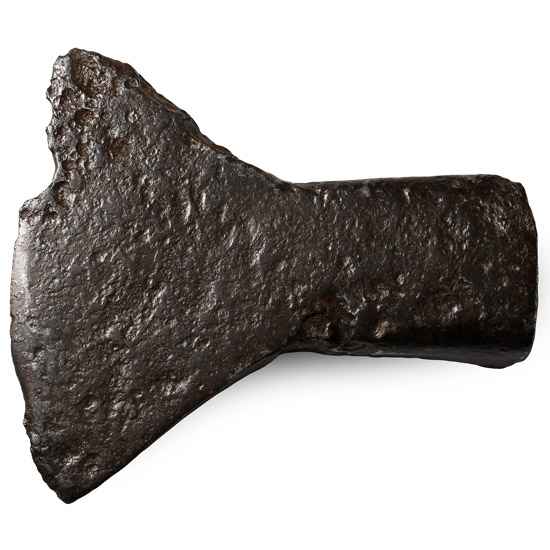
Large Celtic Iron Open Socketted Splayed Axehead
Late Hallstatt-Early La Tene Period, circa 450 B.C.Sold for (Inc. bp): £72
With a flaring blade and a rectangular socket open on one side. 424 grams, 12.5 cm
Ex M. Spiegelberg collection, since 1989-1992; thence by descent. Accompanied by a previous yellow cataloguing slip. -

Celtic Bronze Roundel Fragment
Iron Age, 1st century B.C.-1st century A.D.Sold for (Inc. bp): £78
Fragment of a discoid harness mount with flange rim to the central hole, concentric punched detailing of triangles and fractal curves; colour recently added. 16.5 grams, 65 mm
From the private collection of Mr Brian Edwards, New Malden, Surrey, UK, formed from the late 1970s-early 1980s; thence by descent. Accompanied by the original collector's data sheet(s) with reference no.A105. -
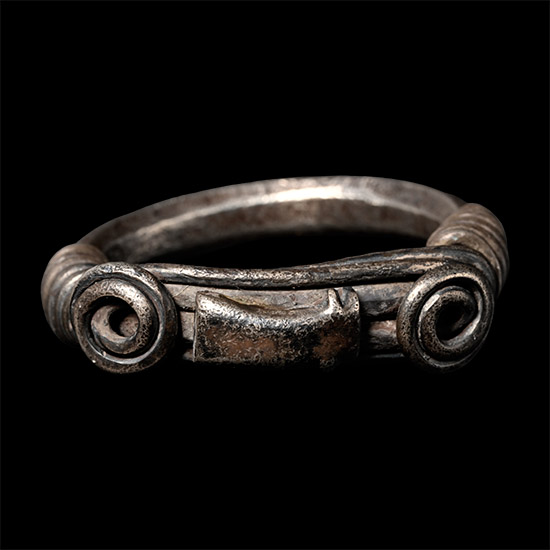
Central Balkans Silver Ring with Spiralled Terminals and Axe Motif Ornament
Iron Age, 1st-2nd century A.D.Sold for (Inc. bp): £845
Robust ring of octagonal section, fashioned from drawn and hammered wire, the hoop terminating in tightly coiled spirals, which flank a rectangular ornament soldered across the bezel, recalling a miniature axe-head; the coils further reinforced with wrapped silver wire, securing the decorative composition. 8.30 grams, 28.40 mm overall, 21.70 x 19.32 mm internal diameter (approximate size British T 1/2, USA 9 3/4, Europe 21.89, Japan 21)
Bonhams, Fine Antiquities, 4 July 1998, no.19. Private collection, UK, 1990s. with Rupert Wace Ancient Art Ltd, London. with Ariadne Galleries, New York and London, acquired from the above at TEFAF 2014, New York. Private American collection, acquired from the above, 23 January 2017.
This ring belongs to the repertoire of autochthonous Balkan silverwork that flourished from the Roman conquest through the mid-3rd century. The type is closely related to ornaments documented in the Tekija and Bare hoards, where bracelets and rings with spiral-wrapped ends and miniature axes appear as apotropaic symbols. While the axe motif was deeply embedded in Dacian and Balkan visual culture, its execution here in silver, combined with wire wrapping and spiralled terminals, reflects the enduring influence of Hellenistic toreutics upon local craftsmanship. Rather than a Viking jewel, the ring finds its most convincing parallels among the Balkan-Danubian silver hoards of the early Roman Empire.
