
Loading, please wait...
LOT 1708
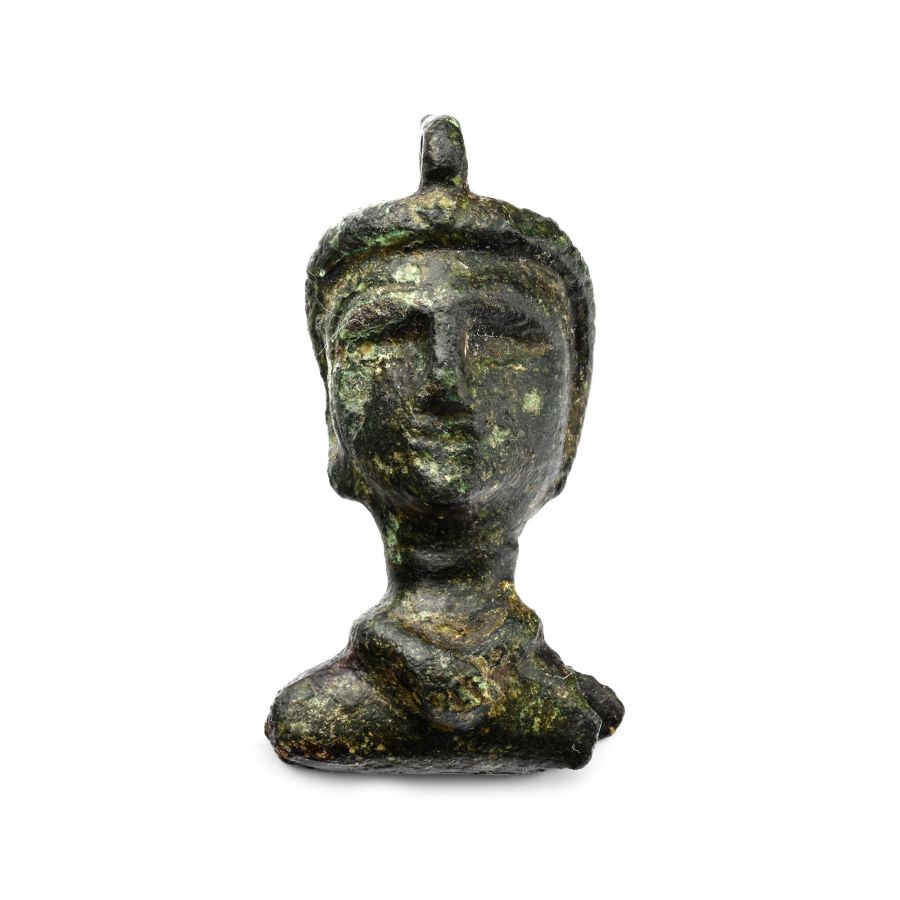
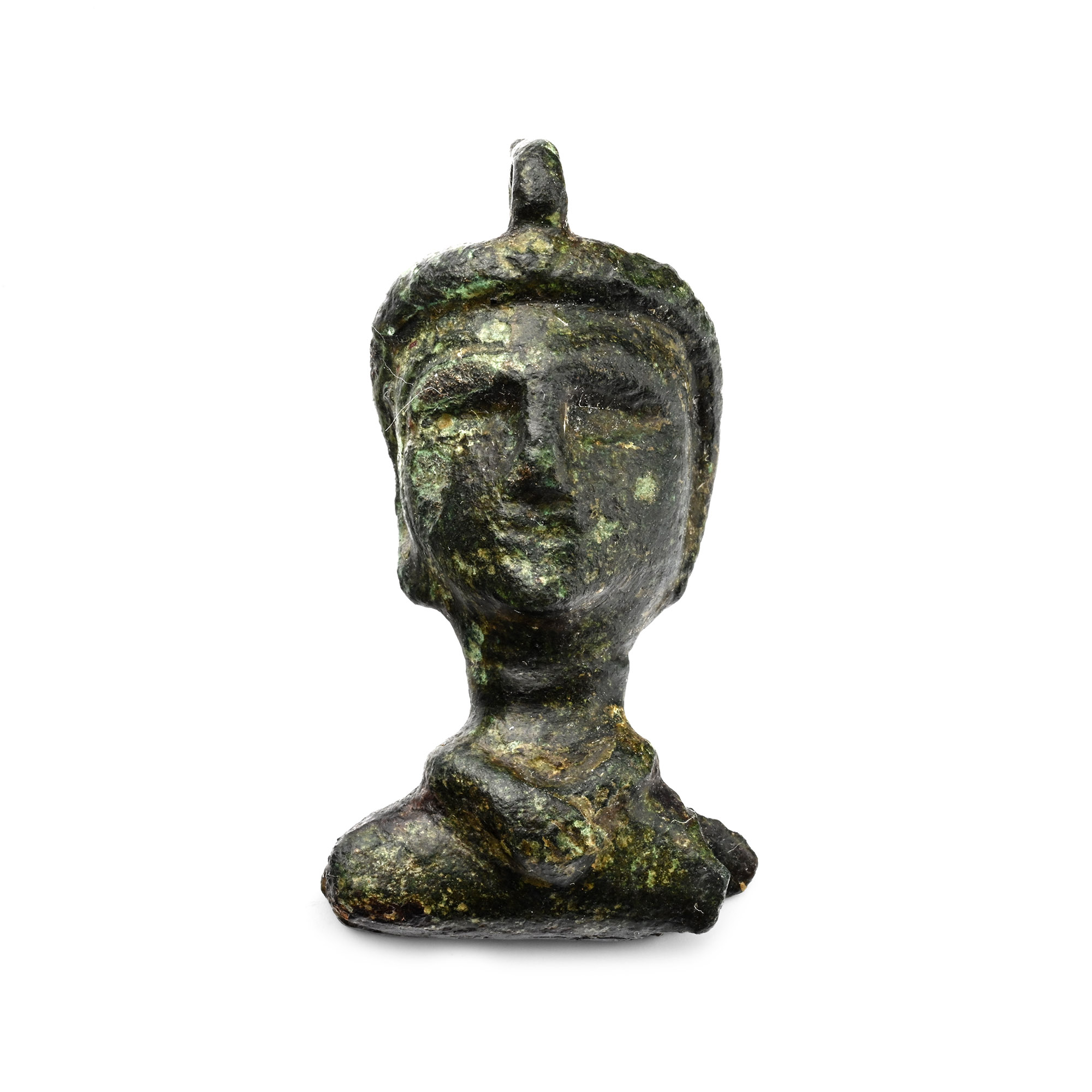
Celtic Bronze God Cauldron Mount
IRON AGE, 1ST CENTURY B.C.-1ST CENTURY A.D.
1 7/8 in. (51.28 grams, 47 mm).
Modelled in the half-round as a male bust with serpent headdress and torc; the hair depicted with a braided outer band framing the face and terminating at the jawline; the brow broad and heavy with raised eyebrows and sunken eye-sockets, narrow nose and small flat mouth; fleshy cheeks and chin; the slender neck with V-shaped collar or torc; the shoulders and chest with a slot to the lower edge to accept a gerrous insert; at the apex a S-curved crest extending to the rear and terminating in a narrow loop.
ProvenanceAcquired on the UK art market in the 1980s.
From the private collection of an Essex gentleman.
See Rolland, H., Bronzes Antiques de Haute Provence, Paris, 1965; Boucher, S., Recherches sur les Bronzes Figurés de Gaule Pré-Romaine et Romaine, Rome, 1976; Boucher, S. & Tassinari, S., Musée de la Civilisation Gallo-Romaine a Lyon: Bronzes Antiques I. Inscriptions, Statuaire, Vaisselle, Lyon, 1976.
FootnotesThe format, workmanship and proportions of the piece recall a number of Gallic images of Iron Age date. The slanting eye sockets below a heavy brow appear, for example, on the idol from Neuvy Pailloux (Boucher, item 47), as does the collar with a centrepiece below the chin on the same item. The thick band of hair appears on a bronze figurine from Neuvy-en-Sullias (Boucher, item 55) and several others (e.g. items 56, 71), but its placement and curvature also suggest a ram's horns. The curved crest may represent a serpent, or more likely the neck of a swan or goose, as seen in a figure of Mars from Chaudon (Rolland, item 24; Boucher, item 69).
The likely function of the piece is difficult to determine since it is too short to form an effective handle or hilt for a dagger, yet the width of the slot (about 1.mm) suggests that it was meant to accept a thin iron sheet. It is possible that the piece was intended to be a decorative mount for the rim of a bowl or cauldron.
TimeLine Auctions follows a vetting process to ensure the authenticity and legality of all items, reinforcing our commitment to integrity and responsible trading. Each antiquity, antique, and coin lot undergoes thorough examination by a vetting committee of at least ten external specialists, professional trade association members, scientists, and archaeologists: Our Vetting Process
AUCTIONS:
TimeLine is a leading auction house specialising in antiquities, ancient art, collectables, natural history, coins, medals, and books. Our auctions offer museums, collectors, historians, and enthusiasts the opportunity to acquire unique and historically significant pieces.
-
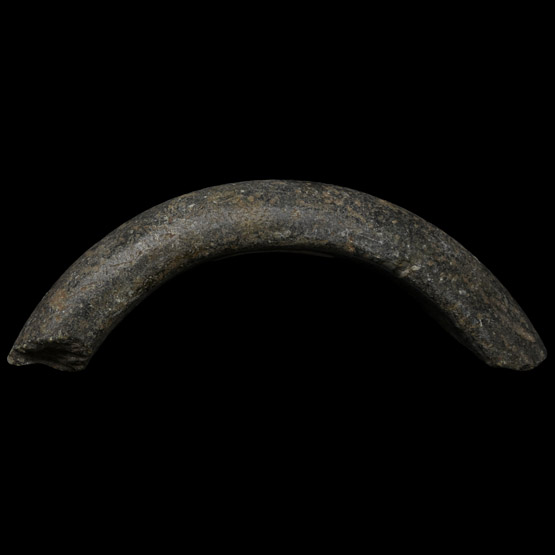
Celtic Shale Bracelet Fragment
Iron Age, 4th-1st century B.C.Sold for (Inc. bp): £39
Plano-convex in section and curved in profile with polished faces; old collector's label to inner face' Broch / Nordwall / Caithness'. 70 grams, 10.5 cm
From the private collection of a West Midlands lady collector. -
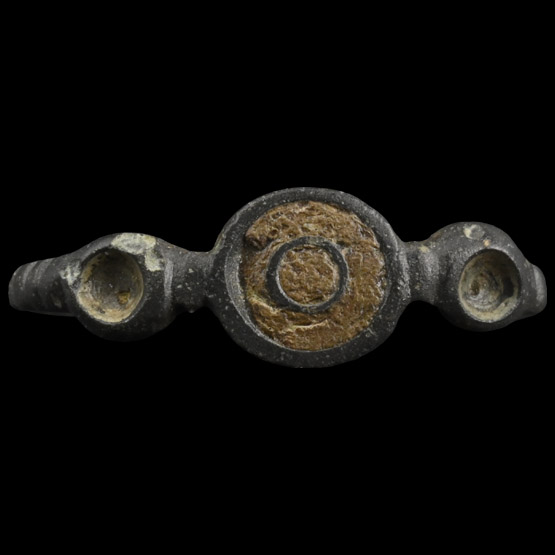
Romano-British Bronze Child's Ring
1st-3rd century A.D.Sold for (Inc. bp): £52
Slender hoop with the bezel formed of three circular cells, each recessed to accept enamel. 0.91 grams, 18.90 mm overall, 16.38 x 13.20 mm internal diameter (approximate size British G 1/2, USA 3 1/2, Europe 5.55, Japan 5)
Found Kent, UK. Acquired on the UK and EU art market before 2000. From the private collection of a Surrey, UK, gentleman.
Some of these rings, found in the children's graves, bear the inscription TOT and were dedicated to the devotion of the god Totatis, a Celtic divinity absorbed into the Romano-British pantheon. Originally, our ring was ornamented with enamel. -
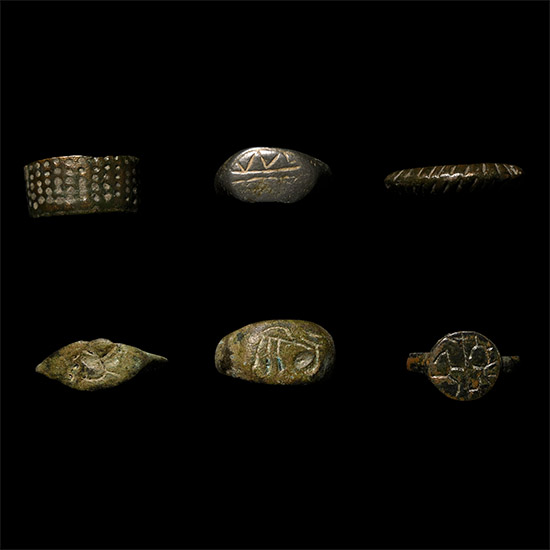
Celtic to Medieval Bronze Ring Collection
1st century B.C.-16th century A.D.Sold for (Inc. bp): £143
Comprising: four rings with decorative bezels; a ring with a keeled faux-twist hoop; a ring-type thimble with pointillé decoration. 18.54 grams total, 18-23 mm
Acquired on the UK and EU art market before 2000. From the private collection of a Surrey, UK, gentleman.
Similar cast bronze rings were found in the Necropolis of Ruski Krstur, and dated 10th-15th century A.D.
