
LOT 2967
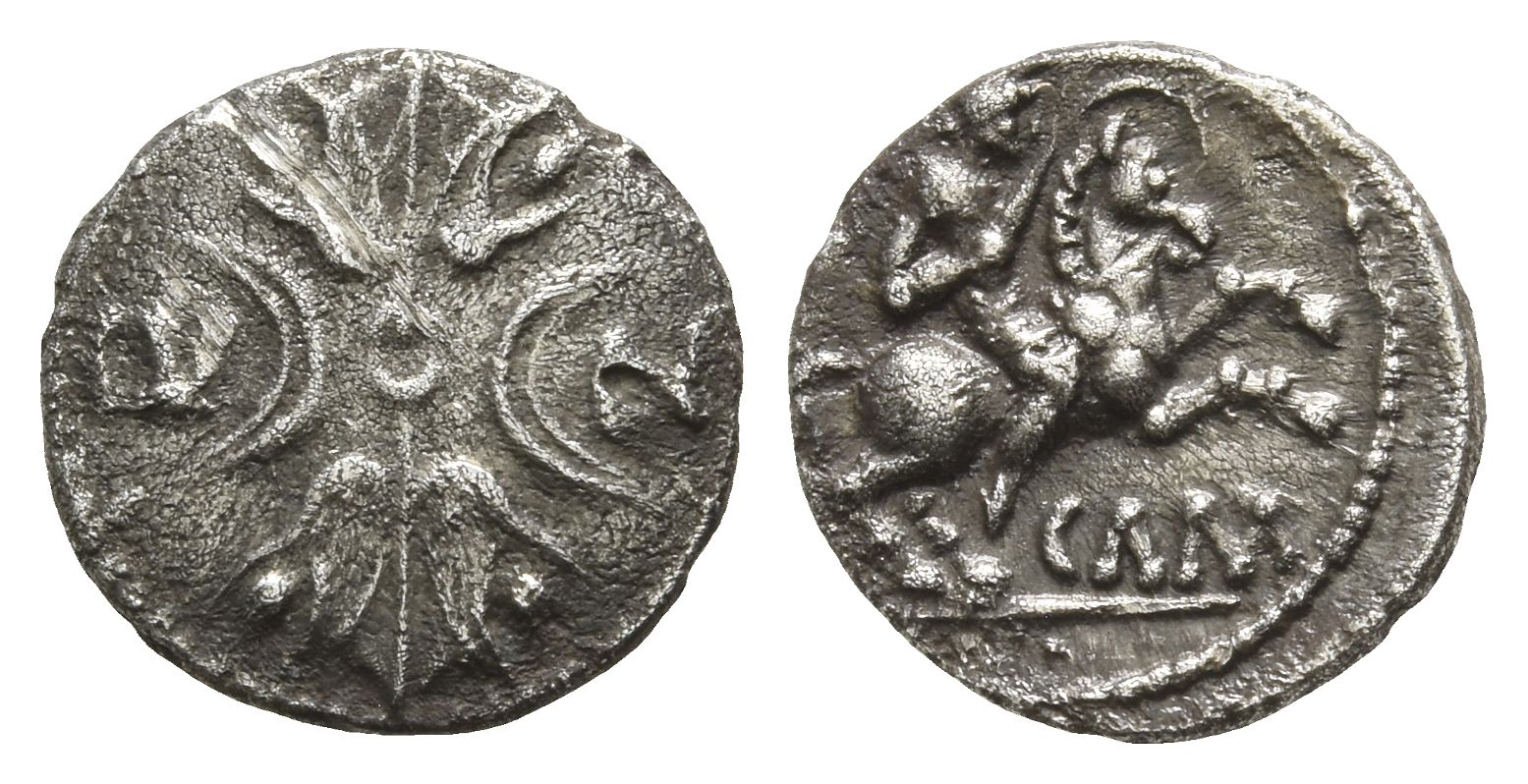
Celtic Britannia. Catuvellauni and Trinovantes, Cunobelin AR Unit. Circa AD 10-41. Cunobelinus Two Leaves type.
Two crescents back-to-back, CV to left, N to right, two leaves above and below / Warrior on horse rearing up right, sword in right hand, CAM below. ABC 2888; VA 2047; BMC 1866-67; S 304. Good Very Fine. Fabulous warrior, bold CAM. Very rare.(1.31gr, 13mm, 10h.).
ProvenanceEx Gary Leeke collection.
Ex Chris Rudd, 122, lot 50, ref. no.15518.
From the private collection of John Meredith, acquired since the 1990s; thence by descent.
The two-moon vegetal motif could possibly be seen as a reinterpretation of the obverse of the Tasciovanos Quatrefoil gold quarter stater (ABC 2583) or Tasciovanos Capricorn silver unit (ABC 2619). John Evans says: "The type of the obverse is quite new, and seems to be formed of two ivy(?) leaves with berries on either side. In general character, however, the device recalls the winged thunderbolt on a denarius of the Salvia family" [struck for Octavian, early 40 BC, Sear RCV 1541, RRC 523/1] (The Coins of the Ancient Britons, Supplement, 1890, p.566). Chris Rudd is sure that the two leaves are ivy leaves. Evergreen ivy symbolises enduring strength and the eternal cycle of death (leaf facing down) and rebirth (leaf facing up), a visual idea repeated by the two crescent moons - one waxing (dying), the other waning (born again). Ivy climbs up oak trees - trees sacred to the druids whose very name means 'oak-knowers', holy men with strong insight. Chris Rudd thinks that the ivy leaves on this coin were drawn from life, not copied from a coin or gemstone. Ivy leaves can occasionally be seen in miniature on Roman coins (for example, Sear RCV 298 and 362) but bear little resemblance to these two large leaves. The English word 'ivy', along with the names Ivo, Yvonne, Yvette and St.Ives, are all probably linked to the Celtic word ivos 'yew' - another evergreen.
TimeLine Auctions follows a vetting process to ensure the authenticity and legality of all items, reinforcing our commitment to integrity and responsible trading. Each antiquity, antique, and coin lot undergoes thorough examination by a vetting committee of at least ten external specialists, professional trade association members, scientists, and archaeologists: Our Vetting Process
AUCTIONS:
TimeLine is a leading auction house specialising in antiquities, ancient art, collectables, natural history, coins, medals, and books. Our auctions offer museums, collectors, historians, and enthusiasts the opportunity to acquire unique and historically significant pieces.
LOT 2967
Celtic Britannia. Catuvellauni and Trinovantes, Cunobelin AR Unit.
Sold for (Inc. bp): £494
-
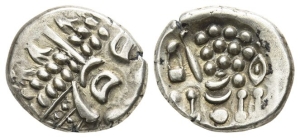
Celtic Britannia. Durotriges AR Stater. Circa 65 BC-AD 45. Cranborne Chase type.
Sold for (Inc. bp): £286
Devolved and disjointed laureate head of Apollo to right / Devolved and disjointed horse to left with numerous pellets above and a pellet below. ABC 2157; VA 1235-1. 5.58gr, 20mm, 11h.
Good Very FIne.
Found Isle of Wight, Hampshire, UK, 19 October 2005. Ex Chris Rudd, IOW, lot 28, ref. no.12753. From the private collection of John Meredith, acquired since the 1990s; thence by descent. -
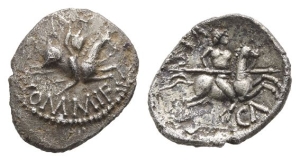
Celtic Britannia. Atrebates and Regni, Verica AR Unit. AD 25-35. Third coinage.
Sold for (Inc. bp): £130
Rider on horse to right, carrying oval shield; COMMI F below / Rider on horse to right, holding spear, VERI-CΛ around. VA 530-1. 1.22gr, 14mm, 10h.
Near Extremely Fine. Toned.
Ex Silbury Coins. From the private collection of John Meredith, acquired since the 1990s; thence by descent. -
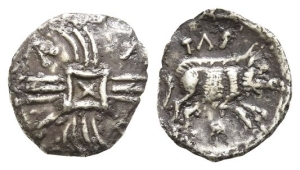
Celtic Britannia. Tasciovanos AR Unit. Circa 20 BC-AD 10. X-Box type.
Sold for (Inc. bp): £195
Crossed wreaths, one curved, box at centre containing X, VERL in angles / Boar right, TAS above, tiny star below. ABC 2628; VA 1796; BMC 1661-62; S 236. 1.13gr, 14mm.
Very Fine. Large flan, dark toned, clear X, lovely boar. Very rare.
Found near St Albans. Ex L. Tongue collection. Ex Chris Rudd, LL61, lot 37, ref. no.16260. From the private collection of John Meredith, acquired since the 1990s; thence by descent.
