Click to Enlarge
Details

LOT 2970

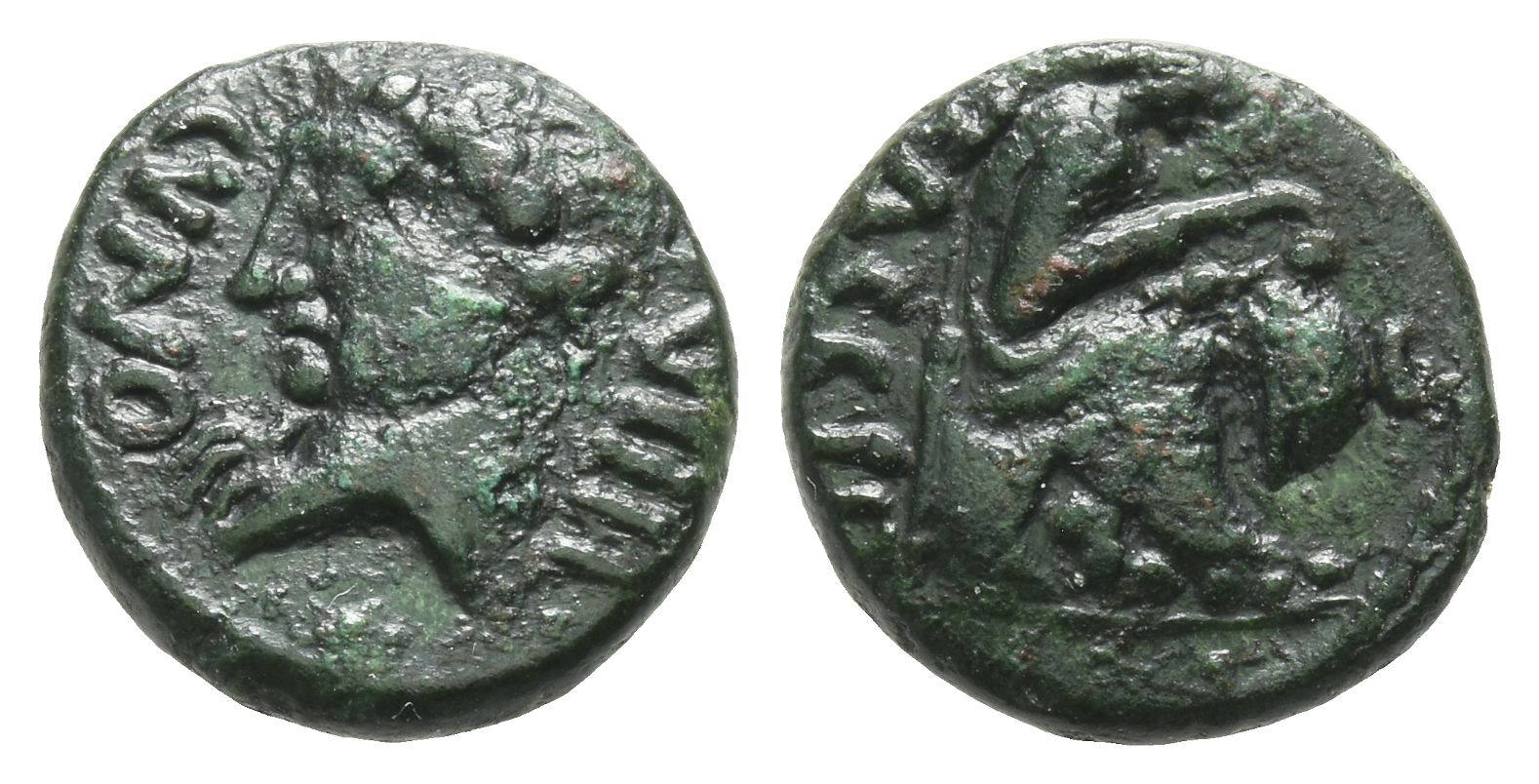
Celtic Britannia. Catuvellauni and Trinovantes, Cunobelin AE Unit. AD 8-41. Cunobelinus Metalworker type.

Winged head left, CVNO[B]ELIN around / Metal worker right, TASCIO before. ABC 2969; VA 2097; BMC 1072-83; S 342; CCI 07.0420. Good Very Fine. Dark holly-green patina.(2.25gr, 14mm,10h.).

Provenance

Found Essex, spring 2001.
Ex D Lee collection.
Ex Chris Rudd, LL73, lot 44, ref. no.18135.
From the private collection of John Meredith, acquired since the 1990s; thence by descent.

VETTING:

TimeLine Auctions follows a vetting process to ensure the authenticity and legality of all items, reinforcing our commitment to integrity and responsible trading. Each antiquity, antique, and coin lot undergoes thorough examination by a vetting committee of at least ten external specialists, professional trade association members, scientists, and archaeologists: Our Vetting Process


AUCTIONS:

TimeLine is a leading auction house specialising in antiquities, ancient art, collectables, natural history, coins, medals, and books. Our auctions offer museums, collectors, historians, and enthusiasts the opportunity to acquire unique and historically significant pieces.

Cunobelinus Metalworker Type

LOT 2970

Celtic Britannia. Catuvellauni and Trinovantes, Cunobelin AE Unit.

Sold for (Inc. bp): £143

Print page

RELATED LOTS
  • Celtic Britannia. Catuvellauni and Trinovantes, Cunobelin AR Unit.
    Cunobelinus Two Leaves Type
    Celtic Britannia. Catuvellauni and Trinovantes, Cunobelin AR Unit. Circa AD 10-41. Cunobelinus Two Leaves type.

    Sold for (Inc. bp): £494

    Two crescents back-to-back, CV to left, N to right, two leaves above and below / Warrior on horse rearing up right, sword in right hand, CAM below. ABC 2888; VA 2047; BMC 1866-67; S 304. 1.31gr, 13mm, 10h.

    Good Very Fine. Fabulous warrior, bold CAM. Very rare.

    Ex Gary Leeke collection. Ex Chris Rudd, 122, lot 50, ref. no.15518. From the private collection of John Meredith, acquired since the 1990s; thence by descent.

    The two-moon vegetal motif could possibly be seen as a reinterpretation of the obverse of the Tasciovanos Quatrefoil gold quarter stater (ABC 2583) or Tasciovanos Capricorn silver unit (ABC 2619). John Evans says: "The type of the obverse is quite new, and seems to be formed of two ivy(?) leaves with berries on either side. In general character, however, the device recalls the winged thunderbolt on a denarius of the Salvia family" [struck for Octavian, early 40 BC, Sear RCV 1541, RRC 523/1] (The Coins of the Ancient Britons, Supplement, 1890, p.566). Chris Rudd is sure that the two leaves are ivy leaves. Evergreen ivy symbolises enduring strength and the eternal cycle of death (leaf facing down) and rebirth (leaf facing up), a visual idea repeated by the two crescent moons - one waxing (dying), the other waning (born again). Ivy climbs up oak trees - trees sacred to the druids whose very name means 'oak-knowers', holy men with strong insight. Chris Rudd thinks that the ivy leaves on this coin were drawn from life, not copied from a coin or gemstone. Ivy leaves can occasionally be seen in miniature on Roman coins (for example, Sear RCV 298 and 362) but bear little resemblance to these two large leaves. The English word 'ivy', along with the names Ivo, Yvonne, Yvette and St.Ives, are all probably linked to the Celtic word ivos 'yew' - another evergreen.

    Lot Details

  • Celtic Southern Gaul. Allobroges AR Quinarius.
    Celtic Southern Gaul. Allobroges AR Quinarius. Circa 75-60 BC.

    Sold for (Inc. bp): £104

    Helmetted head of Roma to right; DVRNACVS before / Horseman galloping to right, holding spear; AVSCRO below. LT 5762; DT 3157; RIG 148. 1.99gr, 15mm, 3h.

    Good Very Fine. Attractive old cabinet toning.

    Ex cgb.fr. (bga_238803). From the private collection of John Meredith, acquired since the 1990s; thence by descent.

    Lot Details

  • Celtic Northeast Gaul. Ambiani AR Fraction.
    Picardy Horse Face Type
    Celtic Northeast Gaul. Ambiani AR Fraction. Circa 75-50 BC. Picardy Horse Face type.

    Sold for (Inc. bp): £286

    Stylised helmet head right, horse's head forming eye and nose / Horse right, with long beaded mane, six armed 'star' in front with ring at centre, two rings above, small horse's head below. LT 8500/8515 var.; BMC 156; Sch/ GB 51, fig. 330; DT 189; Allen 'Les pièces d'argent minces du comté de Hampshire', Revue Numismatique, VI série, VII (1965), p.79-93, pl.V, no.29. 0.48gr, 13mm, 11h.

    Good Very Fine. Toned, great horse, full 'star'. Very rare.

    Ex Chris Rudd, 118, lot 5, ref. no.15074. From the private collection of John Meredith, acquired since the 1990s; thence by descent.

    As Derek Allen (1965) says, this extraordinary type was ultimately derived from the Pallas Athene silver coins of the Aulerci Cenomani (cf. LT 5967, 5973, 5980, 5985) and heavily influenced the Hampshire Thin Silver series of the British Belgae (ABC 911) and the Chichester Chariot Wheel thin silver of the Regini (ABC 701). This lovely example of the Picardy Horse Face explicitly shows a horse's head emerging from the forehead of the stylised head. The spear is also clearly displayed as part of the helmet. The spidery 'star' symbol in front of the horse can be seen again before the horse on the Yarmouth gold stater of the Regini (ABC 518).

    Lot Details

Stay up-to-date with the latest from TimeLine Auctions by joining our mailing list