
Loading, please wait...
LOT 0180
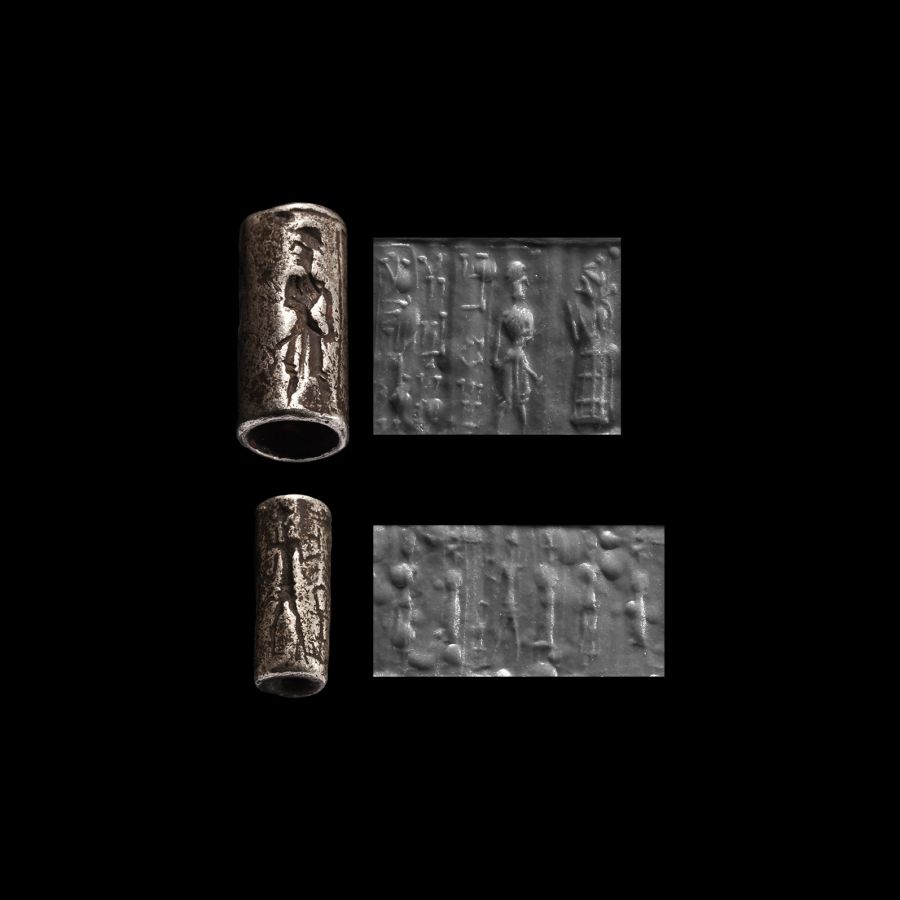
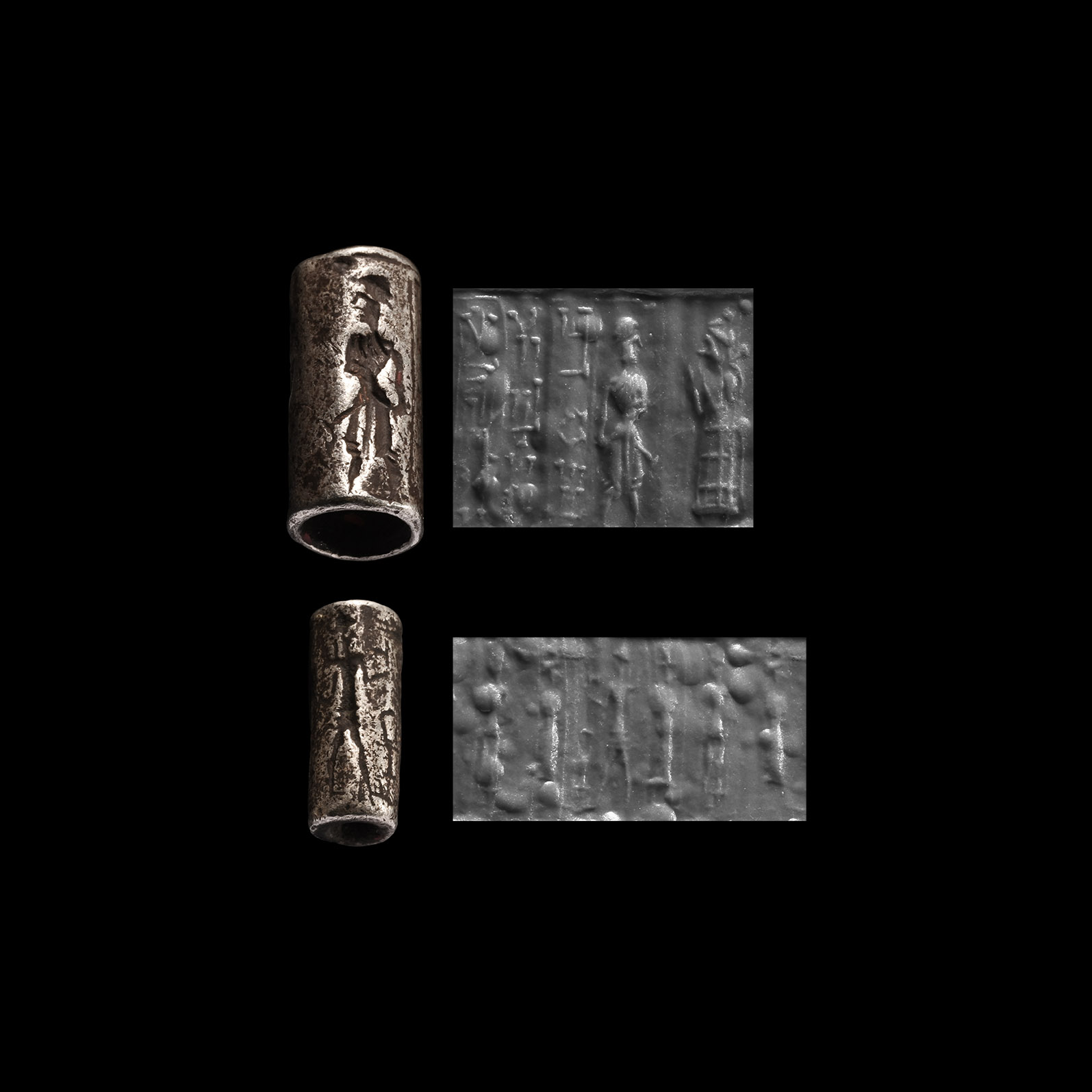
Cassite Silver Cylinder Seal Pair
CIRCA 13TH-12TH CENTURY B.C.
7/8 in. (7.53 grams, 22 mm).
A pair of hollow-formed silver cylinder seals comprising: the smaller with frieze of tall slender figures flanking an ankh symbol; the larger with facetted outer face featuring a standing female with raised arm, plaited hair and hatched skirt, a standing male with dagger(?), three panels of cuneiform text; the smaller seal able to fit within the larger.
ProvenanceFrom an important family collection.
Examined by Professor Wilfrid George Lambert FBA (1926-2011), historian, archaeologist, and specialist in Assyriology and Near Eastern archaeology, in the late 1980s and early 1990s.
This lot has been checked against the Interpol Database of stolen works of art and is accompanied by search certificate no.11639-199231.
Cf. similar in the collection of the British Museum, London, under accession no.1864,0609.4.
CONDITIONTimeLine Auctions follows a vetting process to ensure the authenticity and legality of all items, reinforcing our commitment to integrity and responsible trading. Each antiquity, antique, and coin lot undergoes thorough examination by a vetting committee of at least ten external specialists, professional trade association members, scientists, and archaeologists: Our Vetting Process
AUCTIONS:
TimeLine is a leading auction house specialising in antiquities, ancient art, collectables, natural history, coins, medals, and books. Our auctions offer museums, collectors, historians, and enthusiasts the opportunity to acquire unique and historically significant pieces.
LOT 0180
Cassite Silver Cylinder Seal Pair
Estimate £3,000 - 4,000€3,480 - 4,640 (for guidance only)$4,050 - 5,400 (for guidance only)
-
Western Asiatic Earring Pair Collection
1st millennium B.C. or laterSold for (Inc. bp): £26
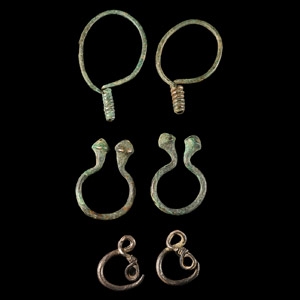
A group of three pairs of copper-alloy earrings: one pair with conical terminals; one annular pair with coiled wire projections; hoop formed two additional loops with coiled sleeve between. 17 grams total, 21-43 mm
Early 1990s London collection. Acquired on the UK art market. From a private collection, Lancashire, UK. -
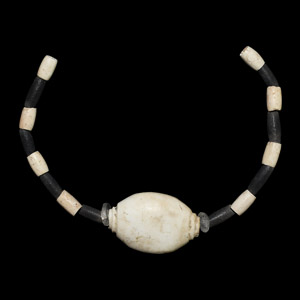
Western Asiatic Necklace String
1st millennium B.C.Estimate: £100 - 140 (+bp*)
Opening Bid: £50
A group of black and white jasper cylindrical beads with irregular quartz discs and a large oval-shaped white jasper bead with double collar at either end, restrung on a string. 36.86 grams, 24 cm
Fine condition.
Acquired before 1990. Central London gallery. Private collection of a North West London lady. -
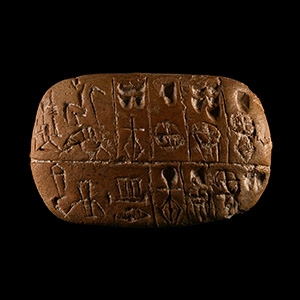
Mesopotamian Pictographic Administrative Tablet
Uruk III, circa 3000 B.C.Sold for (Inc. bp): £4,940
A bifacial, lentoid-section rectangular clay tablet with rounded corners and short sides, medial horizontal line to each face, with hand-drawn pictographs above and below, a count of sheep and caprids. 42 grams, 66 mm wide
Specialised collection of cuneiform texts, the property of a London gentleman and housed in London before 1992. Thence by descent to family members. Examined by Professor Wilfrid George Lambert FBA (1926-2011), historian, archaeologist, and specialist in Assyriology and Near Eastern archaeology, in the late 1980s and early 1990s. The collection is exceptional for the variety of types, including some very rare and well preserved examples. This lot has been checked against the Interpol Database of stolen works of art and is accompanied by search certificate no.11637-198551.
Early writing was used primarily as a means of recording economic data; this tablet likely records deliveries and distributions of grain. At the end of the 4th millennium B.C., written language developed in Mesopotamia as pictographs, later evolving into abstract forms called cuneiform. Pictographs were drawn in the clay with a pointed implement. Circular impressions alongside the pictographs represented numerical symbols. Cuneiform (meaning wedge-shaped) script was written by pressing a reed pen or stylus with a wedge-shaped tip into a clay tablet.
