Loading, please wait...

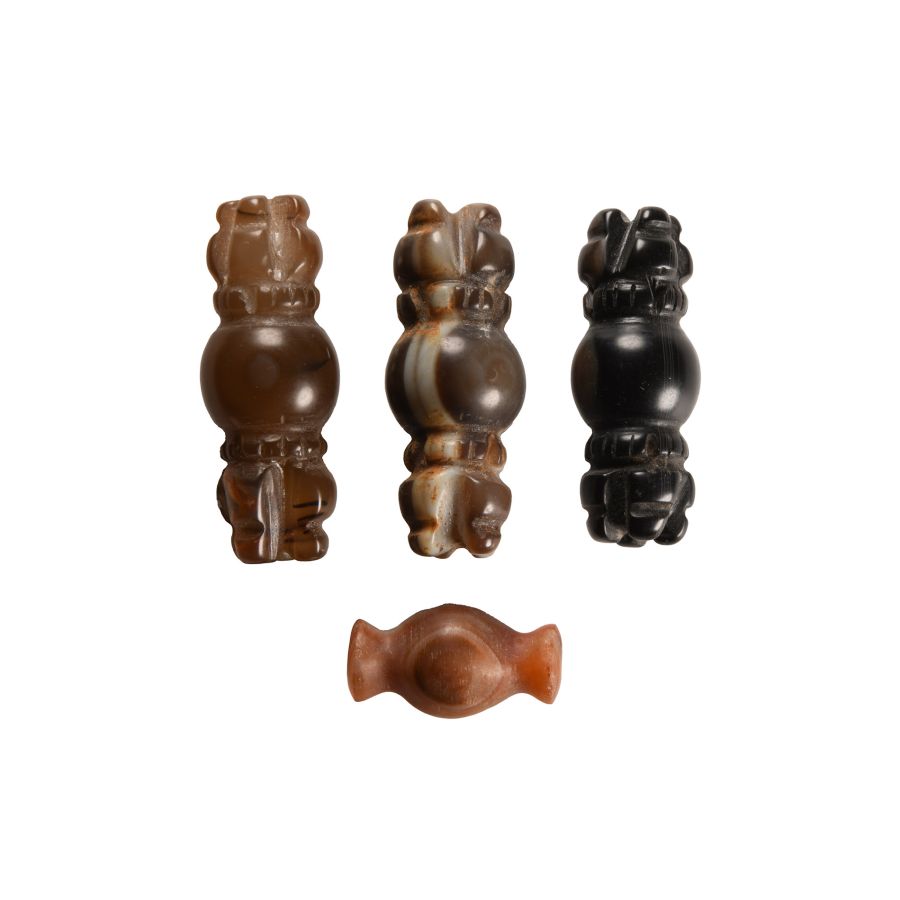
Carved Agate Amuletic Bead Group Carved Agate Amuletic Bead Group Carved Agate Amuletic Bead Group
Use mousewheel to zoom in and out, click to enlarge
Details

LOT 1589

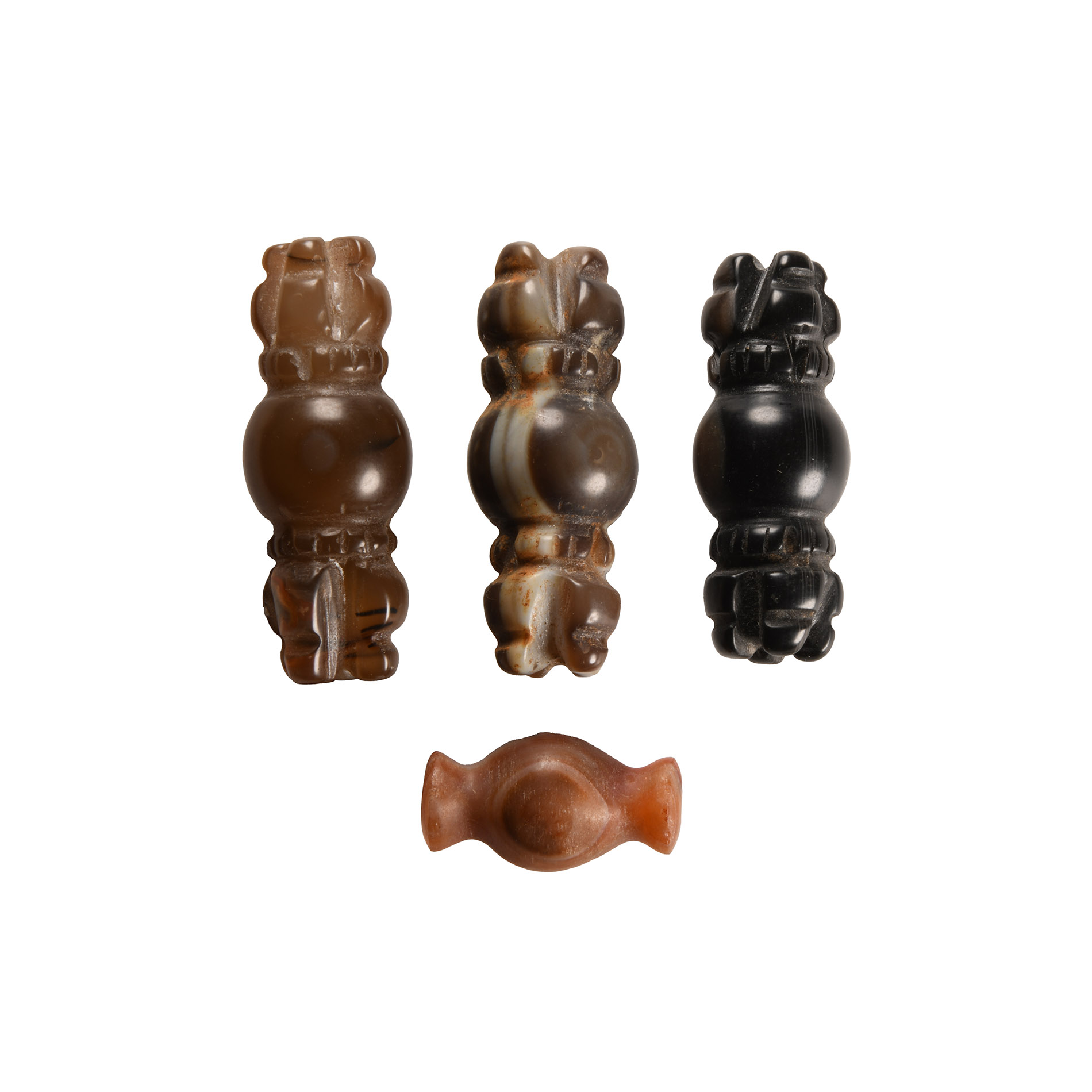
Carved Agate Amuletic Bead Group

20TH CENTURY A.D. OR EARLIER

1 - 1 5/8 in. (39.1 grams total, 24-41 mm).

Each bead polished and drilled for suspension, three carved in the form of what are possibly vajras, together with a bow-tie shaped bead. [No Reserve]

Provenance

UK gallery, early 2000s.

CONDITION
VETTING:

TimeLine Auctions follows a vetting process to ensure the authenticity and legality of all items, reinforcing our commitment to integrity and responsible trading. Each antiquity, antique, and coin lot undergoes thorough examination by a vetting committee of at least ten external specialists, professional trade association members, scientists, and archaeologists: Our Vetting Process


AUCTIONS:

TimeLine is a leading auction house specialising in antiquities, ancient art, collectables, natural history, coins, medals, and books. Our auctions offer museums, collectors, historians, and enthusiasts the opportunity to acquire unique and historically significant pieces.

Live Bidding

LOT 1589

Carved Agate Amuletic Bead Group

Sold for (Inc. bp): £13

Print page

RELATED LOTS
  • Black and Other Glass Bead Necklace Collection
    Black and Other Glass Bead Necklace Collection
    20th century A.D. or earlier

    Sold for (Inc. bp): £124

    Comprising seven necklaces restrung from beads of drilled ancient glass bangle fragments. 120 grams total, 70 cm long


    UK gallery, early 2000s.

    Lot Details

  • Russian Icon with Virgin of Kazan with the Blessing Child
    Russian Icon with Virgin of Kazan with the Blessing Child
    19th-20th century A.D.

    Estimate: £500 - 700 (+bp*)

    Opening Bid: £278

    Painted on a wooden board with mounting slots and panels to the reverse, gessoed surface with painting of the Virgin of Kazan, head of Mary with gilded nimbus and russet-coloured veil, standing infant Jesus similarly nimbate with right hand raised in the pax gesture; gilt monograms to the upper corners and title to the lower left corner. 968 grams, 31 cm high

    Fine condition.

    Ex property of a London lady, part of her family's collection.

    The original icon, also known as the Theotokos of Kazan, is thought to have originated in Constantinople in the 13th century before it was taken to Russia. When the Turks took over Kazan in 1438, the icon was most probably hidden to keep it safe. Ivan the Terrible liberated Kazan in 1552, and the town was destroyed by fire in 1579, after which the icon was found and brought to the Church of Saint Nicholas. It was subsequently stolen in 1904 and never found again, though there are many copies in existence.

    Lot Details

  • Caroline Silver-Gilt Third Earl of Essex Military Reward Badge
    Caroline Silver-Gilt Third Earl of Essex Military Reward Badge
    1642 A.D.

    Sold for (Inc. bp): £1,248

    Cast and chased badge of Robert Devereux, Earl of Essex, by Thomas Simon (or Thomas Rawlins?), bifacial with obverse portrait bust of the Earl of Essex turned slightly to left, and to the reverse an oval garnished shield of Essex, surmounted by coronet; Platt II, type G. 5.39 grams, 30.20 mm


    From a late 19th-early 20th century collection based on the old handwritten coin tickets. Acquired on the UK art market in the 1980s. From an East Anglian private collection. Accompanied by two old faded handwritten coin tickets.

    Essex became Commander-in-Chief of the Parliamentary forces in the Civil War before being displaced in 1645. Badges of several types and varieties bearing his image were presented to various ranks in the army. The grandson of Francis Walsingham, the Principal Secretary and 'spymaster' of Elizabeth I, as well as the son of Elizabeth's favourite, Robert Devereux figured prominently in the First English Civil War. At its outset, he became the first Captain-General or Chief Commander of the Parliamentarian army, known as the 'Roundheads.' However, unable and unwilling to defeat the Royalist forces during the Lostwithiel Campaign in 1644, Devereux became overshadowed by the ascending Oliver Cromwell and, less than six months after resigning from his commission, died without an heir in 1646.

    Lot Details

Stay up-to-date with the latest from TimeLine Auctions by joining our mailing list