
Loading, please wait...


LOT 2080
Carnelian Gemstone with a Bucolic Scence
18TH CENTURY A.D.
5/8 in. (1.66 grams, 17 mm).
Oval orange carnelian gem showing two goats, one resting on top of a large stone while the other is standing against another boulder. [No Reserve]
ProvenanceUK private collection, acquired on the English art market in the 2000s.
CONDITIONTimeLine Auctions follows a vetting process to ensure the authenticity and legality of all items, reinforcing our commitment to integrity and responsible trading. Each antiquity, antique, and coin lot undergoes thorough examination by a vetting committee of at least ten external specialists, professional trade association members, scientists, and archaeologists: Our Vetting Process
AUCTIONS:
TimeLine is a leading auction house specialising in antiquities, ancient art, collectables, natural history, coins, medals, and books. Our auctions offer museums, collectors, historians, and enthusiasts the opportunity to acquire unique and historically significant pieces.
-
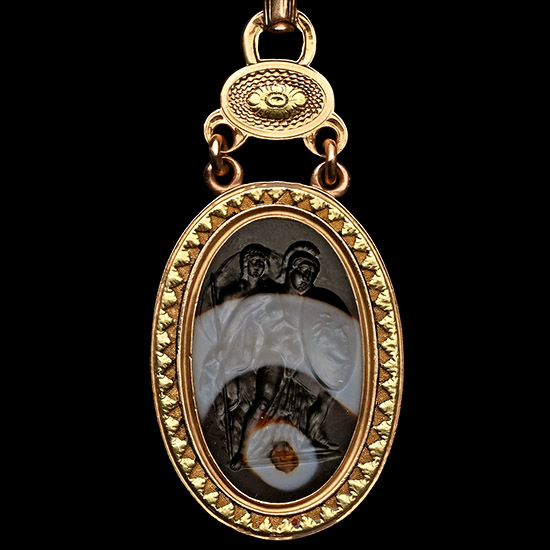
Banded Agate Intaglio Depicting Perseus and Andromeda in Gold Pendant
Italy, 17th-18th century A.D.Estimate: £4,000 - 6,000 (+bp*)
Current Winning Bid: £2,000
Translucent intaglio featuring a dynamic mythological scene of Perseus rescuing Princess Andromeda; Perseus depicted nude and wearing a crested helmet, holding a round shield with a Medusa mask in his hand and a spear in the other, Andromeda standing behind him and dressed in long flowing robes; set in an elaborate late 18th-century English gold frame; supplied with a museum-quality impression. 13.64 grams, 61 mm
Acquired on the European art market. This lot has been checked against the Interpol Database of stolen works of art and is accompanied by search certificate number no.13343-257990.
Andromeda was the daughter of the Aethiopian king Cepheus and Cassiopeia. According to the legend, Cassiopeia angered Neptune by claiming that her daughter was more beautiful than the nereids, and Neptune, in revenge, sent a monster to ravage the coast. Told that the only way to save their country is to sacrifice their daughter to the creature, Andromeda’s parents chained her to a rock by the sea. The demigod Perseus, son of Jupiter, killed the sea monster by petrifying it with the head of Medusa and rescued Andromeda. -

Georgian Era Gold Fob Seal with Carnelian Intaglio of Inigo Jones Attributed to Edward Burch
England, 18th century A.D.Estimate: £1,500 - 2,000 (+bp*)
Opening Bid: £750
Vibrant red carnelian intaglio skilfully carved with a bust of a mature man in three-quarter view, gazing right, wearing a wide-collared, buttoned tunic and a cap, long curly hair framing his bearded face with a deeply furrowed forehead; set in a gold frame with an amphora-like looped handle; supplied with a museum-quality impression. 11.72 grams, 33 mm
Acquired on the European art market.
Edward Burch (1730–1814) was a distinguished English gem engraver and miniaturist, celebrated for his intricate craftsmanship and artistic versatility. A founding member of the Royal Academy of Arts in 1768, Burch gained acclaim for his engraved gemstones, which often depicted classical and mythological themes, reflecting the neoclassical style of the Georgian era. His skill in miniature painting further demonstrated his artistic range and mastery of detail. Highly respected in his time, Burch’s works remain admired for their technical precision and elegance, preserving his legacy as a key figure in 18th-century British art. Inigo Jones (1573–1652) was a pioneering English architect who is widely regarded as the first significant figure to introduce the principles of Renaissance architecture to England. Influenced by his studies in Italy and the works of Andrea Palladio, Jones designed elegant structures characterised by classical symmetry, proportion, and restraint. His most famous works include the Banqueting House at Whitehall, the Queen’s House in Greenwich, and contributions to the layout of Covent Garden. Jones’s adoption of Palladian ideals marked a departure from the Gothic style that had dominated English architecture, laying the foundation for subsequent developments in the Classical tradition. -

Russian Orthodox Enamelled Bronze Travel Icon with Extended Deesis
19th century A.D.Sold for (Inc. bp): £117
Depicting Deesis with Jesus at the centre, Saint Mary on the left and Saint John the Baptist on the right; Jesus seated upon a throne, depicted with the open Gospel in his left hand and raising his right hand in blessing; Mary, with veiled head and mantle, wearing a maphorion mantle over an embroidered robe and holding a scroll; the Deesis surrounded by a theory of saints, with Saint Zosima and Saint Sabbas making the Proskynesis in front of the Christ; Old Slavic inscription above the figures: 'ΙC ΧΡ' (Jesus Christ). 67 grams, 64 mm
Acquired from Chris Martin-Zakheim, Iconastas, 5 Piccadilly Arcade, London SW1. From the private collection of a West London, UK, gentleman, formed since the early 2000s.
The Deisis or Deesis (Деисус, Gk. for “supplication”) was the depiction of the Virgin, John the Baptist and possibly other saints interceding with Christ on behalf of mankind.
