
Loading, please wait...
LOT 0257
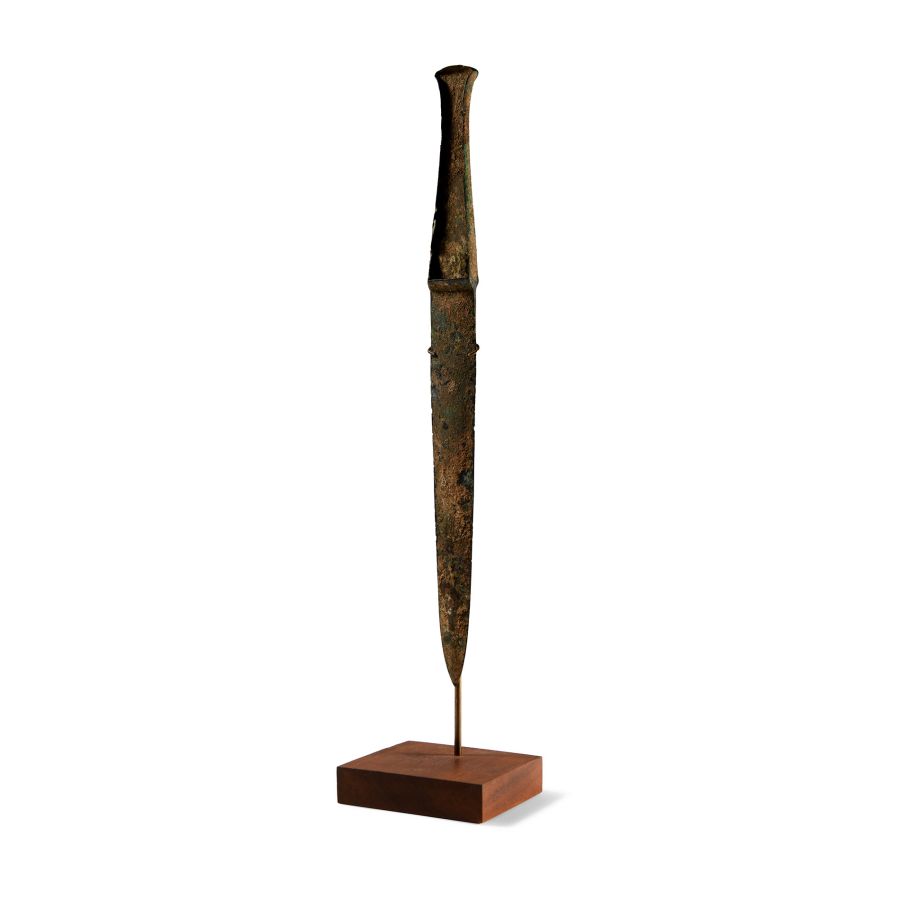
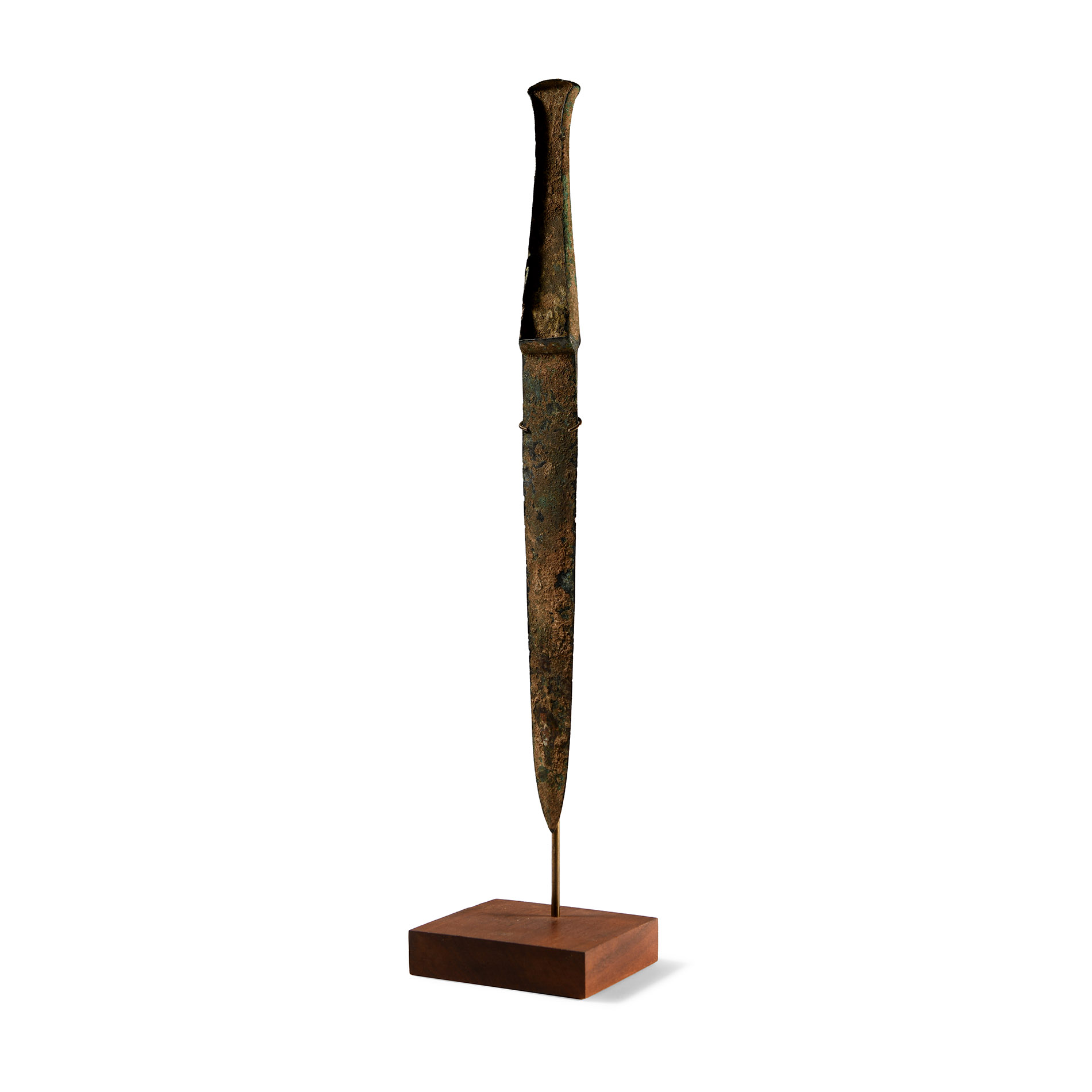
Canaanite Bronze Dirk
13TH-12TH CENTURY B.C.
15 1/2 in. (289 grams total, 39.5 cm high including stand).
With lentoid-section blade, tongue-shaped in plan, integral tapering hilt with flared finial, lateral flanges to accept a panel of bone or wood to each face forming the grip.
ProvenanceEx Joseph J. Gancie (1923-2010), Washington, Silver Spring, Maryland.
with Alex Cooper Auctioneers Inc., sale 1035, 27 January 2013, lot 162a.
Cf. Khorasani, M.M., Arms and Armour from Iran - The Bronze Age to the End of the Qajar Period, Tübingen, 2006, p.377, cat.6.
FootnotesThe dirk belongs to the type III in the Medvedskaya classification, used in Near East from the 13th to the 6th century B.C. The type is the 32a of the Maxwell-Hyslop study. The Asiatic daggers of this type are confined to Syria and Persia, but Transcaucasia also provides an interesting analogy from Kalekent on the Baku peninsula, where a pointed straight-sided dagger blade has a flanged hilt with the whole of the side flanges bent over the centre.
CONDITIONTimeLine Auctions follows a vetting process to ensure the authenticity and legality of all items, reinforcing our commitment to integrity and responsible trading. Each antiquity, antique, and coin lot undergoes thorough examination by a vetting committee of at least ten external specialists, professional trade association members, scientists, and archaeologists: Our Vetting Process
AUCTIONS:
TimeLine is a leading auction house specialising in antiquities, ancient art, collectables, natural history, coins, medals, and books. Our auctions offer museums, collectors, historians, and enthusiasts the opportunity to acquire unique and historically significant pieces.
LOT 0257
Canaanite Bronze Dirk
Estimate £700 - 900€810 - 1,040 (for guidance only)$950 - 1,220 (for guidance only)
-
Medieval Iron Hand and Half Sword with Polyhedral Pommel
Late 14th-early 15th century A.D.Sold for (Inc. bp): £2,860
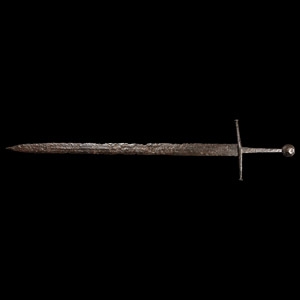
Of Oakeshott's Type XVIIIa or b, cross style 11, pommel style I1; strongly tapering pointed blade with straight edges and evident battle nicks; straight cross guard, long grip and an octagonal pommel. 1.26 kg, 1 m
From the private collection of a London gentleman, from his grandfather's collection formed before the early 1970s.
This magnificent example was well-suited to a cut-and-thrust style of fighting, a logical development of the Oakeshott XVI typology. This is mainly visible in the specimens of typology XVIIIb, typical of English effigies and brasses between 1370-1425. Because the previous types of swords were practically useless against the fully armoured man-at-arms, Western European warfare needed a sword capable of piercing the weak points of the enemy's protective equipment, leading to the development of types XV, XVI and XVII, and eventually of type XVIII. The subtypes XVIIIa and b had a longer blade, and type XVIIIb was a very long-gripped bastard sword. This word (often referred to as ‘hand-and-a-half sword’) was applied through the late Middle Ages to the long-gripped weapons. Marc de Vulson, writing on the occasion of a duel fought in 1549 before Henry II of France, stated 'Deux epées bâtardes, pouvant servir à une main ou à deux' (two bastard swords able to serve with one hand or with two). -
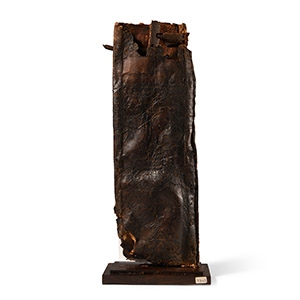
Ilkhanid Decorated Leather Quiver
13th-14th century A.D.Sold for (Inc. bp): £416
Rectangular hide case with saddle-stitched edge, knotted attachment thong to reverse; obverse with panels of low-relief moulded tendril and geometric ornament with decorative stitching; mounted on a custom-made stand. 498 grams total, 39.5 cm high
Ex Yacob's Gallery, London W1, 2000. From a private UK collection. Ex central London gallery. -
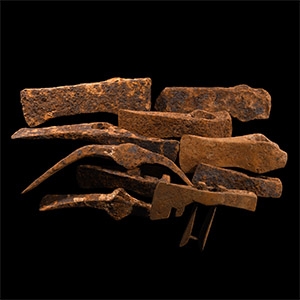
Viking Age and Later Iron Axehead Group
10th-18th century A.D.Estimate: £200 - 300 (+bp*)
Opening Bid: £88
Mainly comprising socketted axeheads and adzes, together with other items; including at least one stamped with maker's marks. 9.5 kg total, 14.5-28.5 cm
Acquired 1990s-early 2000s. East Anglian private collection.
