
Loading, please wait...
LOT 0161
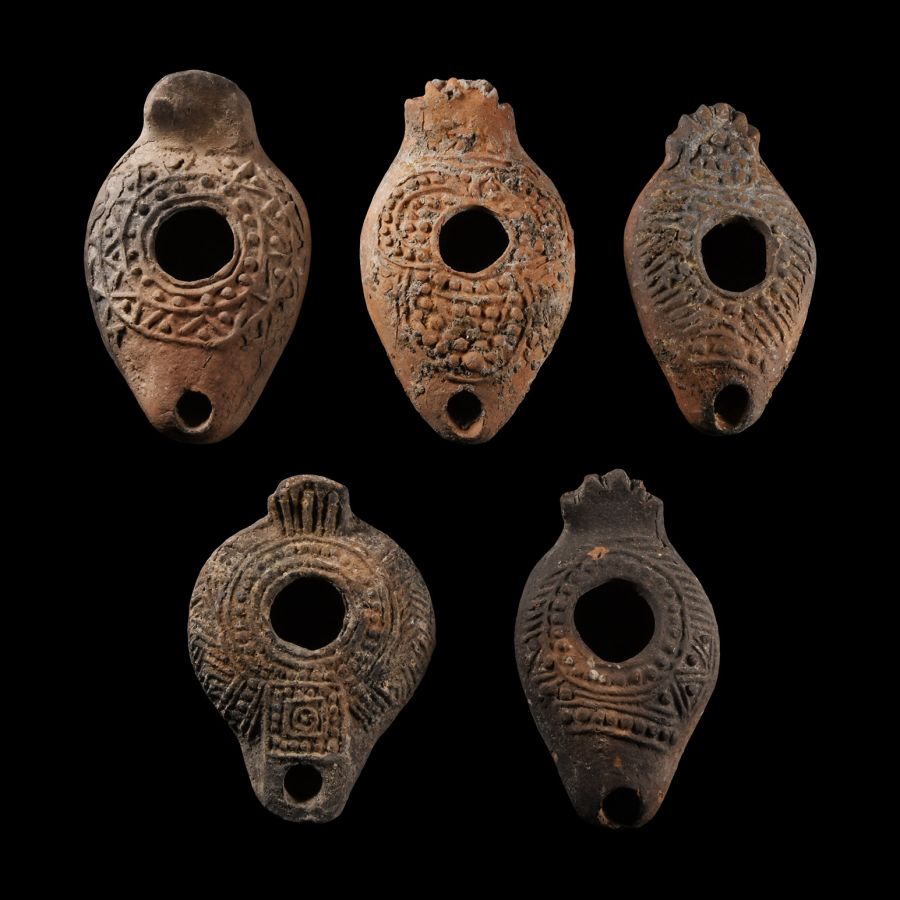
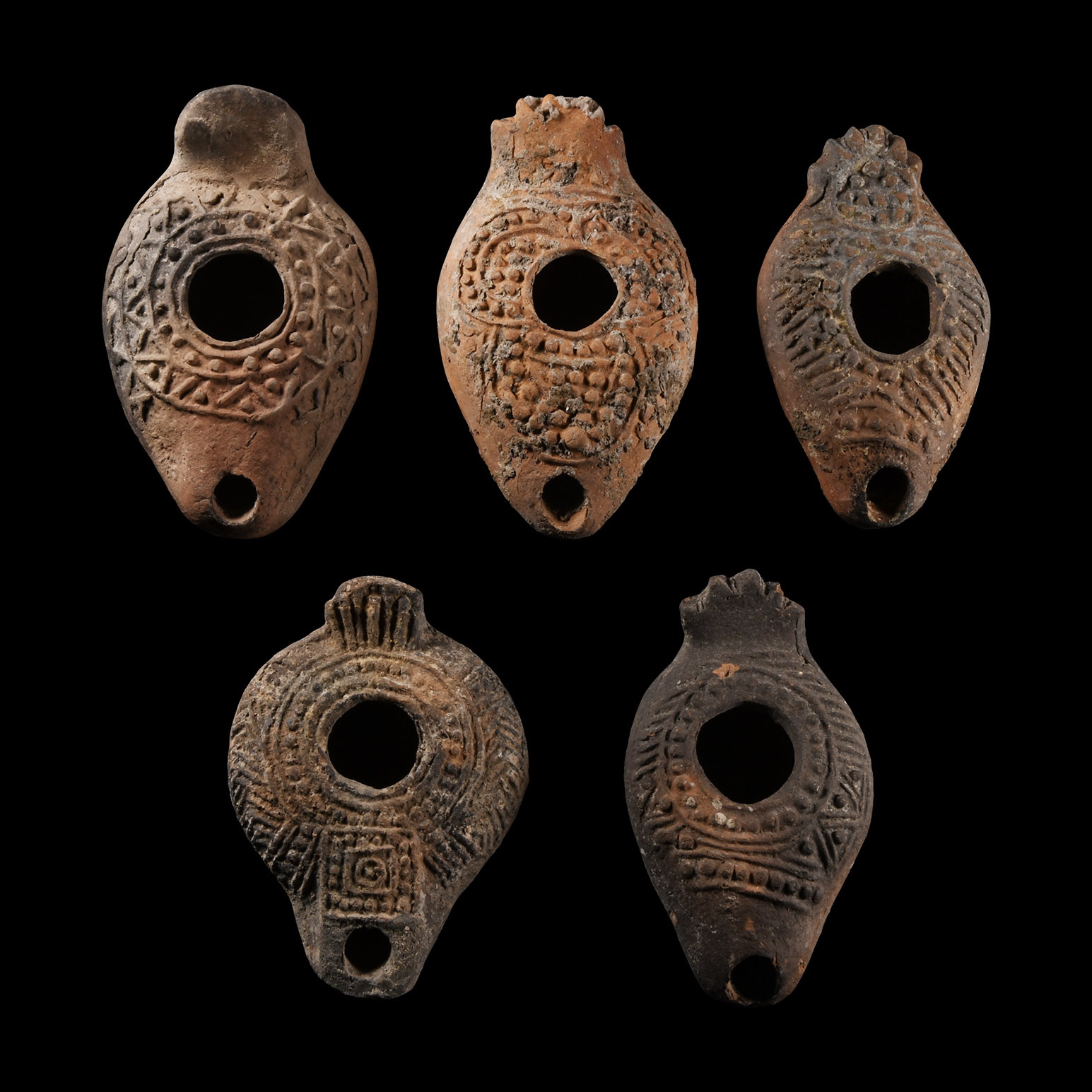
Byzantine Terracotta Slipper Lamp Collection
6TH-7TH CENTURY A.D.
3 1/2 - 4 in. (337 grams total, 8.9-10.1 cm).
A collection of five terracotta oil lamps including slipper and discoid types with shaped ledge handles, each decorated with raised geometric motifs composed largely of pellets and plain lines. [5]
ProvenanceEx Y.M. collection, Tiberias, Israel.
Private Swiss collection.
Cf. De Vincenz, A., ‘Ceramic Vessels and Oil Lamps from the Burial Cave at ‘En Lavan, Nahal Refa’im’ in Atiqot, 98, 2020, pp.103-122, fig.8, for similar.
FootnotesSome authors suggest that these 'candlestick' lamps were produced in or around Jerusalem: this has been confirmed by the discovery of a lamp workshop at Zuba, in which large candlestick lamps with a radiating pattern and their moulds were found. Based on evidence from the City of David and the Jewish Quarter, these lamps begin to appear in the mid-6th century and continue throughout the 7th century A.D.
CONDITIONTimeLine Auctions follows a vetting process to ensure the authenticity and legality of all items, reinforcing our commitment to integrity and responsible trading. Each antiquity, antique, and coin lot undergoes thorough examination by a vetting committee of at least ten external specialists, professional trade association members, scientists, and archaeologists: Our Vetting Process
AUCTIONS:
TimeLine is a leading auction house specialising in antiquities, ancient art, collectables, natural history, coins, medals, and books. Our auctions offer museums, collectors, historians, and enthusiasts the opportunity to acquire unique and historically significant pieces.
LOT 0161
Byzantine Terracotta Slipper Lamp Collection
Estimate £1,000 - 1,400€1,160 - 1,620 (for guidance only)$1,350 - 1,890 (for guidance only)
-
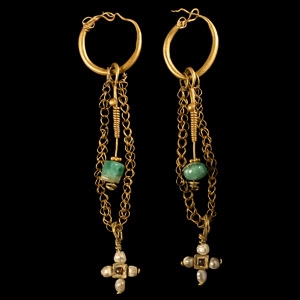
Byzantine Gold Earrings with Gemstone Drops
6th-7th century A.D.Estimate: £2,000 - 3,000 (+bp*)
Opening Bid: £1,000
A pair of gold earrings, each with a tapering hoop and chain suspending a cross set with polished garnet at the centre and a pearl bead to each arm, drop positioned at the centre of the chain composed of a gold stem with coiled wire sleeve, granulated bead and emerald bead below. 13.6 grams total, 90-96 mm
Acquired 1980-2015. Ex Abelita family collection. This lot has been checked against the Interpol Database of stolen works of art and is accompanied by search certificate no.11635-198428. -
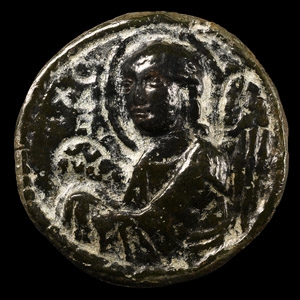
Byzantine Roundel with Saint
Circa 12th century A.D.Sold for (Inc. bp): £143
A roundel bearing an angel in high-relief to one face, looking left, the hands in offering gesture covered by his garment, Greek letters 'APX' (for Archangel) on the left side of his face. 29.2 grams, 44 mm
German art market, 1990s. Mr A.H., a North American collector living in the UK. -
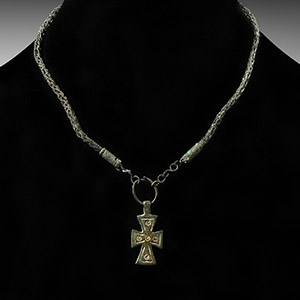
Byzantine Chain with Cross Pendant
Circa 6th-8th century A.D.Estimate: £200 - 300 (+bp*)
Opening Bid: £100
A copper-alloy trichinopoly chain with cruciform pendant, decorated on one face with a geometric design representing the five wounds of Christ. 14.5 grams, 40 cm
Acquired in the late 1990s-2000. Property of an East London gentleman.
