
Loading, please wait...
_900x900.jpg "Byzantine Steatite Mount with Saint John the Theologian")
_200x200.jpg "Byzantine Steatite Mount with Saint John the Theologian")
_900x900.jpg "Byzantine Steatite Mount with Saint John the Theologian")
_200x200.jpg "Byzantine Steatite Mount with Saint John the Theologian")
.jpg "Byzantine Steatite Mount with Saint John the Theologian")
.jpg "Byzantine Steatite Mount with Saint John the Theologian")
LOT 1363
Byzantine Steatite Mount with Saint John the Theologian
10TH-12TH CENTURY A.D.
3/4 in. (2.52 grams, 19 mm).
Showing a bust of a man dressed in a cloak and with his head turned to look over his right shoulder, possibly depicting St John; rectangular in plan with rounded corners.
ProvenanceAcquired from Artemis Gallery, 2003.
Private collection, Europe.
Cf. Kalavrezou-Maxeiner, Byzantine Icons in Steatite, Wien, 1985, pl.2. for type.
CONDITIONTimeLine Auctions follows a vetting process to ensure the authenticity and legality of all items, reinforcing our commitment to integrity and responsible trading. Each antiquity, antique, and coin lot undergoes thorough examination by a vetting committee of at least ten external specialists, professional trade association members, scientists, and archaeologists: Our Vetting Process
AUCTIONS:
TimeLine is a leading auction house specialising in antiquities, ancient art, collectables, natural history, coins, medals, and books. Our auctions offer museums, collectors, historians, and enthusiasts the opportunity to acquire unique and historically significant pieces.
LOT 1363
Byzantine Steatite Mount with Saint John the Theologian
Estimate £500 - 700€580 - 810 (for guidance only)$680 - 950 (for guidance only)
-
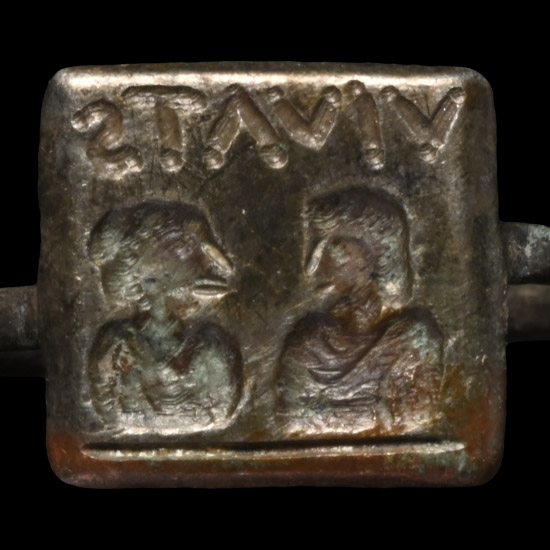
Byzantine Silver Marriage Ring
6th-7th century A.D.Sold for (Inc. bp): £143
Comprising a slender round-section hoop with a rectangular bezel featuring an opposing couple, reversed inscription 'VIVTΛS' above. 1.97 grams, 21.66 mm overall, 18.81 mm internal diameter (approximate size British Q, USA 8, Europe 17.49, Japan 16)
From an English private collection, 1980s. Property of a London, UK, antiquarian. -
.jpg)
Byzantine Silver Cross Pendant with Cabochon
Circa 10th-14th century A.D.Sold for (Inc. bp): £111
Round-section arms with ribbing at the finials, central cell set with an agate intaglio with an engraved cross motif, and a central X-motif on the reverse. 2.95 grams, 27 mm
Acquired on the UK art market from the 1990s. From the private collection of a Lincolnshire, UK, gentleman. -
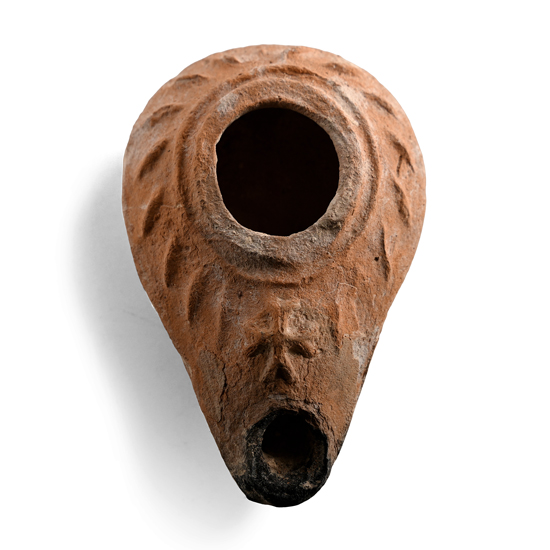
Byzantine Terracotta Slipper Oil Lamp with Cross
5th-7th century A.D.Sold for (Inc. bp): £117
Piriform body with raised rim around the filler hole and tapering nozzle, low-relief linear slashes to the shoulder, and low basal ring. 32.3 grams, 79 mm
From a collection of lamps of a late Scottish gentleman, 1970-1990s.
