
Loading, please wait...

LOT 0168
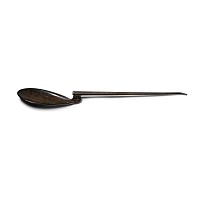
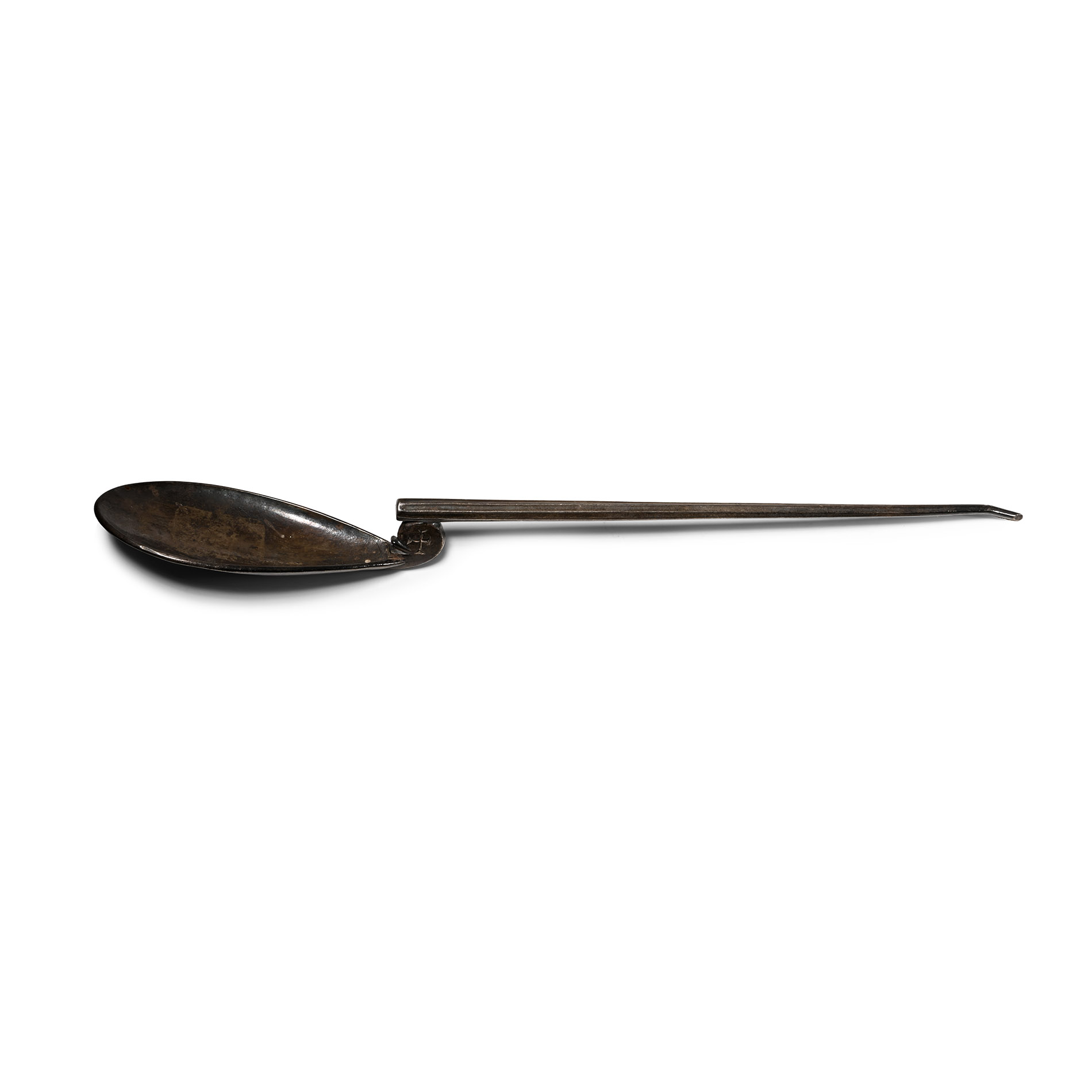
Byzantine Silver Swan-Necked Ligula Spoon with Cross
5TH-7TH CENTURY A.D.
9 in. (46 grams, 22.7 cm).
Shallow piriform bowl attached to a stepped baluster, hexagonal-section handle with spike finial; engraved cross potent to either side of the junction.
ProvenanceFrench private collection.
Acquired on the French art market in 2011.
Acquired by the present owner at the above.
This lot has been checked against the Interpol Database of stolen works of art and is accompanied by search certificate number no.12240-222347.
This lot has been cleared against the Art Loss Register database, and is accompanied by an illustrated lot declaration signed by the Head of the Antiquities Department, Dr Raffaele D'Amato.
Cf. Shelton, K.J., The Esquiline Treasure, London, 1981, item 27, for type.
FootnotesThe lateral incised cross motifs suggest that the spoon may have had a liturgical purpose, possibly associated with baptism.
CONDITIONTimeLine Auctions follows a vetting process to ensure the authenticity and legality of all items, reinforcing our commitment to integrity and responsible trading. Each antiquity, antique, and coin lot undergoes thorough examination by a vetting committee of at least ten external specialists, professional trade association members, scientists, and archaeologists: Our Vetting Process
AUCTIONS:
TimeLine is a leading auction house specialising in antiquities, ancient art, collectables, natural history, coins, medals, and books. Our auctions offer museums, collectors, historians, and enthusiasts the opportunity to acquire unique and historically significant pieces.
LOT 0168
Byzantine Silver Swan-Necked Ligula Spoon with Cross
Estimate £1,500 - 2,000€1,740 - 2,320 (for guidance only)$2,030 - 2,700 (for guidance only)
-
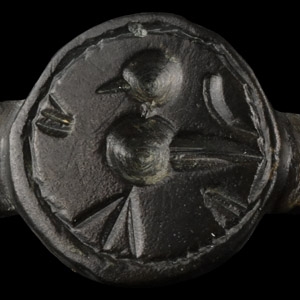
Byzantine Bronze Ring with Bird
6th-8th century A.D.Sold for (Inc. bp): £169
With flared D-section shoulders, discoid bezel with intaglio bird motif. 5.89 grams, 23.32 mm overall, 19.28 mm internal diameter (approximate size British N 1/2, USA 6 3/4, Europe 14.35, Japan 13)
Ex German art market, 2000s. Acquired from an EU collector living in London. From the collection of a Surrey, UK, gentleman. This lot is accompanied by an illustrated lot declaration signed by the Head of the Antiquities Department, Dr Raffaele D'Amato. -
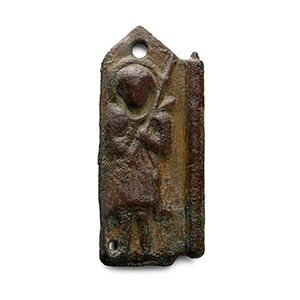
Byzantine Bronze Folding Icon with Military Saint
Circa 14th century A.D.Sold for (Inc. bp): £117
Diptych panel with triangular upper edge and hinged edge; obverse with facing armoured nimbate figure holding a spear; reverse with part of a cruciform design. 20.2 grams, 51 mm
Ex German art market, 2000s. Acquired from an EU collector living in London. From the collection of a Surrey, UK, gentleman. This lot is accompanied by an illustrated lot declaration signed by the Head of the Antiquities Department, Dr Raffaele D'Amato. -
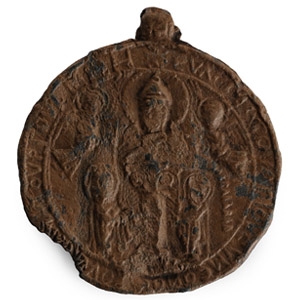
Byzantine Lead Pendant with Simeon Stylites
12th century A.D.Estimate: £250 - 350 (‡+bp*)
Opening Bid: £139
Discoid with integral loop, tondo with figural scene of Simeon Stylites standing on his column, two worshippers at the base and two angels above; legend to the rim. 22 grams, 48 mm
Acquired in the mid 1980s-1990s. Private collection, Switzerland, thence by descent. Private collection, since the late 1990s. This lot is accompanied by an illustrated lot declaration signed by the Head of the Antiquities Department, Dr Raffaele D’Amato. This lot is accompanied by an illustrated lot declaration signed by the Head of the Antiquities Department, Dr Raffaele D'Amato.
