
Loading, please wait...


_900x900.jpg "Byzantine Silver Offering Dish with Chi Rho and Inscription")
_200x200.jpg "Byzantine Silver Offering Dish with Chi Rho and Inscription")

.jpg "Byzantine Silver Offering Dish with Chi Rho and Inscription")
LOT 0989
Byzantine Silver Offering Dish with Chi Rho and Inscription
CIRCA 11TH-12TH CENTURY A.D.
9 1/4 in. (395 grams, 23.5 cm wide).
With rounded underside and flange rim; tondo with incised symmetrical vinescroll with bunches of grapes enclosing central disc with niello-filled Chi Rho flanked by alpha and omega; legend to the rim in capitals: '+++ ΥΠΕΡ ΑΝΑΠΑΥϹΕΩϹ ΕΥΧΗϹ ΟΝ ΟΙΔΕΝ ΟΘϹ ΤΑ ΟΝΟΜΑΤΑ' (For the eternal rest of him who had knowledge in the name of the Lord).
ProvenanceFrom a European family collection formed in the 1990s; thence by descent to a UK gentleman.
Accompanied by an academic report of Dr. Raffaele D’Amato
This lot has been checked against the Interpol Database of stolen works of art and is accompanied by search certificate no.11963-210867.
Cf. similar item of an earlier date in the British Museum, London, under accession no. 1899,0425.1; Aimone, M., The Wyvnern collection, Byzantine and Sasanian Silver, Enamels and Works of Art, London, 2020, figs.43a-b-c.
FootnotesThe decorative apparatus of this plate could be associated with Eastern Roman art of the 11-12th century A.D., although we cannot exclude an earlier dating.
CONDITIONTimeLine Auctions follows a vetting process to ensure the authenticity and legality of all items, reinforcing our commitment to integrity and responsible trading. Each antiquity, antique, and coin lot undergoes thorough examination by a vetting committee of at least ten external specialists, professional trade association members, scientists, and archaeologists: Our Vetting Process
AUCTIONS:
TimeLine is a leading auction house specialising in antiquities, ancient art, collectables, natural history, coins, medals, and books. Our auctions offer museums, collectors, historians, and enthusiasts the opportunity to acquire unique and historically significant pieces.
LOT 0989
Byzantine Silver Offering Dish with Chi Rho and Inscription
Estimate £20,000 - 30,000€23,200 - 34,800 (for guidance only)$27,000 - 40,500 (for guidance only)
-
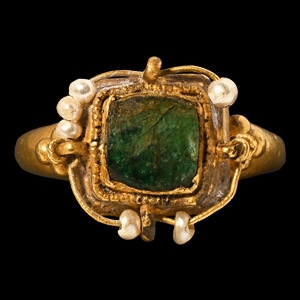
Byzantine or Merovingian Gold Ring with Emerald and Pearls
7th-9th century A.D.Sold for (Inc. bp): £2,080
With a heavy hollow-formed hoop, three pellets to each shoulder; raised square bezel set with emerald framed with pelletted border, four applied loops to the outer edge holding decorative gold wire with seed pearls. 6.70 grams, 27.95 mm overall, 16.94 mm internal diameter (approximate size British I, USA 4 1/4, Europe 7.44, Japan 7)
Ex New York, USA, private collection in the early 1990s. This lot has been checked against the Interpol Database of stolen works of art and is accompanied by search certificate no.12105-214336. -
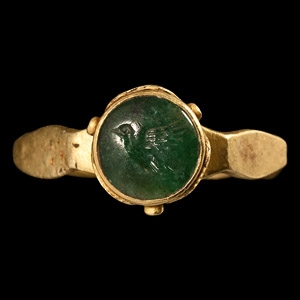
Byzantine Architectural Electrum Ring with Emerald Engraved with a Dove
6th-8th century A.D.Sold for (Inc. bp): £2,860
With facetted hoop and conical architectural bezel with applied filigree decoration, set with an emerald with engraved dove flying left. 7.55 grams, 37.12 mm overall, 20.74 mm internal diameter (approximate size British W, USA 11, Europe 25, Japan 24)
Ex Michael O'hara collection, before 1989. From the private collection of the late A.B., London, UK. Accompanied by an academic report by Dr Raffaele D’Amato. This lot has been checked against the Interpol Database of stolen works of art and is accompanied by a search certificate number no.12004-213033.
The quality of this finger ring suggests that it was the work of an excellent goldsmith who may have worked for the court in Constantinople or an important provincial imperial capital, like Ravenna or Carthage. -
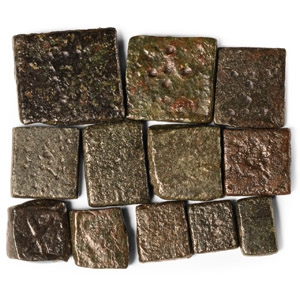
Byzantine Bronze Trade Weight Collection
Circa 6th-12th century A.D.Sold for (Inc. bp): £59
Mixed group of square trade weights of various typessome with pointillé or stamped detailing. 38.6 grams total, 8-17 mm
Acquired since the 1970s. From the private collection of a Surrey, UK, gentleman.
