
Loading, please wait...
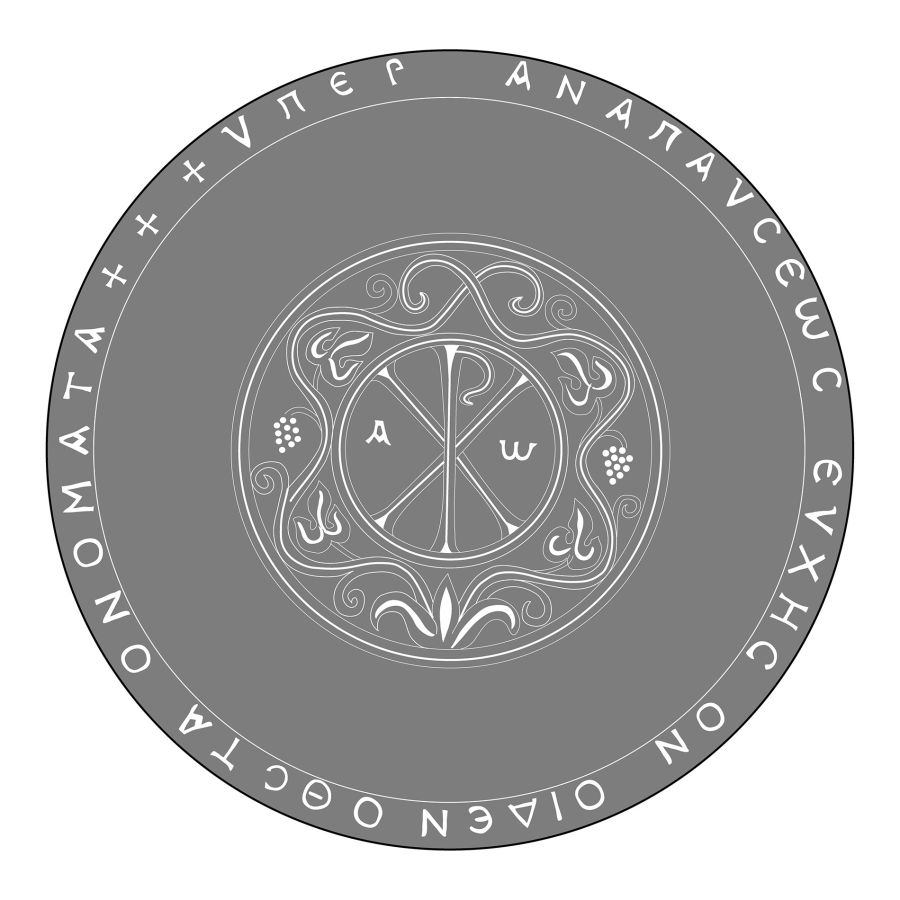

_900x900.jpg "Byzantine Silver Offering Dish with Chi Rho and Inscription")
_200x200.jpg "Byzantine Silver Offering Dish with Chi Rho and Inscription")
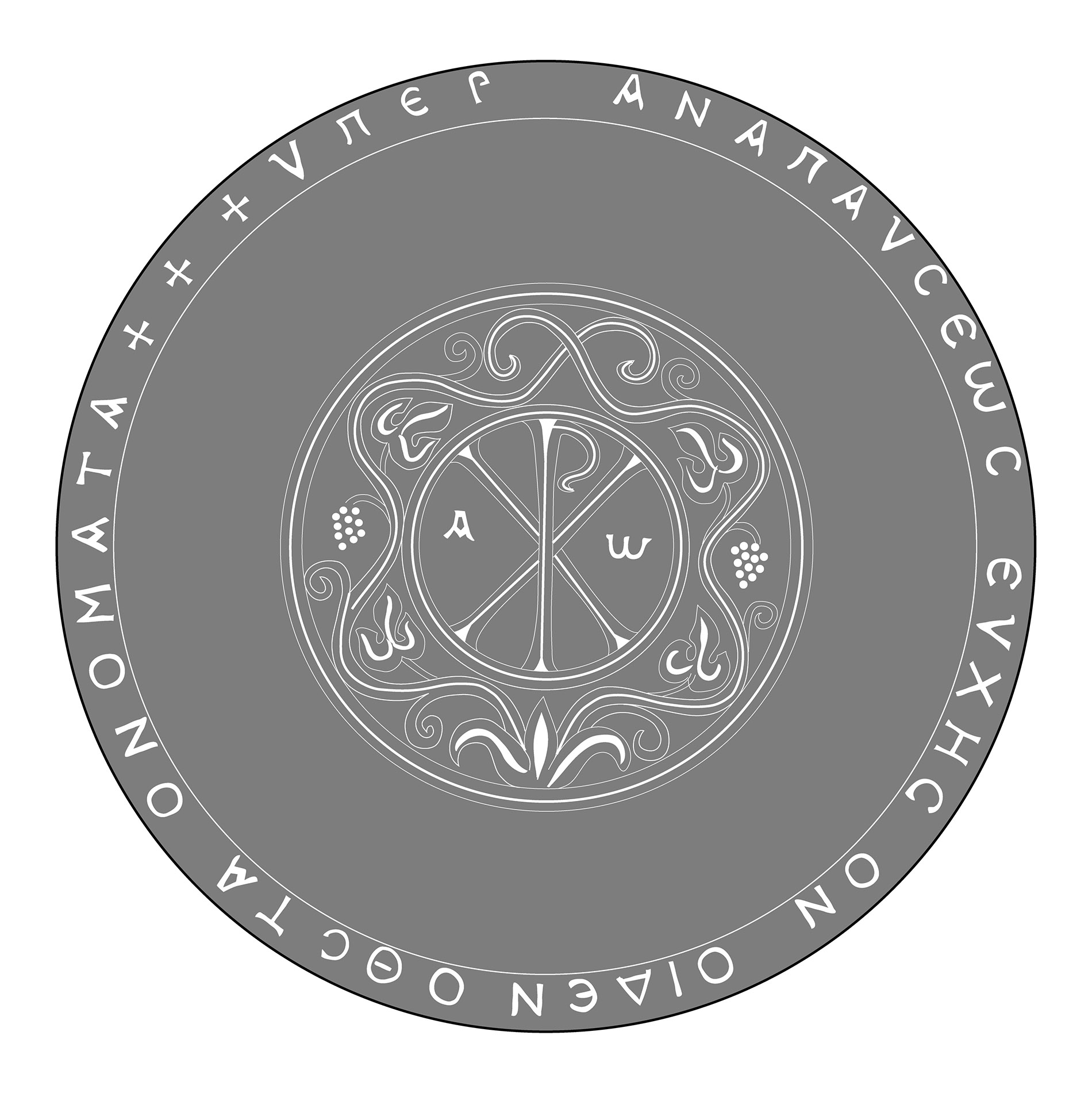
.jpg "Byzantine Silver Offering Dish with Chi Rho and Inscription")
LOT 0225
Byzantine Silver Offering Dish with Chi Rho and Inscription
CIRCA 11TH-12TH CENTURY A.D.
9 1/4 in. (395 grams, 23.5 cm wide).
With rounded underside and flange rim; tondo with incised symmetrical vinescroll with bunches of grapes enclosing central disc with niello-filled Chi Rho flanked by alpha and omega; legend to the rim in capitals: '+++ ΥΠΕΡ ΑΝΑΠΑΥϹΕΩϹ ΕΥΧΗϹ ΟΝ ΟΙΔΕΝ ΟΘϹ ΤΑ ΟΝΟΜΑΤΑ' (For the eternal rest of him who had knowledge in the name of the Lord).
ProvenanceFrom a European family collection formed in the 1990s; thence by descent to a UK gentleman.
Accompanied by an academic report of Dr. Raffaele D’Amato
This lot has been checked against the Interpol Database of stolen works of art and is accompanied by search certificate no.11963-210867.
Cf. similar item of an earlier date in the British Museum, London, under accession no. 1899,0425.1; Aimone, M., The Wyvnern collection, Byzantine and Sasanian Silver, Enamels and Works of Art, London, 2020, figs.43a-b-c.
FootnotesThe decorative apparatus of this plate could be associated with Eastern Roman art of the 11-12th century A.D., although we cannot exclude an earlier dating.
CONDITIONTimeLine Auctions follows a vetting process to ensure the authenticity and legality of all items, reinforcing our commitment to integrity and responsible trading. Each antiquity, antique, and coin lot undergoes thorough examination by a vetting committee of at least ten external specialists, professional trade association members, scientists, and archaeologists: Our Vetting Process
AUCTIONS:
TimeLine is a leading auction house specialising in antiquities, ancient art, collectables, natural history, coins, medals, and books. Our auctions offer museums, collectors, historians, and enthusiasts the opportunity to acquire unique and historically significant pieces.
LOT 0225
Byzantine Silver Offering Dish with Chi Rho and Inscription
Estimate £25,000 - 35,000€29,000 - 40,600 (for guidance only)$33,750 - 47,250 (for guidance only)
-
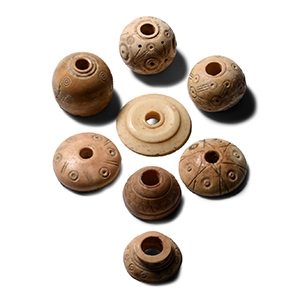
Byzantine Decorated Bone Spindle Whorl Collection
Circa 6th-10th century A.D.Sold for (Inc. bp): £247
Comprising two beehive-shaped, one oblate, two sub-conical, and three domed whorls; all but one with carved ring-and-dot and line motifs. 30 grams total, 17-23 mm
UK private collection. Acquired from Redhouse Antiques Centre, York, 2009. Property of a Nottinghamshire gentleman. -
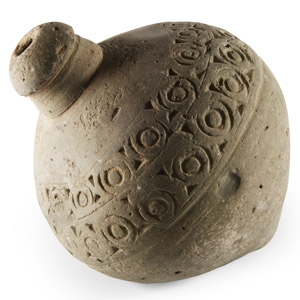
Byzantine 'Greek Fire' Ceramic Fire Bomb or Hand Grenade
9th-11th century A.D.Sold for (Inc. bp): £286
Piriform body with domed filler-hole, decorated with two circumferential bands of circlets; intended to be filled with explosive liquid and wick, used as a hand grenade. 351 grams, 96 mm
Acquired 1980-2015. Ex Abelita family collection. Accompanied by an academic paper by military specialist Dr Raffaele D'Amato, dated 15 July 2019 and titled 'Eastern Roman Empire - Greek Fire Bomb or Hand Grenade (μεσαίον kακάβιον) 9th-11th century AD'.
Apart from the use of siphons or manual flame-throwers called cheirosiphona, special corps of Roman soldiers employed terracotta grenades, in the form of small jars, abundantly evidenced in archaeological excavations. They were called μεσαία kακαβιά or κυτροκακάβια where the former had a bulbous shape and the latter a more cylindrical form. -
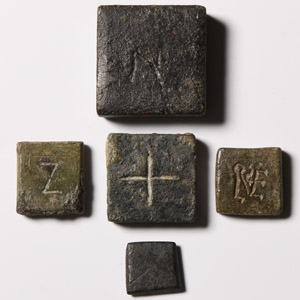
Byzantine Bronze Trade Weight Collection
Circa 8th-12th century A.D.Sold for (Inc. bp): £78
Group of tabular weights with markings including incised cross, monogram 'Z', 'N', NE monogram and others. 43.9 grams total, 10-20 mm
Ex Simmons Gallery, London E11, UK, in the 1990s. From a North London collection.
