
Loading, please wait...
_900x900.jpg "Byzantine Seal Matrix with Inscription")
_200x200.jpg "Byzantine Seal Matrix with Inscription")
.jpg "Byzantine Seal Matrix with Inscription")
LOT 1345
Byzantine Seal Matrix with Inscription
CIRCA 11TH-12TH CENTURY A.D.
3/4 in. (13.1 grams, 18 mm).
With inscription '+ΘKEB / OΘTO / ΔΟΛΟ / ΤΘΛΑ' for 'ΘΕΟΤΟΚΕ ΒΟΗΘΕI ΤΩ ΔΟΥΛΩ ΤΟΥ ΘΕΟΥ ΛΑΔΕ' (Mother of God, help Lades, the servant of God).
ProvenanceFrom an important collection formed before 1988, London and Geneva.
LiteratureCf. Wamser, L., Die Welt von Byzanz - Europas Östliches Erbe, München, 2004, item 743, for type.
FootnotesThe stamp seals that have survived in large numbers from Byzantium are objects a few centimetres high and conical in shape, featuring a sealing surface at the lower end and a pendant at the upper end. They served the same function as signet rings and were used to seal everyday objects, primarily for personal purposes, using wax and other soft materials.
CONDITIONTimeLine Auctions follows a vetting process to ensure the authenticity and legality of all items, reinforcing our commitment to integrity and responsible trading. Each antiquity, antique, and coin lot undergoes thorough examination by a vetting committee of at least ten external specialists, professional trade association members, scientists, and archaeologists: Our Vetting Process
AUCTIONS:
TimeLine is a leading auction house specialising in antiquities, ancient art, collectables, natural history, coins, medals, and books. Our auctions offer museums, collectors, historians, and enthusiasts the opportunity to acquire unique and historically significant pieces.
LOT 1345
Byzantine Seal Matrix with Inscription
Estimate £100 - 140€120 - 160 (for guidance only)$140 - 190 (for guidance only)
-
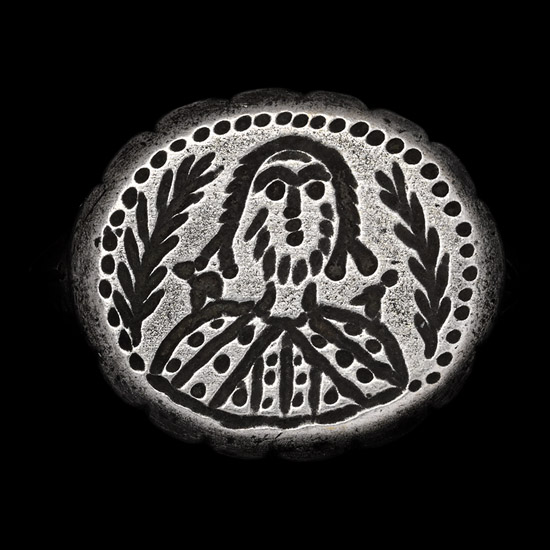
Byzantine Silver Ring with Bust
12th-15th century A.D.Sold for (Inc. bp): £234
Featuring a D-section hoop with a palm frond on both shoulders, oval bezel with a piecrust edge and pelletted border, central profile bust of a robed and bearded man flanked by palm fronds. 7.45 grams, 22.59 mm overall, 18.57 mm internal diameter (approximate size British Q, USA 8, Europe 17.49, Japan 16)
From the collection of a gentleman, acquired on the London art market in the 1990s. -
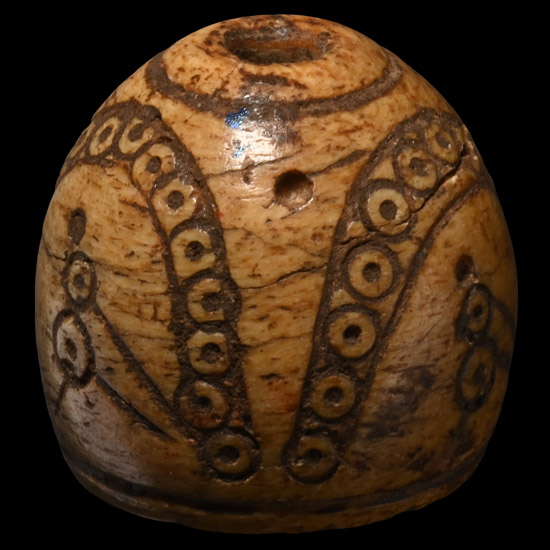
Byzantine Engraved Bone Spindle Whorl with Birds Below Canopy
Circa 8th-12th century A.D.Estimate: £100 - 140 (+bp*)
Opening Bid: £50
Barrel-shaped with incised ring-and-dot ornament forming an arcade. 7.78 grams, 17.78 mm
Ex Abelita family collection, 1980s-2000s. -
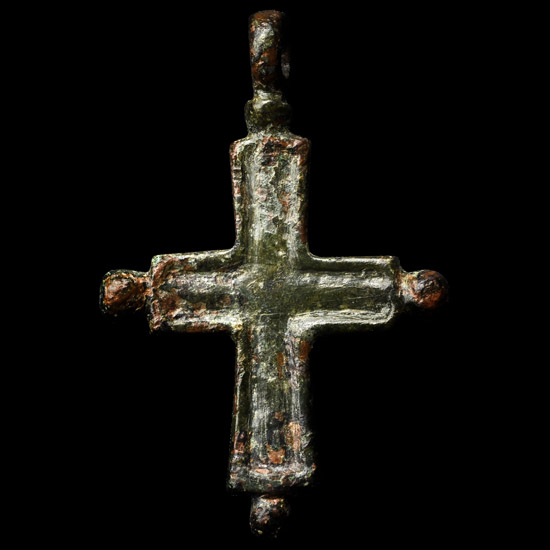
Byzantine Bronze Cross Pendant
Circa 10th-14th century A.D.Sold for (Inc. bp): £65
A bifacial pendant with raised edges and knops at the end of each arm. 5.06 grams, 40 mm
Acquired on the UK art market from the 1990s. From the private collection of a Lincolnshire, UK, gentleman.
