
Loading, please wait...


LOT 0206
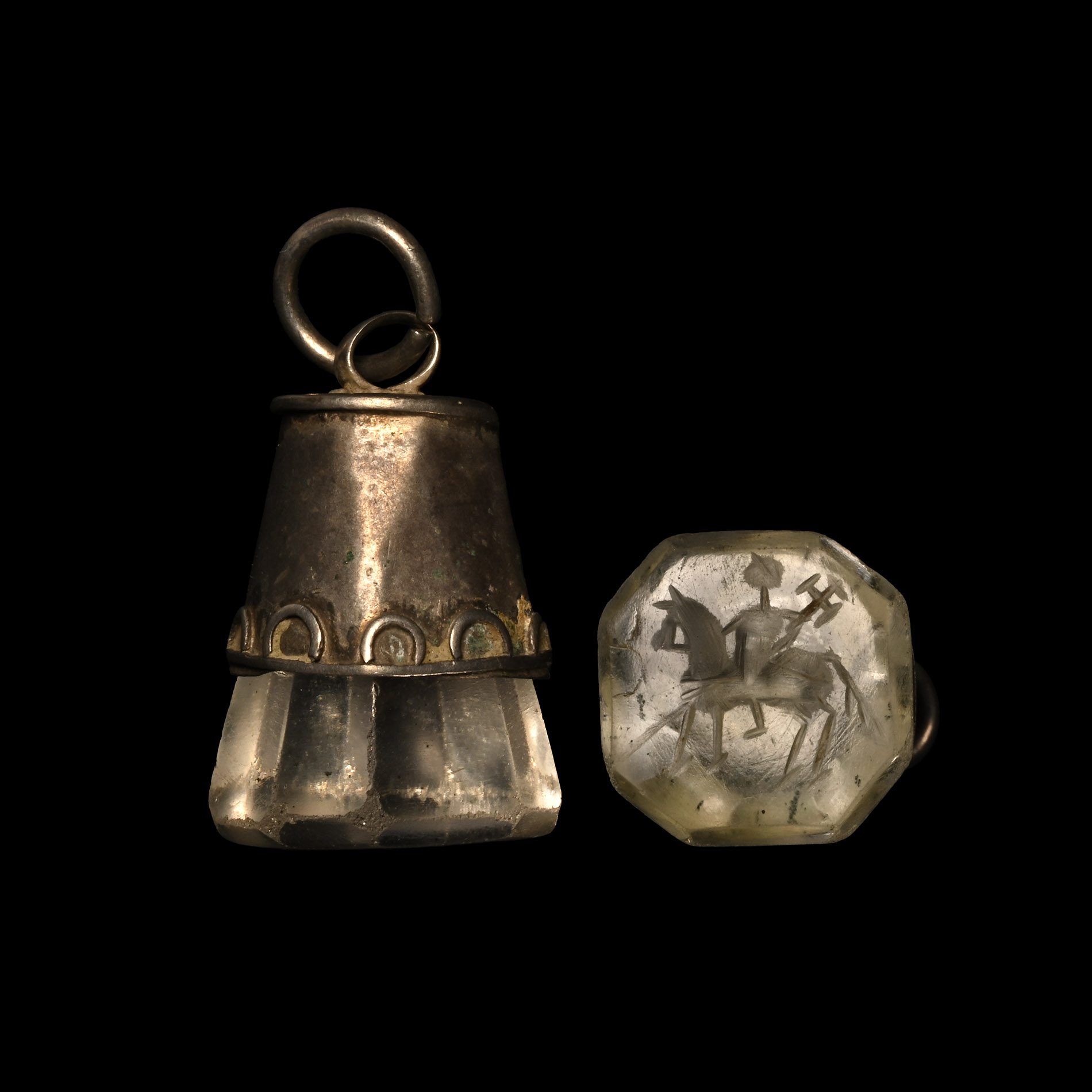
Byzantine Rock Crystal Stamp Seal in Silver Pendant with Military Saint on Horseback
CIRCA 6TH-7TH CENTURY A.D.
1 1/4 in. (7.9 grams, 30 mm).
With a tapering octagonal body, the military saint on horseback holding a long spear, the horse wearing a detailed harness; set in a conical silver frame with suspension loop and crenellated edge.
ProvenanceFrom an old New Zealand private collection.
Acquired on the New Zealand art market circa 2014.
Property of a New Zealand legal professional.
Accompanied by an academic report by Dr Raffaele D’Amato.
This lot has been checked against the Interpol Database of stolen works of art and is accompanied by search certificate number no.12327-223721.
Cf. Daux, G., Collection Hélène Stathatos. Les Objets Byzantins et Post-Byzantins, Strasbourg, Amandry, 1957; Lady Carnegie, H., Catalogue of the Collection of Antique Gems formed by James Ninth Earl of Southesk, London, 1908, Vol.2, 13, P29, pl.1; Delaporte, L., Musée du Louvre. Catalogue des cylinders, cachets et pierres gravées de style oriental, vols.1-2, Paris, 1920, 1923, Vol.I, D.284, pls.56-60; Boardman, J. and Scaribrick, D., The Ralph Harari Collection of Finger Rings, London, 1977, 53, no.120; Lerner, J.A., Christian Seals of the Sasanian Period, Leiden, 1977; p.32, nos.6, pl.1,4; 7,8; Spier, J., Late Antique and Early Christian Gems, Wiesbaden, 2013, pls.118-119.
FootnotesThe motif of a saint on horseback was common in the Romano-Christian culture of the 6th-7th centuries. The figure of a saint symbolised protection of the local church or monastery and its community, and could also be related to the priest leader of the community, as their personal seal.
CONDITIONTimeLine Auctions follows a vetting process to ensure the authenticity and legality of all items, reinforcing our commitment to integrity and responsible trading. Each antiquity, antique, and coin lot undergoes thorough examination by a vetting committee of at least ten external specialists, professional trade association members, scientists, and archaeologists: Our Vetting Process
AUCTIONS:
TimeLine is a leading auction house specialising in antiquities, ancient art, collectables, natural history, coins, medals, and books. Our auctions offer museums, collectors, historians, and enthusiasts the opportunity to acquire unique and historically significant pieces.
LOT 0206
Byzantine Rock Crystal Stamp Seal in Silver Pendant with Military Saint on Horseback
Estimate £1,600 - 2,000€1,860 - 2,320 (for guidance only)$2,160 - 2,700 (for guidance only)
-
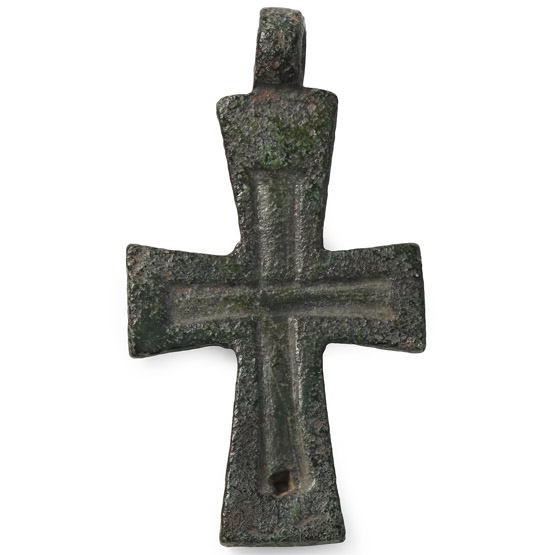
Byzantine Bronze Pendant Cross
10th-12th century A.D.Sold for (Inc. bp): £104
Expanding-arm cross with incised voided motif, pierecd to accept a suspension ring for a dangle. 3.48 grams, 33 mm
Ex German art market, 2000s. Acquired from an EU collector living in London. From the collection of a Surrey, UK, gentleman. -
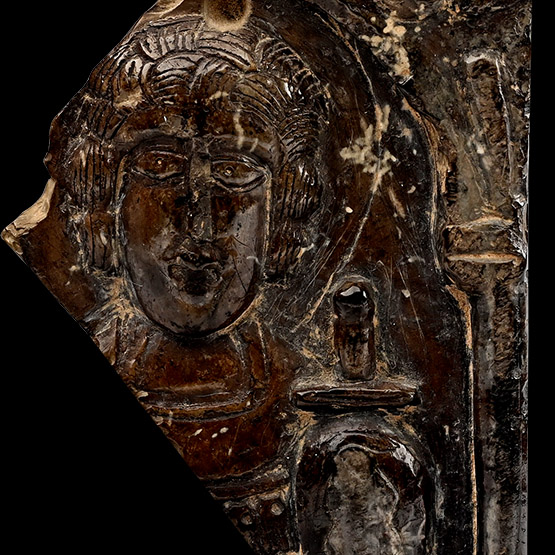
Byzantine Steatite Icon with Military Saint
10th-12th century A.D.Estimate: £8,000 - 10,000 (‡+bp*)
Opening Bid: £4,000
Fragment of an icon depicting a facing saint modelled in the half-round within an arch; an ellipsoid low-relief face with hatched collar-length hair, lentoid eyes with pointillé pupils flanking a long nose; wearing a lamellar cuirass (klivanion); stylised sword (spathion) to the shoulder with lobe pommel, piriform blade with hatched median bar and undulations to the flanks (simulating damascening); arch resting on a balustered column with shallow fixing socket above the saint's head; mounted on a custom-made stand. 60 grams total, icon: 72 mm high
Jacques and Henriette Schumann collection, Paris, France. with Christie's, Paris, France, 30 September 2003, no.248. European private collection. Accompanied by a copy of French passport no.061301, dated 3 September 2003. Accompanied by an academic report by Dr Raffaele D'Amato. This lot has been checked against the Interpol Database of stolen works of art and is accompanied by a search certificate number no.12690-234660. This lot has been cleared against the Art Loss Register database, and is accompanied by an illustrated lot declaration signed by the Head of the Antiquities Department, Dr Raffaele D'Amato.
Jacques and Henriette Schumann were distinguished Parisian collectors known for their discerning taste and passion for antiquities and decorative arts. Their collection, assembled over several decades, reflected a deep appreciation for cultural heritage and historical significance. Works from their collection have been included in major European auctions and are recognised for their provenance and quality. -
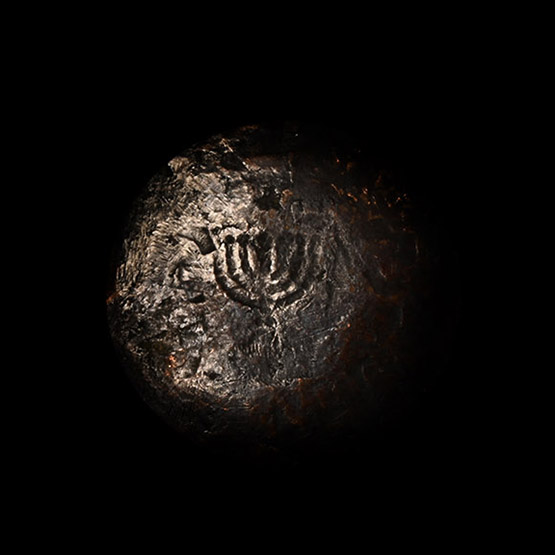
Byzantine Bronze Punch with Menorah and Hebrew Inscription
Circa 5th-6th century A.D.Estimate: £900 - 1,200 (+bp*)
Opening Bid: £475
Columnar stem with conical base extending to a square-section shank. 18.8 grams, 31 mm
From the collection of a gentleman, acquired on the London art market in the 1990s.
Stamping in antiquity and in the Roman Empire was under strict regulations, and it was not limited to food and liquid containers. Bricks and tiles used in construction were impressed with the names of magistrates, workshops, estate owners from whom the material came, and the names of individual makers. Among the myriad Late Roman stamps, a great number were to mark bread or containers holding flour and other foods, as well as a variety of liquids such as wine, oil, fish and fruits preserved in sauces, medical ointments, and even water. It is interesting to note as the Jewish symbols here engraved are very stylised: as mentioned by various scholars, the Jewish representations of shofar and lulav on this category of stamps degenerated in quality in Late Antiquity, and this is why they are variously dated between the 4th and the 7th century.
