
Loading, please wait...
LOT 0855
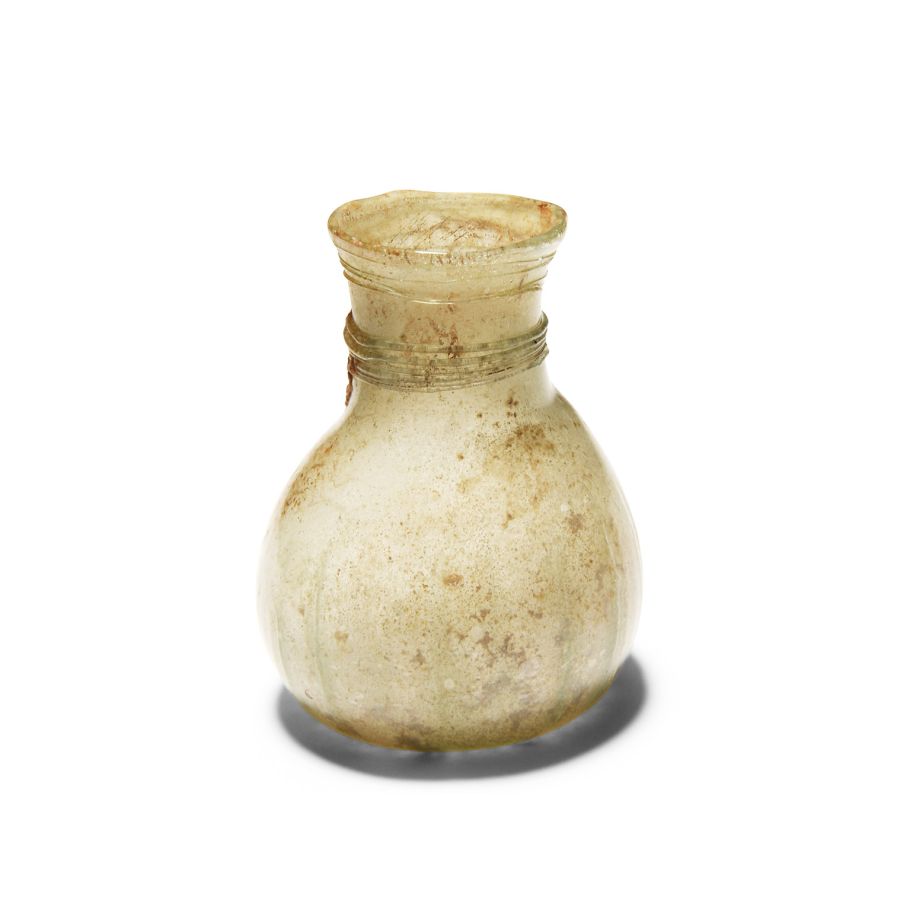
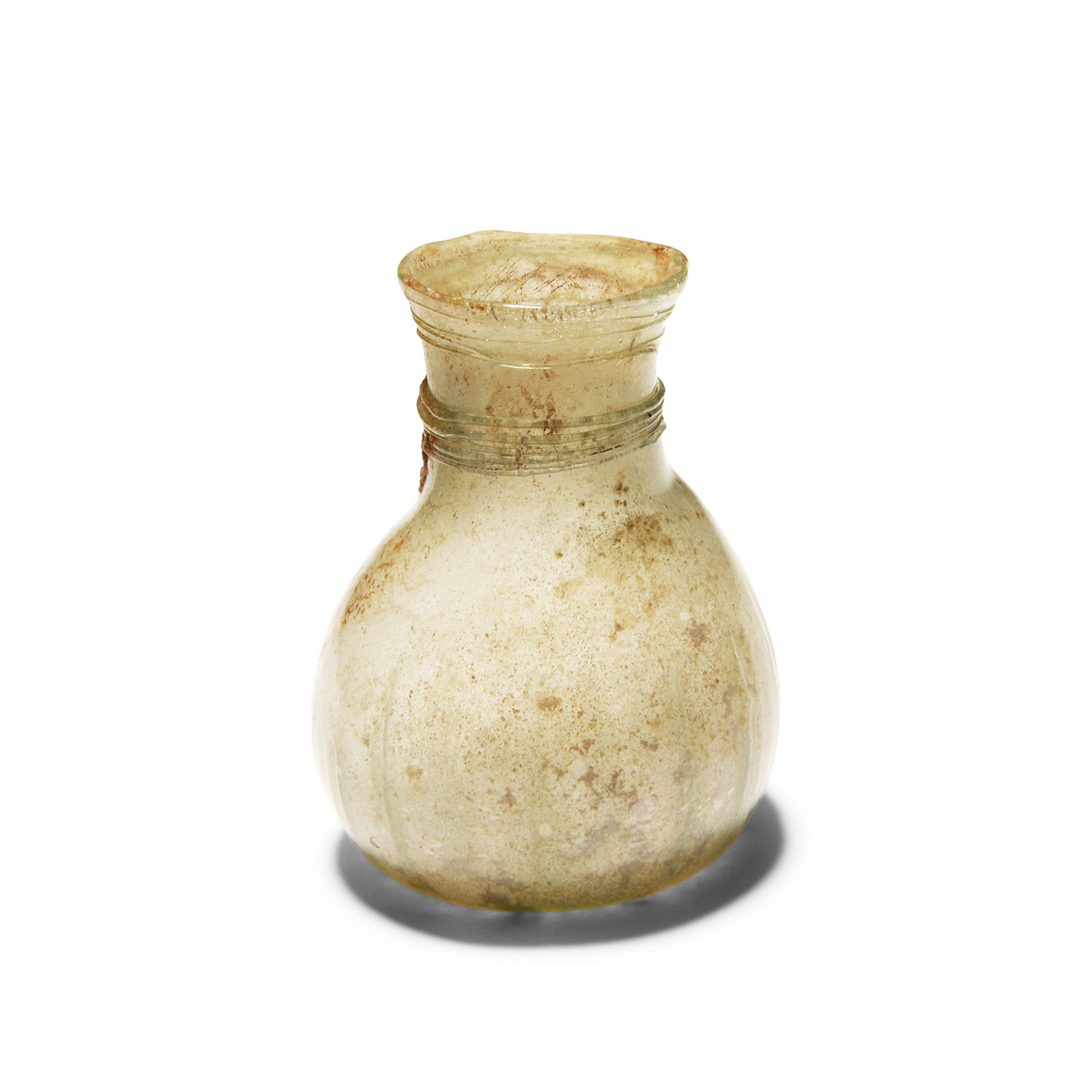
Byzantine Ribbed Glass Cosmetic Bottle with Trail
CIRCA 5TH-6TH CENTURY A.D.
2 1/4 in. (15.3 grams, 57 mm).
Globular-bodied with a cylindrical neck and everted rim, applied trails around the neck and shallow vertical ribbing rising from the base up the lower body. [No Reserve]
ProvenanceEx Coincraft, London WC1.
Ex private Merseyside, UK, collection.
Accompanied by a Coincraft certificate of authenticity.
TimeLine Auctions follows a vetting process to ensure the authenticity and legality of all items, reinforcing our commitment to integrity and responsible trading. Each antiquity, antique, and coin lot undergoes thorough examination by a vetting committee of at least ten external specialists, professional trade association members, scientists, and archaeologists: Our Vetting Process
AUCTIONS:
TimeLine is a leading auction house specialising in antiquities, ancient art, collectables, natural history, coins, medals, and books. Our auctions offer museums, collectors, historians, and enthusiasts the opportunity to acquire unique and historically significant pieces.
-
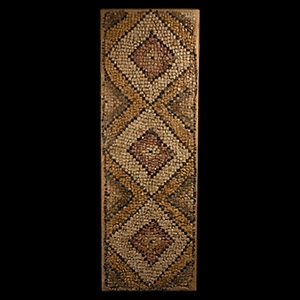
Byzantine Geometric Floor Mosaic
Circa 6th century A.D.Sold for (Inc. bp): £2,600
Comprising a triple geometric rhomboidal figure, where three rhombuses are drawn one inside the other and distinguished by different shades of yellow, white and light red, the latter figure marked in the centre by a white space; the three figures are vertically arranged in a perfect geometric axis on a light background. 36.3 kg, 114.5 cm including frame
Acquired 1970s-1996. Property of a North American collector. London collection, 2016. This lot has been checked against the Interpol Database of stolen works of art and is accompanied by search certificate number no.11823-207411.
The tendency to use abstract and geometric motifs characterises the mosaic art of the Levant under the domination of Byzantium. Close ties can be identified between these rhomboidal figures and those of some of the famous Lebanese mosaics of Beit el Dine, or the mosaics of Tiberias and Hammat, which represent the last expression of Roman art in that area before the Islamic conquest. -
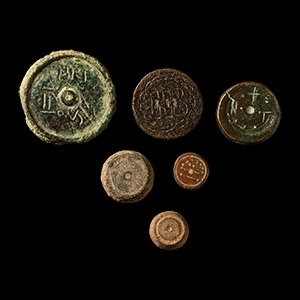
Byzantine Bronze Weight Collection
6th-8th century A.D.Sold for (Inc. bp): £65
Comprising six circular commercial weights of different types and sizes, including examples stamped with letter motifs. 61 grams total, 10-27 mm
Ex Simmons Gallery, London E11, UK, in the 1990s. From a North London collection.
The biggest weight is a one ounce weight, having an engraved monogram of Γ and Α. The flans of circular coin weights were turned on a lathe in the 6th century A.D., giving them a neat appearance. The designs are usually quite simple and often crudely executed, either engraved or slipped. -
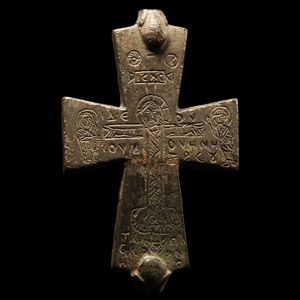
Byzantine Bronze Reliquary Cross Pendant Plate
10th-12th century A.D.Sold for (Inc. bp): £260
The frontal section of an enkolpion, with the representation of crucified Jesus among Saint Mary and Saint John; Christ dressed in a long tunic (colobium) decorated with parallel stripes (clavi) and patterned hatches, his head turned to the right; his wounds on the cross are marked by nails; the cross standing upon a small hill, identified by rare inscription 'Ο ΤΟΠΟС КРАΝΙΟΥ' (a place of a skull, Matthew 27:33), indicating Golgota; the titulum with inscription 'Ι(ΗСΟΥ)С X(ΡΙ СΤΟ)C' (Jesus Christ), and the sun (left) with the moon (right); the central inscription corresponds to the words of the Gospel of John 19:26: 'here is your son, (ΙΔΕ Ο Υ {ΙΟ} С {C}ΟΥ ) here is your Mother (ΙΔΟΥ Η ΜΗΤ{Η}Ρ CΟΥ)'. 56.5 grams, 86 mm
Formerly in a 1980s collection. Acquired on the UK art market. Previously the property of an Essex gentleman.
Usually the reliquary crosses or enkolpia, were composed of two separate halves, inside of which a relic of a saint was contained; this could have been a piece of cloth or a bone. This extraordinary piece is very rare due to containing part of the Gospel of John about the Crucifixion.
