
Loading, please wait...
_900x900.jpg "Byzantine Liturgical Bronze Bowl with Figures")
_200x200.jpg "Byzantine Liturgical Bronze Bowl with Figures")
_900x900.jpg "Byzantine Liturgical Bronze Bowl with Figures")
_200x200.jpg "Byzantine Liturgical Bronze Bowl with Figures")
_900x900.jpg "Byzantine Liturgical Bronze Bowl with Figures")
_200x200.jpg "Byzantine Liturgical Bronze Bowl with Figures")
_900x900.jpg "Byzantine Liturgical Bronze Bowl with Figures")
_200x200.jpg "Byzantine Liturgical Bronze Bowl with Figures")
_900x900.jpg "Byzantine Liturgical Bronze Bowl with Figures")
_200x200.jpg "Byzantine Liturgical Bronze Bowl with Figures")
.jpg "Byzantine Liturgical Bronze Bowl with Figures")
.jpg "Byzantine Liturgical Bronze Bowl with Figures")
.jpg "Byzantine Liturgical Bronze Bowl with Figures")
.jpg "Byzantine Liturgical Bronze Bowl with Figures")
.jpg "Byzantine Liturgical Bronze Bowl with Figures")
LOT 0224
Byzantine Liturgical Bronze Bowl with Figures
11TH-12TH CENTURY A.D.
11 1/2 in. (418 grams, 29.2 cm).
With sloping walls and a thin everted rim, the interior of the vessel engraved with a scene comprising four nimbate Evangelists around a central figure of beardless Christ, each holding a gospel in the right hand, the left hand raised to make the sign of blessing; the four Evangelists each depicted beneath an arch with a Corinthian column flanking, the body of the column decorated with fish-scale motifs.
ProvenancePrivate German collection since the 1980s.
Acquired on the German art market in 2001.
Property of a gentleman.
Accompanied by an academic report by Dr Raffaele D’Amato.
This lot has been checked against the Interpol Database of stolen works of art and is accompanied by search certificate no.10940-181731.
Cf. Papanikola-Bakirtzi, D. (ed.), Everyday life in Byzantium. Byzantine Hours. Works and days in Byzantium, Exhibition catalogue, Thessaloniki, White Tower October 2001-January 2002, Athens, 2002, no.372, for the type; Wamser, L., Die Welt von Byzanz - Europas Östliches Erbe, München, 2004, item 149, for a paten with similar engravings; see a paten with incisions in similar style in the Royal Ontario Museum, accession number 994.220.196.
FootnotesThis vessel belongs to a well-known type of rich liturgical objects, likely produced in the workshops of the Imperial capital, Constantinople, although the style used to present Christ and the Evangelists in this artwork points to an important provincial craftsman, certainly influenced by Islamic and Persian iconography. Patens and chalices were the essential containers for the bread and wine of the Divine Liturgy (Eucharist) in Byzantium.
CONDITIONTimeLine Auctions follows a vetting process to ensure the authenticity and legality of all items, reinforcing our commitment to integrity and responsible trading. Each antiquity, antique, and coin lot undergoes thorough examination by a vetting committee of at least ten external specialists, professional trade association members, scientists, and archaeologists: Our Vetting Process
AUCTIONS:
TimeLine is a leading auction house specialising in antiquities, ancient art, collectables, natural history, coins, medals, and books. Our auctions offer museums, collectors, historians, and enthusiasts the opportunity to acquire unique and historically significant pieces.
LOT 0224
Byzantine Liturgical Bronze Bowl with Figures
Estimate £10,000 - 14,000€11,600 - 16,240 (for guidance only)$13,500 - 18,900 (for guidance only)
-
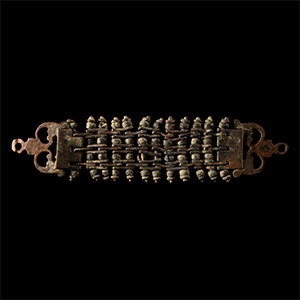
Byzantine Bronze Segmented Strap
10th-15th century A.D.Sold for (Inc. bp): £182
Comprising an articulated strap, openwork finials with volute scrolls supporting the attachment loop. 17 grams, 87 mm
UK private collection. Acquired from York Antiques Centre, in 2001. Property of a Nottinghamshire gentleman. -
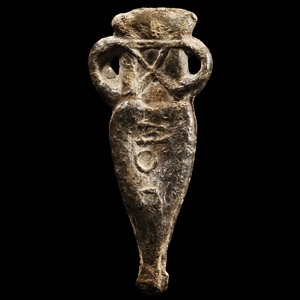
Byzantine Lead Pilgrim's Holy Water Ampulla
Circa 8th-13th century A.D.Sold for (Inc. bp): £39
Flat, piriform type with low-relief saltire to the neck and two loop handles. 16.4 grams, 51 mm
Acquired on the UK art market in the 1990s. Property of a Stowmarket, UK, gentleman. -
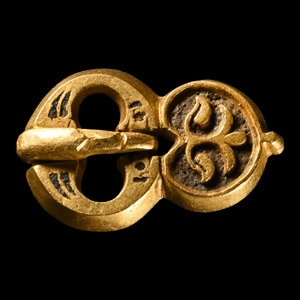
Byzantine Gold Buckle with Heart-Shaped Plate
Later 6th-early 7th century A.D.Estimate: £1,000 - 1,400 (+bp*)
Opening Bid: £500
With loop formed as a disc with two circular piercings and inlaid niello detailing. flared sidewall, hinged tongue with ridge to the forward end, plate with reserved foliage in a cell with knop to the rear edge; three attachment lops to the underside. 15 grams, 32 mm
From a private collection formed in the 1990s. Ex London, UK, gallery.
