
Loading, please wait...
LOT 1093
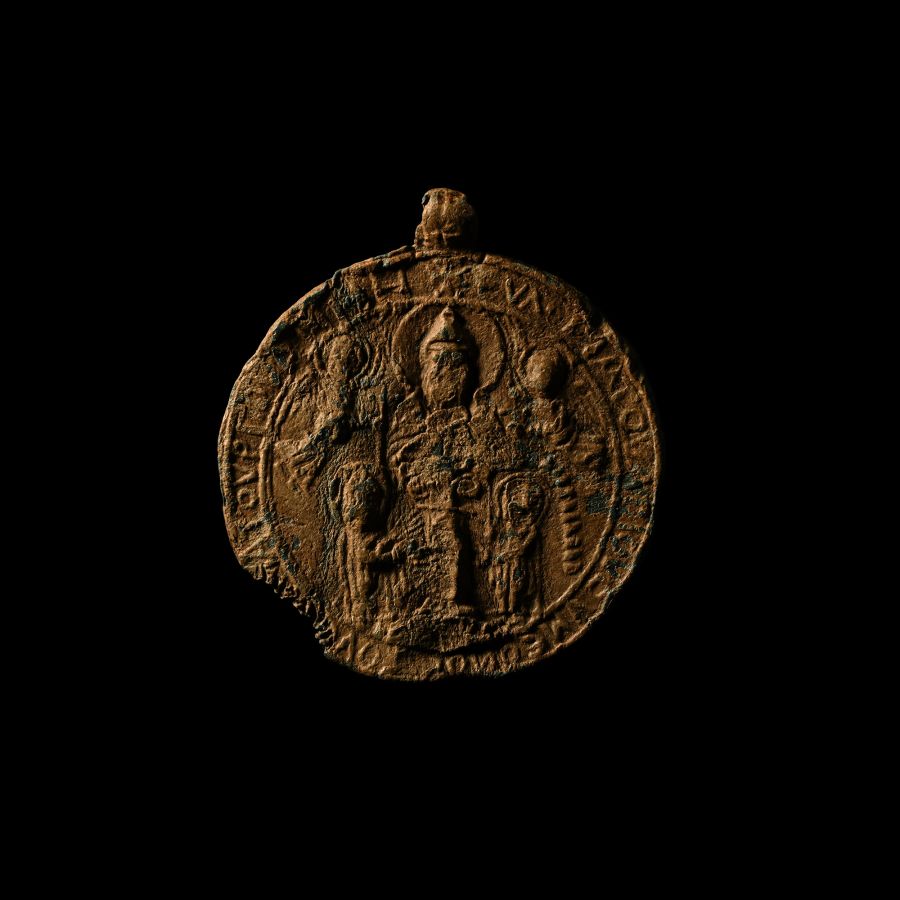
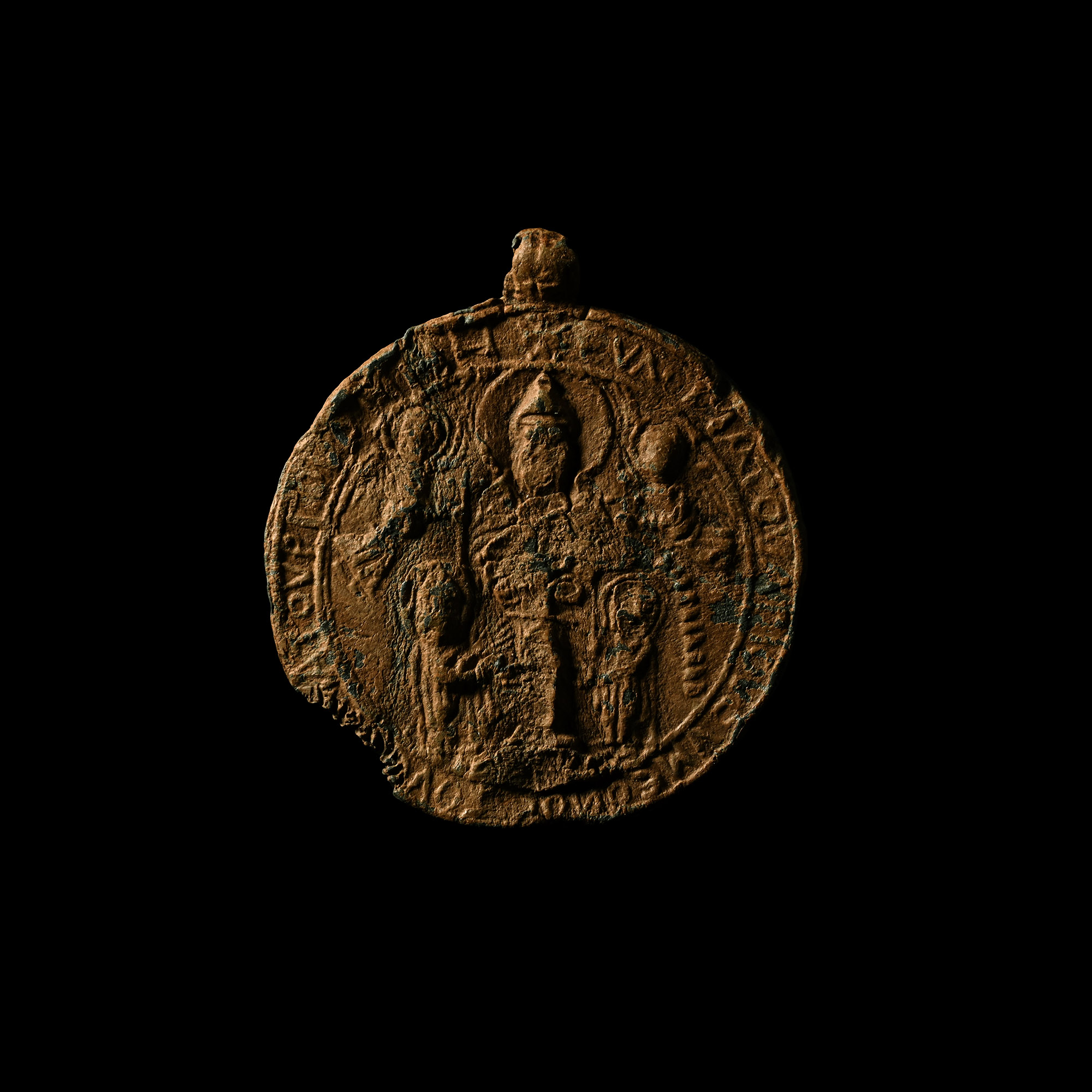
Byzantine Lead Pendant with Simeon Stylites
12TH CENTURY A.D.
1 7/8 in. (22 grams, 48 mm).
Discoid with integral loop, tondo with figural scene of Simeon Stylites standing on his column, two worshippers at the base and two angels above; legend to the rim.
ProvenanceAcquired in the mid 1980s-1990s.
Private collection, Switzerland, thence by descent.
Private collection, since the late 1990s.
TimeLine Auctions follows a vetting process to ensure the authenticity and legality of all items, reinforcing our commitment to integrity and responsible trading. Each antiquity, antique, and coin lot undergoes thorough examination by a vetting committee of at least ten external specialists, professional trade association members, scientists, and archaeologists: Our Vetting Process
AUCTIONS:
TimeLine is a leading auction house specialising in antiquities, ancient art, collectables, natural history, coins, medals, and books. Our auctions offer museums, collectors, historians, and enthusiasts the opportunity to acquire unique and historically significant pieces.
-
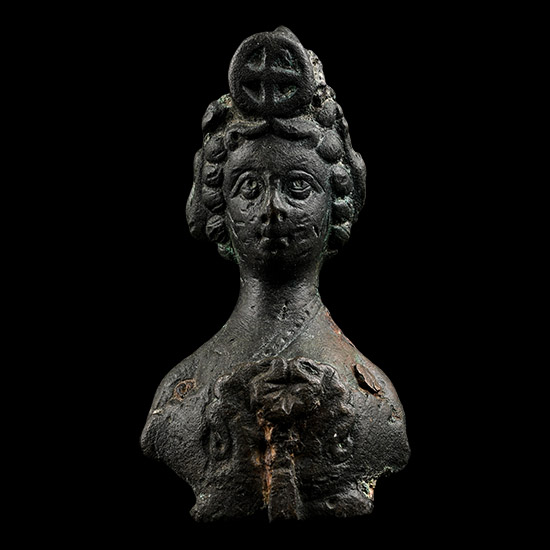
Byzantine Bronze Empress Mount
5th-6th century A.D.Estimate: £1,000 - 1,400 (+bp*)
Opening Bid: £500
Formed in the half-round as a youthful female bust, a cross in the middle of the high hair arrangement (propoloma). 192 grams, 97 mm
Ex law professor in Alexandria, prior to 1930. Ex collection of M. Bouvier, Switzerland (1901-1980). Private collection, UK.
The image of the Roman empress during the late Roman Empire was connected to Christianity by the figure of the Empress Helena. Constantine had several cities renamed Helenopolis in honour of his mother, Helena, and she gained the political verification of power with the status nobilissima femina in 318 A.D. and the rank of Augusta in 324 A.D. Alongside her social and political image, Helena also had a significant reputation as a good Christian who was a patron and took care of poor people. Owing to this powerful religious image that was created, all other Christian women during the Eastern Roman Empire were encouraged spiritually by the fact that Helena was the mother of the first Christian emperor, and the image of the Roman empress was connected to the Christian image of the Mother of God, and represented on weights, bronze appliques and, in this case, maybe as an upper mount of a tripod. -
.jpg)
Byzantine Bronze Ring with Warrior Saints
11th-12th century A.D.Sold for (Inc. bp): £65
Comprising an expanding hoop and a rectangular bezel with two nimbate figures holding weapons; hoop split. 5.20 grams, 19.41 mm overall, 16.43 mm internal diameter (approximate size British I 1/2, USA 4 1/2, Europe 8.07, Japan 7)
Acquired on the UK and EU art market before 2000. From the private collection of a Surrey, UK, gentleman.
This Western Balkan category of rings gradually widens towards the rectangular bezel, which is slightly raised above the ring and flattened. The bezel is decorated with stylised images, often military saints, who were asked for protection and blessing. -
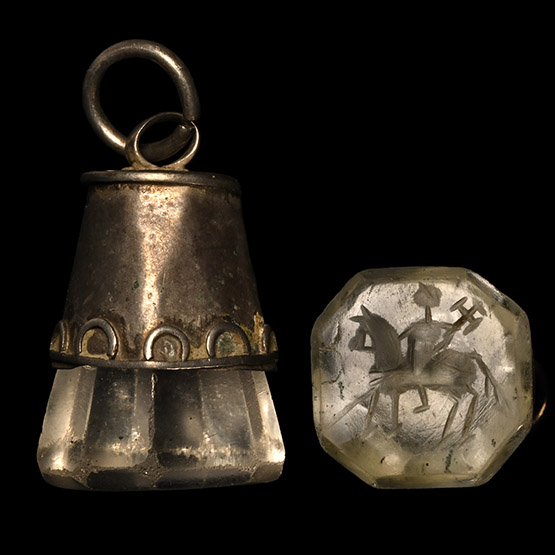
Byzantine Rock Crystal Stamp Seal in Silver Pendant with Military Saint on Horseback
Circa 6th-7th century A.D.Estimate: £1,600 - 2,000 (+bp*)
Opening Bid: £800
With a tapering octagonal body, the military saint on horseback holding a long spear, the horse wearing a detailed harness; set in a conical silver frame with suspension loop and crenellated edge. 7.9 grams, 30 mm
From an old New Zealand private collection. Acquired on the New Zealand art market circa 2014. Property of a New Zealand legal professional. Accompanied by an academic report by Dr Raffaele D’Amato. This lot has been checked against the Interpol Database of stolen works of art and is accompanied by search certificate number no.12327-223721.
The motif of a saint on horseback was common in the Romano-Christian culture of the 6th-7th centuries. The figure of a saint symbolised protection of the local church or monastery and its community, and could also be related to the priest leader of the community, as their personal seal.
