
Loading, please wait...
_900x900.jpg "Byzantine Lead Icon with St George")
_200x200.jpg "Byzantine Lead Icon with St George")
_900x900.jpg "Byzantine Lead Icon with St George")
_200x200.jpg "Byzantine Lead Icon with St George")
.jpg "Byzantine Lead Icon with St George")
.jpg "Byzantine Lead Icon with St George")
LOT 0210
Byzantine Lead Icon with St George
CIRCA 7TH CENTURY A.D.
2 1/2 in. (48.8 grams, 64 mm).
Bifacial lead plaque with figurative decoration: obverse with Saint George, nimbate, on his horse killing a fallen foe with his spear; 'ΓΕΟΡΓ' label above the horse's neck, raised border with pellets and pellet clusters; reverse with relief pattern of a double circle decorated with double arcs forming a cross pellet to the centre.
ProvenancePrivate collection Mr S.A., Switzerland, before 1992, thence by descent.
LiteratureCf. Wamser, L., Die Welt von Byzanz - Europas Östliches Erbe, München, 2004, items 239-240, for similar type in lead.
FootnotesAccording to the Christian tradition, Saint George would have lived between the end of the 3rd century and the beginning of the 4th century: born into a noble Christian family, he became an officer in the Roman army and was then named a prefect by Diocletian. But when the same emperor decided to resume the persecutions, Saint George became a victim despite his important political rank. His role in the development of the faith is so important that he is included among the Great Martyrs of the Eastern Church and his fight against the dragon becomes a symbol par excellence of the fight for Good which defeats Evil. In the Christian symbolism of the Middle Ages, the circle, a perfect geometric shape which has neither beginning nor end, designates the universe whose centre is the source and thus evokes Jesus.
CONDITIONTimeLine Auctions follows a vetting process to ensure the authenticity and legality of all items, reinforcing our commitment to integrity and responsible trading. Each antiquity, antique, and coin lot undergoes thorough examination by a vetting committee of at least ten external specialists, professional trade association members, scientists, and archaeologists: Our Vetting Process
AUCTIONS:
TimeLine is a leading auction house specialising in antiquities, ancient art, collectables, natural history, coins, medals, and books. Our auctions offer museums, collectors, historians, and enthusiasts the opportunity to acquire unique and historically significant pieces.
-
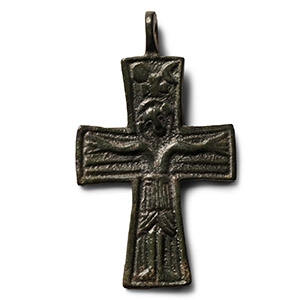
Byzantine Bronze Cross Pendant
11th-12th century A.D.Sold for (Inc. bp): £221
With a low-relief Corpus Christi, small cross above the head flanked by a sun and crescent moon. 5.57 grams, 46 mm
Ex German art market, 2000s. Acquired from an EU collector living in London. From the collection of Surrey, UK, gentleman. -
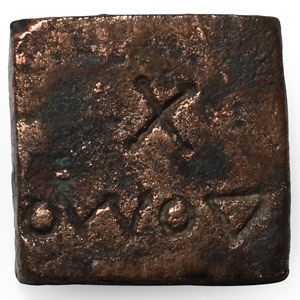
Byzantine Bronze Weight with Inscriptions
6th-8th century A.D.Sold for (Inc. bp): £33
Obverse with impressed text 'ΔΟΜΟ/Χ'. 7.9 grams, 14 mm
From the collection of a gentleman, acquired on the London art market in the 1990s. -
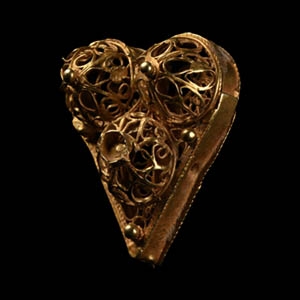
Byzantine Gold Heart-Shaped Fitting
Circa 6th-8th century A.D.Sold for (Inc. bp): £494
Openwork bead or pendant with heart-shaped frame and three domes to the obverse, each formed as a filigree cage; one with cell at the apex and the others with knop finials; granules to the obverse, filigree swirls to the reverse. 2.93 grams, 24 mm
Ex property of a late Japanese collector, 1970-2000s.
