
Loading, please wait...
_900x900.jpg "Byzantine Iron Horse Bit")
_200x200.jpg "Byzantine Iron Horse Bit")
.jpg "Byzantine Iron Horse Bit")
LOT 1060
Byzantine Iron Horse Bit
14TH-15TH CENTURY A.D.
7 3/4 in. (340 grams, 19.5 cm).
Composed of arched openwork shanks with looped terminals; one end fitted with large hoops and bar between; one end with a tripartite mouthpiece comprising two collared bars connected by a central hoop; Byzantine or early Ottoman.
ProvenanceCollection of Dr. Hanns-Ulrich Haedeke (1928-2017), author of ‘Schmuck Aus Drei Jahrtausenden’ and who became the director of the Museum of Klingenmuseum in Solingen, Germany, in 1968; the collection was formed in the early 1960s.
From an important private Dutch collection.
See Витлянов, С., Старобългарското въоъжение (The Old Bulgarian Armament), София, 1996, fig.1, pl.XXIV, and fig.5, for an identical example.
FootnotesThis type of horse bit is visible on one of the most important equestrian artworks of the 15th century - the Cappella dei Magi by Benozzo Gozzoli, a painting representing the Three Kings visiting Christ, depicted in costumes belonging to the early quarter of the 15th century. All the cavalrymen in the artwork had heavy curb-bits (with short and curved shanks, as in our specimen) and heavy, single reins.
CONDITIONTimeLine Auctions follows a vetting process to ensure the authenticity and legality of all items, reinforcing our commitment to integrity and responsible trading. Each antiquity, antique, and coin lot undergoes thorough examination by a vetting committee of at least ten external specialists, professional trade association members, scientists, and archaeologists: Our Vetting Process
AUCTIONS:
TimeLine is a leading auction house specialising in antiquities, ancient art, collectables, natural history, coins, medals, and books. Our auctions offer museums, collectors, historians, and enthusiasts the opportunity to acquire unique and historically significant pieces.
LOT 1060
Byzantine Iron Horse Bit
Estimate £150 - 200€170 - 230 (for guidance only)$200 - 270 (for guidance only)
-
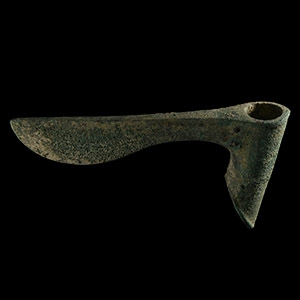
Luristan Sar-e Tabar Socketted Axehead
2nd millennium B.C.Sold for (Inc. bp): £208
With plain cylindrical socket and staff, off-set at the base, of simple undecorated shape with a long lentoid-section D-shaped blade with scooped profile. 465 grams, 18 cm
Earlier 20th century collection. Mayfair, London gallery, UK. Dr D.G. collection, 1990s-2019.
Many examples of bronze axeheads are attributed to the Luristan culture and various shapes have been discussed by different scholars. Moorey (1971, pp.39-41) shows similar axeheads, stating that the texts executed on some specimens have shown them made of arsenical bronze, and attributes them to the late 3rd millennium B.C. or 2nd millennium B.C., period in which this alloy was used abundantly. -
.jpg)
Hellenistic Bronze Armour Section with Herakles Fighting Hydra
Circa 4th-3rd century B.C.Sold for (Inc. bp): £3,120
Comprising an embossed fragment of a breast-plate from muscle-type armour (thorax statos) representing Herakles fighting against the Hydra of Lerna; three-quarters of the hero's body preserved showing him naked in a dynamic position, wearing a fluttering short cloak (chlamys), overlooking the body of the monster of which the long tail covered with scales and fins is visible; fragment of cloak preserved separately. 122 grams total, 3.4-17.5 cm
Good portion of armour, extremely rare
Acquired on the French art market before 2000. From an EU collection before 2020.
This kind of armour is very rare, especially for this period, when most of the attested armour is plain or only slightly decorated. The young Herakles appears in heroic nudity running to the right, but, as on the cheek-piece from Gurlo, his head was probably turned in the opposite direction. The plasticism of the scene finds a good match in the Thracian tradition of the representation of weapons and armour, and the embossed elements with the highly prized work of the Panagyurishte treasure. The warrior-theme and the representation of Herakles or other fighting scenes on the Thracian and Hellenistic armours was a reference to the spirit of the immortal fighter. -
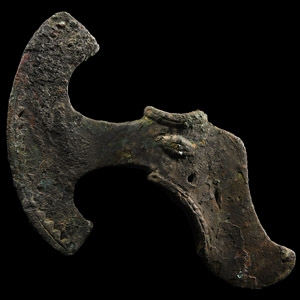
Bactrian Bronze Eye Axehead
3rd-2d millennium B.C.Estimate: £400 - 600 (+bp*)
Opening Bid: £200
Fan-shaped blade; an apotropaic eye in relief to each side of the socket; wing-shaped extension to the rear. 327 grams, 16 cm
From an old London, UK, collection. Ex London, UK, gallery.
Most of these axes are believed to have originated in Bactria, but some objects come from well documented contexts in Margiane (Gonur), Lut (Shahdad) and Kermanshah (Khinaman). According to Gernez they were made for ceremonial use.
